Jones Ella F, Ray Kimberly M, Li Wen, Chien Amy J, Mukhtar Rita A, Esserman Laura J, Franc Benjamin L, Seo Youngho, Pampaloni Miguel H, Joe Bonnie N, Hylton Nola M
1Department of Radiology and Biomedical Imaging, University of California, San Francisco, CA USA.
2Helen Diller Family Comprehensive Cancer Center, University of California, San Francisco, CA USA.
NPJ Breast Cancer. 2019 Apr 16;5:12. doi: 10.1038/s41523-019-0107-9. eCollection 2019.
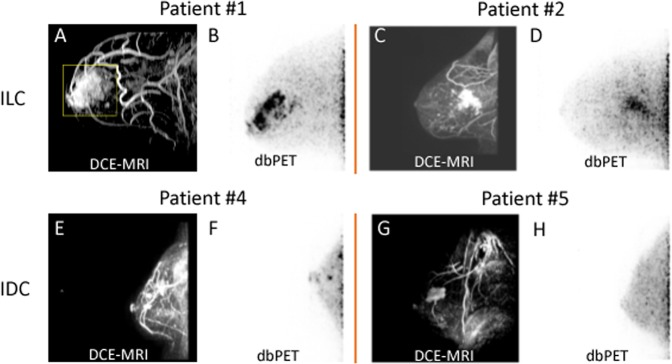
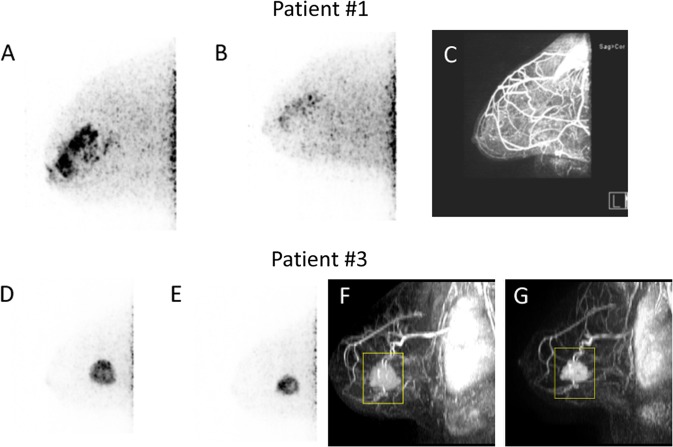
Dedicated breast positron emission tomography (dbPET) is an emerging technology with high sensitivity and spatial resolution that enables detection of sub-centimeter lesions and depiction of intratumoral heterogeneity. In this study, we report our initial experience with dbPET using [F-18]fluoroestradiol (FES) in assessing ER+ primary breast cancers. Six patients with >90% ER+ and HER2- breast cancers were imaged with dbPET and breast MRI. Two patients had ILC, three had IDC, and one had an unknown primary tumor. One ILC patient was treated with letrozole, and another patient with IDC was treated with neoadjuvant chemotherapy without endocrine treatment. In this small cohort, we observed FES uptake in ER+ primary breast tumors with specificity to ER demonstrated in a case with tamoxifen blockade. FES uptake in ILC had a diffused pattern compared to the distinct circumscribed pattern in IDC. In evaluating treatment response, the reduction of SUV was observed with residual disease in an ILC patient treated with letrozole, and an IDC patient treated with chemotherapy. Future study is critical to understand the change in FES SUV after endocrine therapy and to consider other tracer uptake metrics with SUV to describe ER-rich breast cancer. Limitations include variations of FES uptake in different ER+ breast cancer diseases and exclusion of posterior tissues and axillary regions. However, FES-dbPET has a high potential for clinical utility, especially in measuring response to neoadjuvant endocrine treatment. Further development to improve the field of view and studies with a larger cohort of ER+ breast cancer patients are warranted.
专用乳腺正电子发射断层扫描(dbPET)是一项新兴技术,具有高灵敏度和空间分辨率,能够检测亚厘米级病变并描绘肿瘤内异质性。在本研究中,我们报告了使用[F-18]氟雌二醇(FES)进行dbPET评估雌激素受体阳性(ER+)原发性乳腺癌的初步经验。6例ER+且人表皮生长因子受体2阴性(HER2-)的乳腺癌患者接受了dbPET和乳腺磁共振成像(MRI)检查。2例为小叶原位癌(ILC),3例为浸润性导管癌(IDC),1例原发肿瘤不明。1例ILC患者接受来曲唑治疗,另1例IDC患者接受新辅助化疗但未接受内分泌治疗。在这个小队列中,我们观察到ER+原发性乳腺肿瘤摄取FES,在1例接受他莫昔芬阻断的病例中显示出对ER的特异性。与IDC中明显的边界清晰模式相比,ILC中FES摄取呈弥漫性模式。在评估治疗反应时,接受来曲唑治疗的ILC患者和接受化疗的IDC患者在有残留病灶时观察到标准化摄取值(SUV)降低。未来的研究对于了解内分泌治疗后FES SUV的变化以及考虑使用SUV以外的其他示踪剂摄取指标来描述富含ER的乳腺癌至关重要。局限性包括不同ER+乳腺癌疾病中FES摄取的差异以及后位组织和腋窝区域的排除。然而,FES-dbPET具有很高的临床应用潜力,尤其是在测量对新辅助内分泌治疗的反应方面。有必要进一步改进视野并对更大队列的ER+乳腺癌患者进行研究。