Hung Terry Y T, Camsari Kerem Y, Zhang Shengjiao, Upadhyaya Pramey, Chen Zhihong
School of Electrical and Computer Engineering, Purdue University, West Lafayette, IN 47907, USA.
Birck Nanotechnology Center, Purdue University, West Lafayette, IN 47907, USA.
Sci Adv. 2019 Apr 19;5(4):eaau6478. doi: 10.1126/sciadv.aau6478. eCollection 2019 Apr.
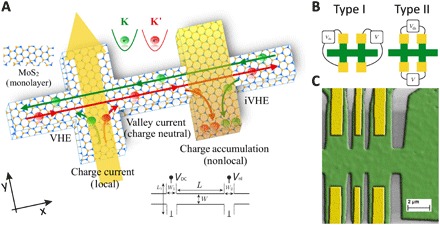
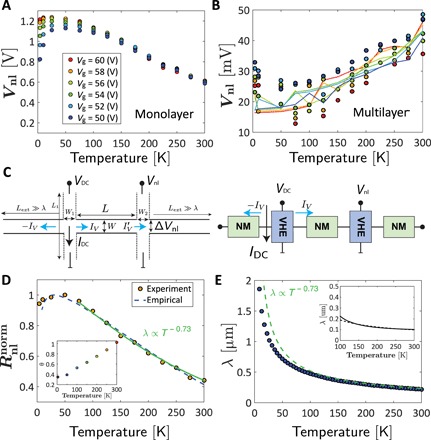
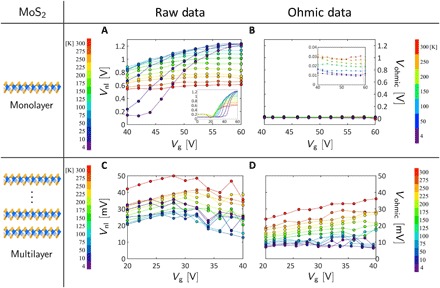
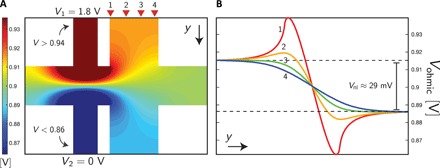
The valley degree of freedom of electrons in two-dimensional transition metal dichalcogenides has been extensively studied by theory (-), optical (-), and optoelectronic (-) experiments. However, generation and detection of pure valley current without relying on optical selection have not yet been demonstrated in these materials. Here, we report that valley current can be electrically induced and detected through the valley Hall effect and inverse valley Hall effect, respectively, in monolayer molybdenum disulfide. We compare temperature and channel length dependence of nonlocal electrical signals in monolayer and multilayer samples to distinguish the valley Hall effect from classical ohmic contributions. Notably, valley transport is observed over a distance of 4 μm in monolayer samples at room temperature. Our findings will enable a new generation of electronic devices using the valley degree of freedom, which can be used for future novel valleytronic applications.
二维过渡金属二硫属化物中电子的能谷自由度已通过理论(-)、光学(-)和光电子(-)实验得到广泛研究。然而,在这些材料中尚未证明不依赖光学选择就能产生和检测纯能谷电流。在此,我们报告在单层二硫化钼中,能谷电流可分别通过能谷霍尔效应和逆能谷霍尔效应被电诱导和检测。我们比较了单层和多层样品中非局部电信号的温度和沟道长度依赖性,以区分能谷霍尔效应与经典欧姆贡献。值得注意的是,在室温下,单层样品中在4μm的距离上观察到了能谷输运。我们的发现将促成新一代利用能谷自由度的电子器件,可用于未来新型能谷电子学应用。