Phan Thanh G, Beare Richard, Parsons Mark, Zhao Henry, Davis Stephen, Donnan Geoffrey A, Srikanth Velandai, Ma Henry
Stroke Unit, Clinical Trials Imaging and Informatics Division of Stroke and Aging Research Group, Monash Medical Centre, Monash University, Clayton, VIC, Australia.
Department of Medicine, Peninsula Health, Melbourne University, Frankston, VIC, Australia.
Front Neurol. 2019 Apr 4;10:331. doi: 10.3389/fneur.2019.00331. eCollection 2019.
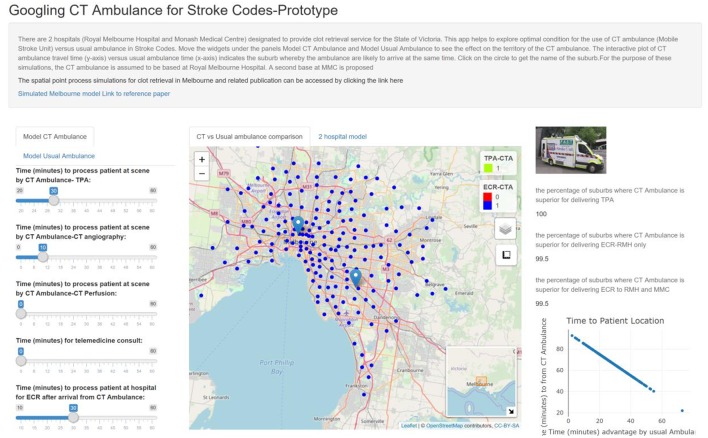
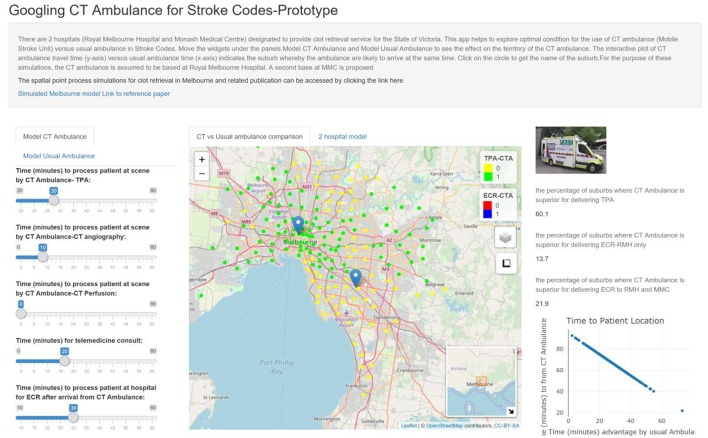
Mobile stroke units (MSU) have been proposed to expedite delivery of recombinant tissue plasminogen activator (tPA) and expedite endovascular clot retrieval (ECR). Unexplored questions in the use of MSU include: maximal distance from base, time limit with regards to the use CT imaging, CT Angiography, CT Perfusion, and Telemedicine. We developed a computational model as an app (https://gntem3.shinyapps.io/ambmc/), taking into account traveling time to explore this issue. The aim of this study was to define the operating parameters for an MSU in a large metropolitan city, based on the geography of Melbourne. There are 2 hospitals (Royal Melbourne Hospital/RMH, Monash Medical Center/MMC) designated to provide state-wide ECR services. In these spatial simulations, the MSU is based at RMH and delivers tPA at the patient's pick-up address and then takes the patient to the nearest ECR center. We extracted the geocode of suburbs in Melbourne and travel time to each hospital using , an interface to Google Map API. The app contains widgets for varying the processing time at the patient location (default = 30 min), performing CT angiography (default = 10 min), performing telemedicine consultation (default = 15 min). The data were compared against those for usual ambulance metrics (default traveling time = 15 min, processing time at patient's location = 20 min, door to tPA = 60 min, door to groin = 90 min). Varying the widgets allow the viewer to explore the trade-off between the variable of interest and time to therapy at a suburb level. The MSU was superior for delivering tPA to all Melbourne suburbs (up to 76 min from RMH). If the CTA times or processing time at location increased by 20 min then it was superior for providing ECR to only 74.9% of suburbs if the return base was RMH. Addition of CT Perfusion or telemedicine consultation affect the ability of a single hospital to provide ECR but not tPA if these additions can be limited to 20 min. Conclusion: The app can help to define how best to deploy the MSU across Melbourne. This app can be modified and used to optimize operating characteristics of MSU in other centers around the world.
移动卒中单元(MSU)已被提议用于加快重组组织型纤溶酶原激活剂(tPA)的输送并加快血管内血栓清除(ECR)。在使用MSU方面尚未探讨的问题包括:与基地的最大距离、使用CT成像、CT血管造影、CT灌注和远程医疗的时间限制。我们开发了一个作为应用程序的计算模型(https://gntem3.shinyapps.io/ambmc/),考虑出行时间来探讨这个问题。本研究的目的是根据墨尔本的地理情况,确定大城市中MSU的运行参数。有两家医院(皇家墨尔本医院/RMH、莫纳什医疗中心/MMC)被指定提供全州范围的ECR服务。在这些空间模拟中,MSU以RMH为基地,在患者接送地址给予tPA,然后将患者送往最近的ECR中心。我们使用谷歌地图API接口提取了墨尔本各郊区的地理编码以及到每家医院的出行时间。该应用程序包含用于改变在患者所在地的处理时间(默认 = 30分钟)、进行CT血管造影(默认 = 10分钟)、进行远程医疗咨询(默认 = 15分钟)的小部件。将这些数据与常规救护车指标(默认出行时间 = 15分钟、在患者所在地的处理时间 = 20分钟、门到给予tPA = 60分钟、门到腹股沟 = 90分钟)的数据进行比较。改变这些小部件可让查看者在郊区层面探索感兴趣的变量与治疗时间之间的权衡。MSU在向墨尔本所有郊区输送tPA方面具有优势(距离RMH最远可达76分钟)。如果CTA时间或在所在地的处理时间增加20分钟,那么若返回基地为RMH,它在仅向74.9%的郊区提供ECR方面具有优势。如果将CT灌注或远程医疗咨询的增加限制在20分钟内,则会影响单一医院提供ECR的能力,但不影响提供tPA的能力。结论:该应用程序有助于确定如何在墨尔本最佳部署MSU。此应用程序可进行修改并用于优化全球其他中心MSU的运行特性。