1 Cardiovascular Center Tazuke Kofukai Foundation Medical Research Institute Kitano Hospital Osaka Japan.
J Am Heart Assoc. 2019 May 7;8(9):e011598. doi: 10.1161/JAHA.118.011598.
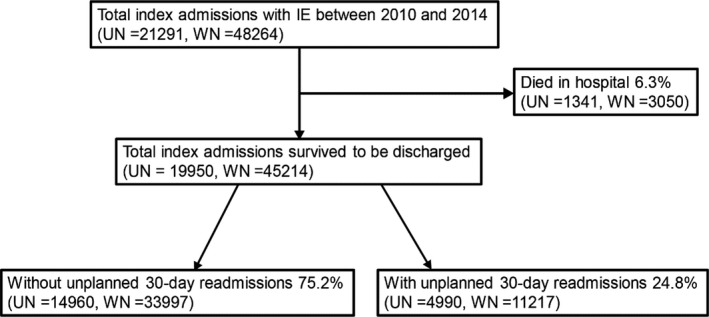
Background The contemporary incidence of and reasons for early readmission after infective endocarditis ( IE ) are not well known. Therefore, we analyzed 30-day readmission demographics after IE from the US Nationwide Readmission Database. Methods and Results We examined the 2010 to 2014 Nationwide Readmission Database to identify index admissions for a primary diagnosis of IE with survival at discharge. Incidence, reasons, and independent predictors of 30-day unplanned readmissions were analyzed. In total, 11 217 patients (24.8%) were nonelectively readmitted within 30 days among the 45 214 index admissions discharged after IE . The most common causes of readmission were IE (20.5%), sepsis (8.7%), complications of device/graft (8.1%), and congestive heart failure (7.6%). In-hospital mortality and the valvular surgery rates during the readmissions were 8.1% and 9.1%, respectively. Discharge to home or self-care, undergoing valvular surgery, aged ≥60 years, and having private insurance were independently associated with lower rates of 30-day readmission. Length of stay of ≥10 days, congestive heart failure, diabetes mellitus, renal failure, chronic pulmonary disease, peripheral artery disease, and depression were associated with higher risk. The total hospital costs of readmission were $48.7 million per year (median, $11 267; interquartile range, $6021-$25 073), which accounted for 38.6% of the total episodes of care (index+readmission). Conclusions Almost 1 in 4 patients was readmitted within 30 days of admission for IE . The most common reasons were IE , other infectious causes, and cardiac causes. A multidisciplinary approach to determine the surgical indications and close monitoring are necessary to improve outcomes and reduce complications in in-hospital and postdischarge settings.
背景 目前,感染性心内膜炎(IE)患者的早期再入院率及其原因尚不清楚。因此,我们分析了美国全国再入院数据库中 30 天再入院的患者情况。
方法和结果 我们调查了 2010 年至 2014 年的全国再入院数据库,以确定原发性 IE 诊断患者的索引入院,并记录其出院时的存活情况。分析了 30 天内非计划性再入院的发生率、原因和独立预测因素。在 45214 例 IE 出院的索引入院中,共有 11217 例(24.8%)在 30 天内非计划性再入院。再入院的最常见原因是 IE(20.5%)、败血症(8.7%)、器械/移植物并发症(8.1%)和充血性心力衰竭(7.6%)。再入院的院内死亡率和瓣膜手术率分别为 8.1%和 9.1%。出院至家庭或自我护理、接受瓣膜手术、年龄≥60 岁和拥有私人保险与较低的 30 天再入院率独立相关。住院时间≥10 天、充血性心力衰竭、糖尿病、肾衰竭、慢性肺部疾病、外周动脉疾病和抑郁症与较高的再入院风险相关。每年再入院的总住院费用为 4870 万美元(中位数为 11267 美元;四分位距为 6021 美元-25073 美元),占总治疗次数(索引+再入院)的 38.6%。
结论 近 1/4 的 IE 患者在入院后 30 天内再次入院。最常见的原因是 IE、其他感染性原因和心脏原因。需要采取多学科方法来确定手术适应证,并密切监测,以改善住院和出院后的结局并减少并发症。