Sousa Catarina, Nogueira Paulo, Pinto Fausto J
Centro Cardiovascular da Universidade de Lisboa (CCUL), Centro Académico de Medicina de Lisboa (CAML), Faculdade de Medicina da Universidade de Lisboa, Av. Prof. Egas Moniz MB, 1649-028, Lisbon, Portugal.
Serviço de Cardiologia, Centro Hospitalar Barreiro Montijo (CHBM), EPE, Barreiro, Portugal.
BMC Cardiovasc Disord. 2021 Mar 16;21(1):138. doi: 10.1186/s12872-021-01937-3.
Nationwide hospital admissions data series have contributed to a reliable assessment of the changing epidemiology of infective endocarditis, even though conclusions are not uniform. We sought to use a recent populational series to describe the temporal trends on the incidence of infective endocarditis, its clinical characteristics and outcome results, in Portugal.
A nationwide retrospective temporal trend study on the incidence and clinical characterization of patients hospitalized with infective endocarditis, between 2010 and 2018.
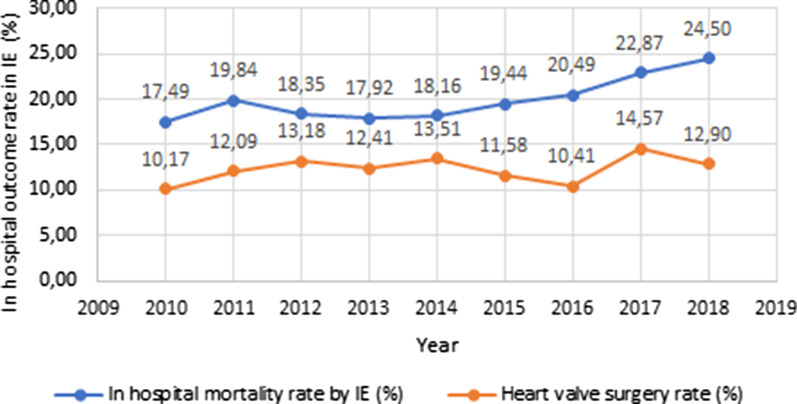
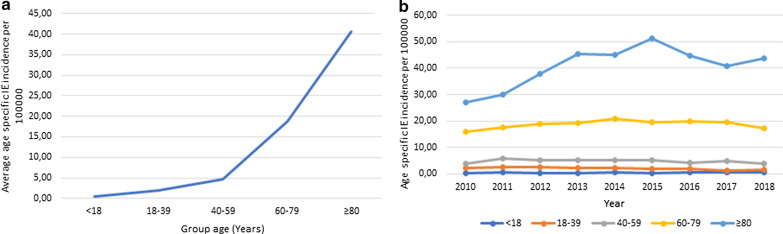
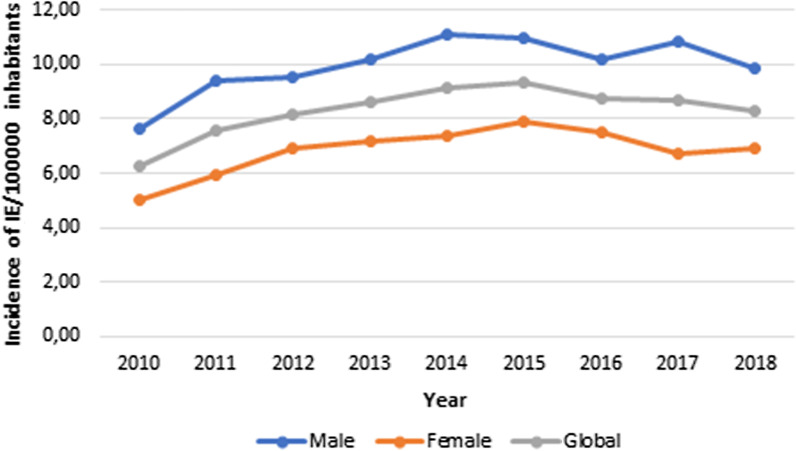
7574 patients were hospitalized with infective endocarditis from 2010 to 2018 in Portuguese public hospitals. The average length of hospitalization was 29.3 ± 28.7 days, predominantly men (56.9%), and 47.1% had between 60 and 79 years old. The most frequent infectious agents involved were Staphylococcus (16.4%) and Streptococcus (13.6%). During hospitalization, 12.4% of patients underwent heart valve surgery and 20% of the total cohort died. After a 1-year post-discharge follow-up, 13.2% of the total initial cohort had had heart valve surgery and 21.2% in total died. The annual incidence of infective endocarditis was 8.31 per 100,000 habitants, being higher in men (9.96 per 100,000 in males versus 6.82 in females, p < 0.001) and increased with age, peaking at patients 80 years old or older (40.62 per 100,000). In-hospital mortality rate significantly increased during the analyzed period, the strongest independent predictors being ischemic or hemorrhagic stroke, sepsis, and acute renal failure. Younger age and cardiac surgery had a protective effect towards a fatal outcome.
In Portugal, between 2010 and 2018, the incidence of infective endocarditis presented a general growth trend with a deceleration in the most recent years. Also, a significant rate of in-hospital complications, a mildly lower than expected stable surgical rate and a still high and growing mortality rate were noted.
尽管结论并不统一,但全国性的医院入院数据系列有助于对感染性心内膜炎不断变化的流行病学进行可靠评估。我们试图利用最近的一个人群系列来描述葡萄牙感染性心内膜炎发病率的时间趋势、其临床特征和预后结果。
对2010年至2018年期间因感染性心内膜炎住院患者的发病率和临床特征进行全国性回顾性时间趋势研究。
2010年至2018年期间,7574例患者因感染性心内膜炎在葡萄牙公立医院住院。平均住院时间为29.3±28.7天,以男性为主(56.9%),47.1%的患者年龄在60至79岁之间。最常见的感染病原体是葡萄球菌(16.4%)和链球菌(13.6%)。住院期间,12.4%的患者接受了心脏瓣膜手术,总队列中有20%的患者死亡。出院后1年随访时,初始队列中有13.2%的患者接受了心脏瓣膜手术,总共有21.2%的患者死亡。感染性心内膜炎的年发病率为每10万居民8.31例,男性发病率更高(男性为每10万居民9.96例,女性为6.82例,p<0.001),且随年龄增长而增加,在80岁及以上患者中达到峰值(每10万居民40.62例)。在分析期间,住院死亡率显著增加,最强的独立预测因素是缺血性或出血性中风、败血症和急性肾衰竭。年轻和心脏手术对致命结局有保护作用。
在葡萄牙,2010年至2018年期间,感染性心内膜炎的发病率总体呈增长趋势,最近几年有所放缓。此外,还注意到住院并发症发生率较高、手术率略低于预期且稳定、死亡率仍然很高且呈上升趋势。