Department of Haematology and Central Haematology Laboratory, Inselspital, Bern University Hospital and University of Bern, Bern, Switzerland.
Division of Haematology and Central Hematology Laboratory, CHUV, Lausanne University Hospital and University of Lausanne, Lausanne, Switzerland.
J Thromb Haemost. 2019 Jul;17(7):1104-1112. doi: 10.1111/jth.14454. Epub 2019 May 22.
Essentials The utility of bleeding assessment tools regarding platelet function disorders is still elusive. We studied consecutive patients in a prospective cohort study in a tertiary hospital. Substantially higher scorings were observed in patients with platelet function disorders. Bleeding assessment tools might provide a useful screening tool.
Bleeding assessment tools (BATs) have been widely implemented in the evaluation of patients with suspected bleeding disorders. However, diagnostic BAT utility regarding platelet function disorders is still elusive.
We aimed to assess the diagnostic value of the International Society on Thrombosis and Haemostasis BAT (ISTH-BAT) for platelet function disorders in clinical practice.
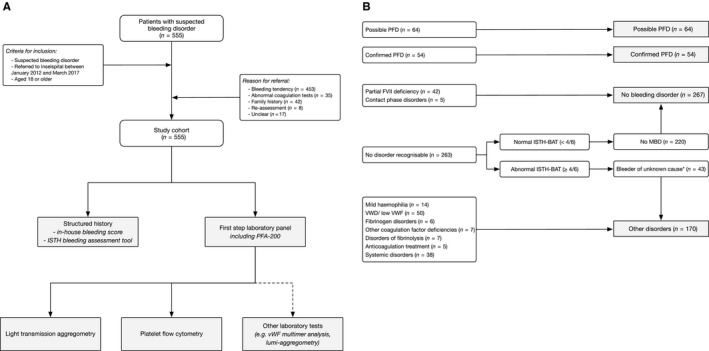
The clinical characteristics and laboratory data of all consecutive patients with a suspected bleeding disorder referred between January 2012 and March 2017 to an outpatient unit of a university hospital were prospectively collected. The diagnostic evaluation was performed according to current recommendations following a prespecified protocol and platelet function was tested using light transmission aggregometry as well as flow cytometry.
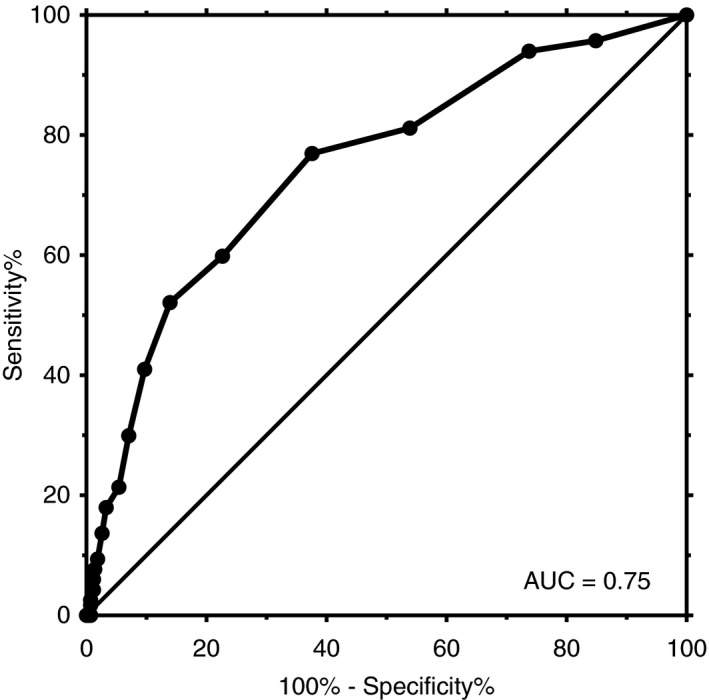
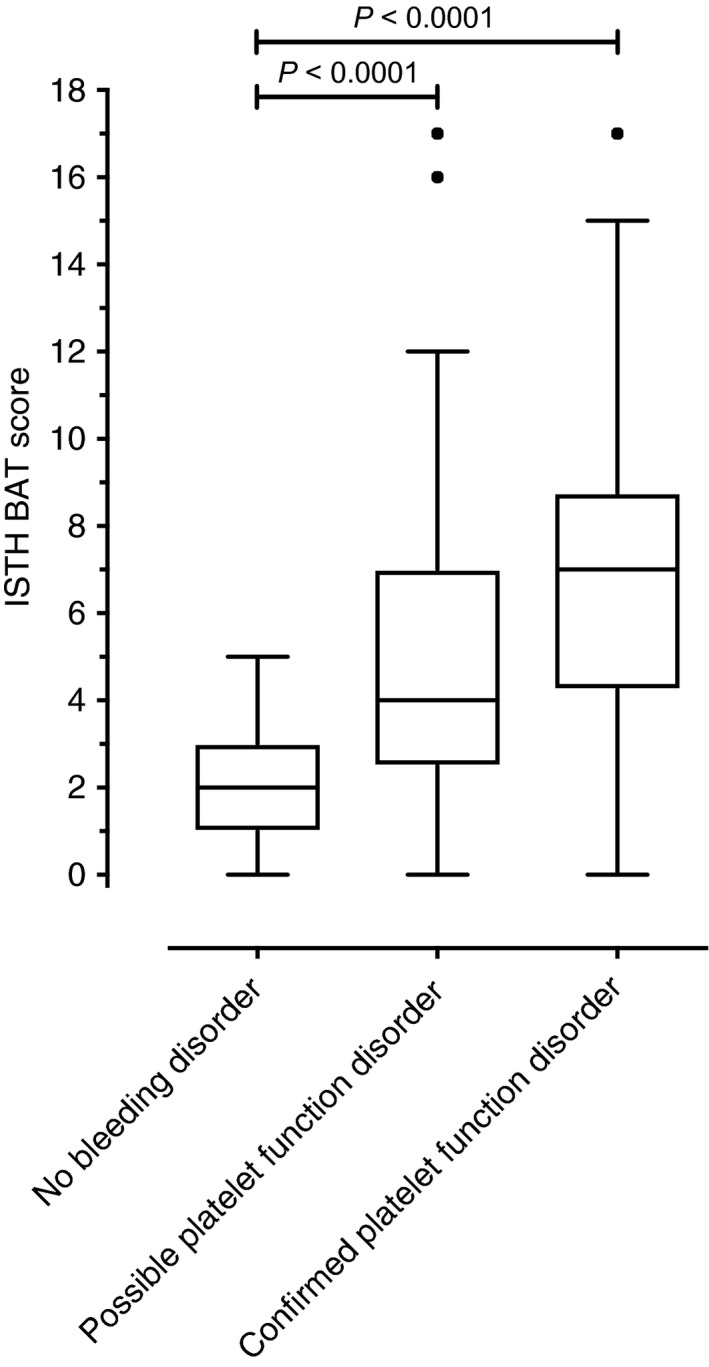
Five hundred and fifty-five patients were assessed; 66.9% were female, median age was 43.7 years (interquartile range [IQR] 29.3, 61.7). Confirmed platelet function disorder was diagnosed in 54 patients (9.7%), possible platelet function disorder in 64 patients (11.5%), and other disorders in 170 patients (30.6%). Median scoring of the ISTH-BAT was 2 in patients without a bleeding disorder (IQR 1, 3), 4 in patients with a possible platelet function disorder (2, 7), and 7 in patients with confirmed platelet function disorder (5, 9). Area under the receiver operating characteristic curve (the area under the curve [AUC]) was 0.75 (95% CI 0.70, 0.80).
Presence of a platelet function disorder was associated with substantially higher BAT scorings compared to patients without. Our data suggest that the ISTH-BAT provides a useful screening tool for patients with suspected platelet function disorders.
评估国际血栓与止血学会出血评估工具(ISTH-BAT)在临床实践中对血小板功能障碍的诊断价值。
前瞻性收集 2012 年 1 月至 2017 年 3 月期间连续就诊于大学医院门诊的疑似出血性疾病患者的临床特征和实验室数据。根据当前的推荐方案,按照预先设定的方案进行诊断评估,并使用透光比浊法和流式细胞术检测血小板功能。
共评估了 555 例患者,其中 66.9%为女性,中位年龄为 43.7 岁(四分位间距 [IQR],29.3,61.7)。确诊为血小板功能障碍 54 例(9.7%),可能为血小板功能障碍 64 例(11.5%),其他疾病 170 例(30.6%)。无出血性疾病患者的 ISTH-BAT 评分中位数为 2(IQR,1,3),可能为血小板功能障碍患者为 4(2,7),确诊为血小板功能障碍患者为 7(5,9)。受试者工作特征曲线下面积(AUC)为 0.75(95%CI,0.70,0.80)。
与无血小板功能障碍患者相比,血小板功能障碍患者的 BAT 评分显著更高。我们的数据表明,ISTH-BAT 可为疑似血小板功能障碍患者提供有用的筛查工具。