Kaufmann Jonas, Adler Marcel, Alberio Lorenzo, Nagler Michael
Department of Hematology and Central Hematology Laboratory, Inselspital, Bern University Hospital, and University of Bern, Bern, Switzerland.
Division of Hematology and Central Hematology Laboratory, CHUV, Lausanne University Hospital and University of Lausanne, Lausanne, Switzerland.
TH Open. 2020 Dec 22;4(4):e427-e436. doi: 10.1055/s-0040-1721502. eCollection 2020 Oct.
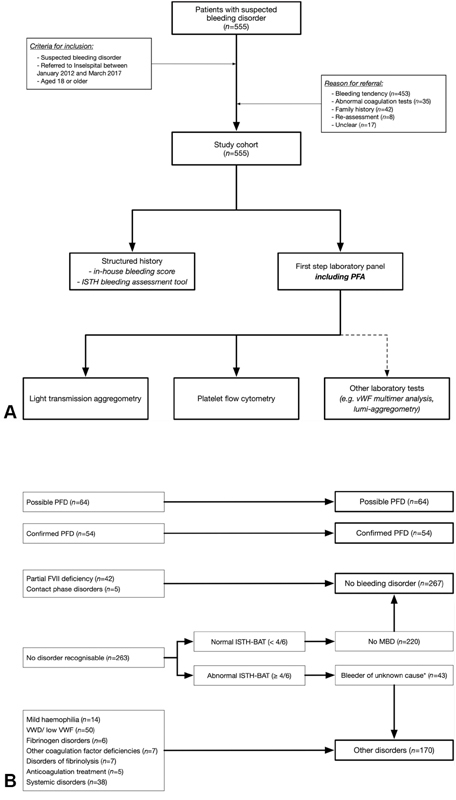
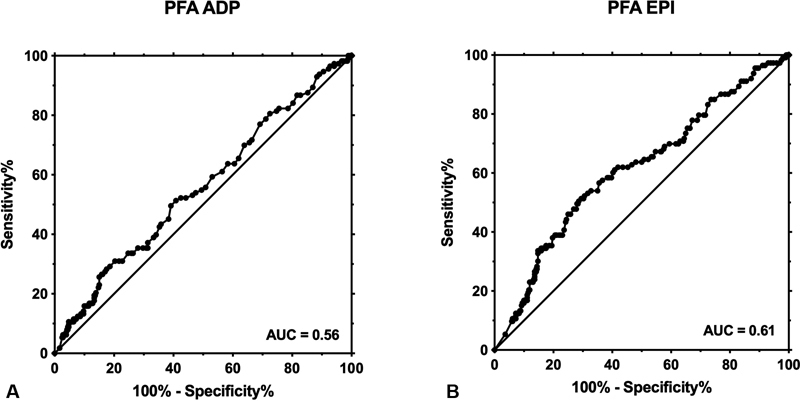
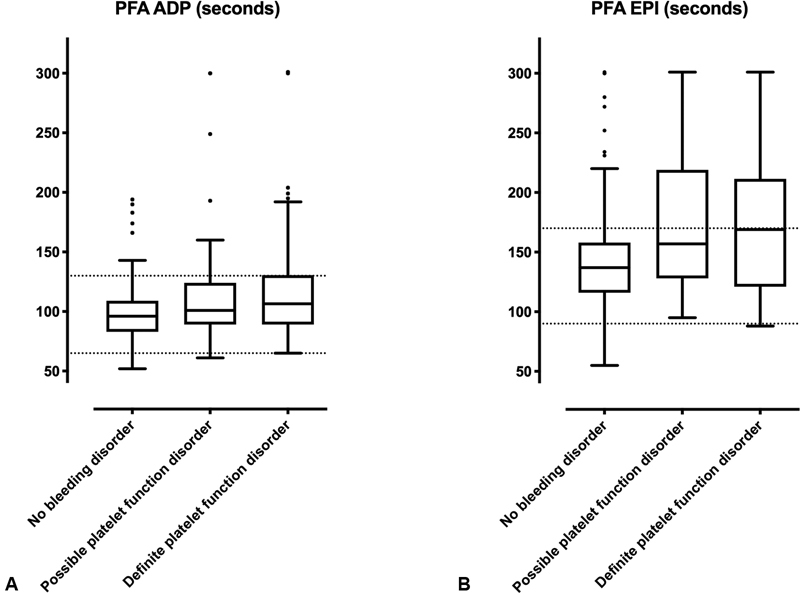
The platelet function analyzer (PFA) is widely used as a screening tool for bleeding disorders in various settings. The diagnostic performance regarding platelet function disorders (PFDs), which are among the most common inherited bleeding disorders, is however still elusive. We aimed to assess the diagnostic value of PFA for PFD in clinical practice. Comprehensive clinical and laboratory data of all consecutive patients referred to a specialized outpatient between January 2012 and March 2017 with a suspected bleeding disorder were prospectively recorded. The diagnostic work-up was performed according to a prespecified protocol following current guidelines and platelet function was tested using light transmission aggregometry as well as flow cytometry. Five hundred and fifty-five patients were included (median age 43.7 years; interquartile range [IQR] 29.3, 61.7; 66.9% female). Possible PFD was diagnosed in 64 patients (11.5%) and confirmed PFD in 54 patients (9.7%). In patients with confirmed PFD, median closure times were 107 seconds (ADP or adenosine diphosphate; IQR 89, 130) and 169 seconds (EPI; IQR 121, 211). In patients without bleeding disorders, PFA closure times were 96 seconds (ADP; IQR 83, 109) and 137 seconds (EPI; IQR 116, 158). The sensitivity was 19.5% in case of PFA ADP (95%CI 12.6, 30.0; specificity 86.4%; 95% CI 82.4, 89.8), and 44.3% in case of PFA EPI (95% CI 34.9, 53.9; specificity 75.6%; 95% CI 70.8, 79.9). The diagnostic performance of PFA for PFD was moderate to poor. Our results do not support the utilization of PFA for screening of PFD in clinical practice.
血小板功能分析仪(PFA)在各种情况下被广泛用作出血性疾病的筛查工具。然而,对于血小板功能障碍(PFD),这是最常见的遗传性出血性疾病之一,其诊断性能仍不明确。我们旨在评估PFA在临床实践中对PFD的诊断价值。前瞻性记录了2012年1月至2017年3月期间所有转诊至专科门诊且疑似出血性疾病的连续患者的综合临床和实验室数据。诊断检查按照当前指南的预先指定方案进行,血小板功能使用光透射聚集法以及流式细胞术进行检测。纳入了555例患者(中位年龄43.7岁;四分位间距[IQR]29.3, 61.7;66.9%为女性)。64例患者(11.5%)被诊断为可能的PFD,54例患者(9.7%)被确诊为PFD。在确诊为PFD的患者中,中位封闭时间为107秒(ADP或二磷酸腺苷;IQR 89, 130)和169秒(EPI;IQR 121, 211)。在无出血性疾病的患者中,PFA封闭时间为96秒(ADP;IQR 83, 109)和137秒(EPI;IQR 116, 158)。PFA ADP时的敏感性为19.5%(95%CI 12.6, 30.0;特异性86.4%;95%CI 82.4, 89.8),PFA EPI时的敏感性为44.3%(95%CI 34.9, 53.9;特异性75.6%;95%CI 70.8, 79.9)。PFA对PFD的诊断性能为中等至较差。我们的结果不支持在临床实践中使用PFA筛查PFD。