• 文献检索
  • 文档翻译
  • 深度研究
  • 学术资讯
  • Suppr Zotero 插件Zotero 插件
  • 邀请有礼
  • 套餐&价格
  • 历史记录
应用&插件
Suppr Zotero 插件Zotero 插件浏览器插件Mac 客户端Windows 客户端微信小程序
定价
高级版会员购买积分包购买API积分包
服务
文献检索文档翻译深度研究API 文档MCP 服务
关于我们
关于 Suppr公司介绍联系我们用户协议隐私条款
关注我们

Suppr 超能文献

核心技术专利:CN118964589B侵权必究
粤ICP备2023148730 号-1Suppr @ 2026

文献检索

告别复杂PubMed语法,用中文像聊天一样搜索,搜遍4000万医学文献。AI智能推荐,让科研检索更轻松。

立即免费搜索

文件翻译

保留排版,准确专业,支持PDF/Word/PPT等文件格式,支持 12+语言互译。

免费翻译文档

深度研究

AI帮你快速写综述,25分钟生成高质量综述,智能提取关键信息,辅助科研写作。

立即免费体验

人工耳蜗植入的语前聋儿童组成的合唱团成员的歌唱能力。

Singing Proficiency of Members of a Choir Formed by Prelingually Deafened Children With Cochlear Implants.

机构信息

Department of Communication Sciences and Disorders, University of Wisconsin-Milwaukee.

Aier Times Ltd., Beijing, China.

出版信息

J Speech Lang Hear Res. 2019 May 21;62(5):1561-1573. doi: 10.1044/2019_JSLHR-H-18-0385.

DOI:10.1044/2019_JSLHR-H-18-0385
PMID:31021668
原文链接:https://pmc.ncbi.nlm.nih.gov/articles/PMC6808322/
Abstract

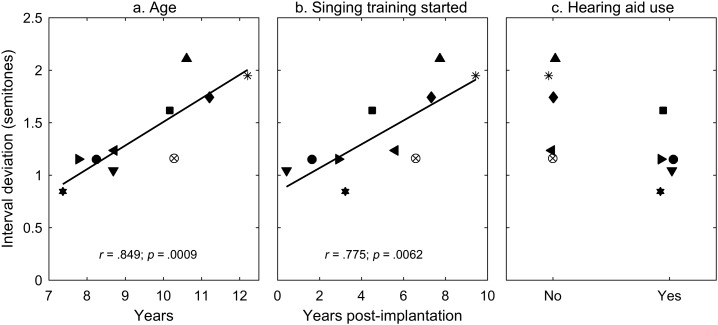
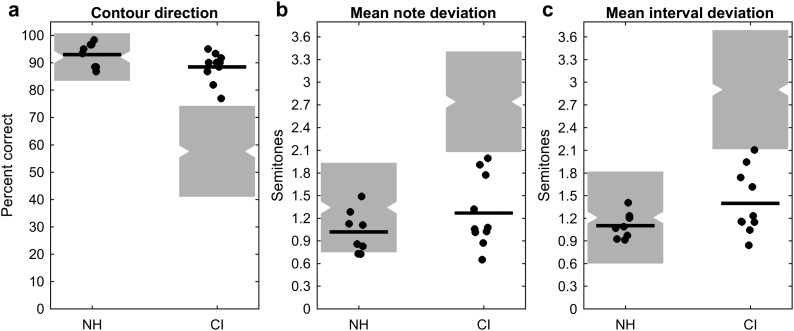
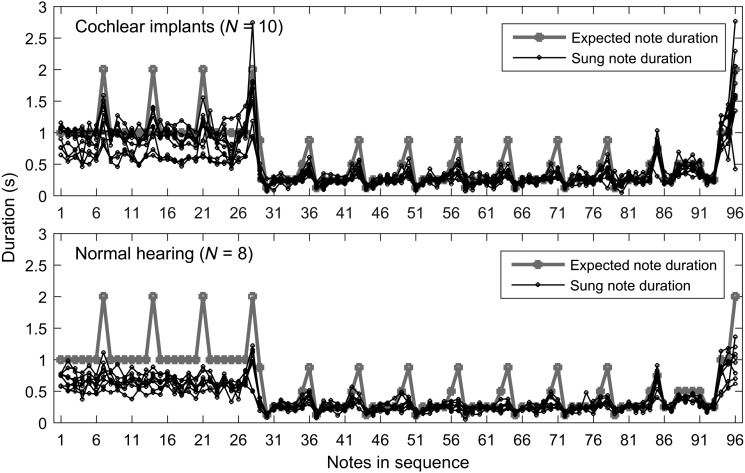
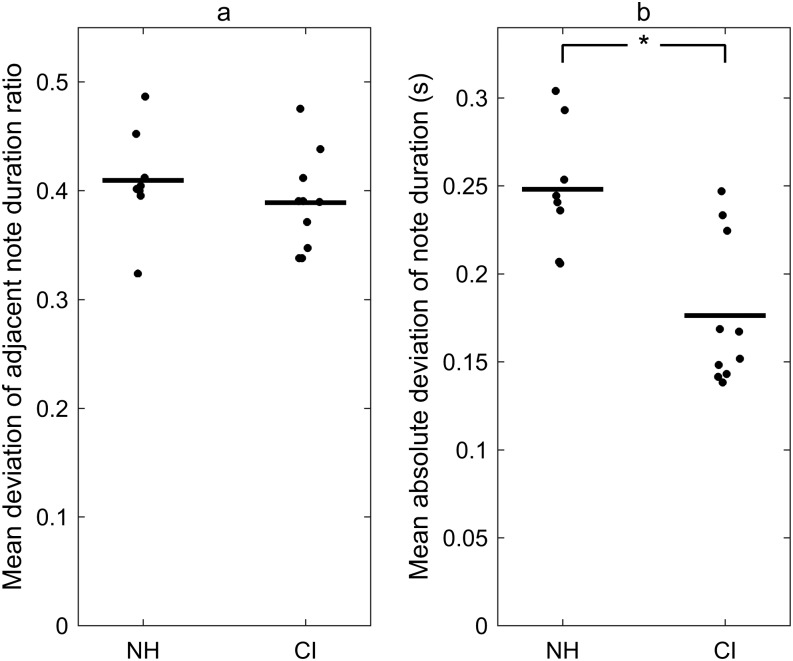
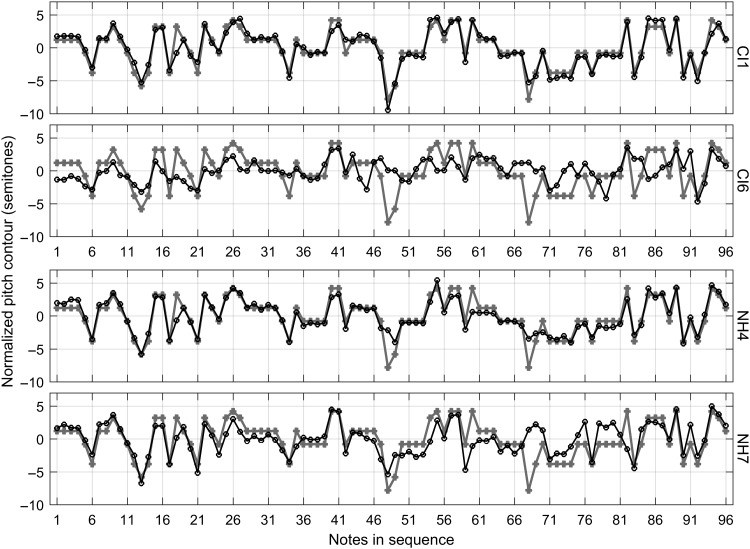
Purpose A group of 10 prelingually deafened children with cochlear implants (CIs) formed a choir and received 21 months of formal music training. The purpose of this study was to evaluate the singing proficiency of these children. Method The participants included all choir members (7 girls and 3 boys, mean age of 9.5 years old) who were unilateral CI users. Meanwhile, 8 age-matched children with normal hearing were recruited as controls and were trained on 1 song for 2 weeks. Individual singing samples without instrument accompaniment were recorded from all participants. The singing samples were subject to acoustic analysis in which the fundamental frequency (F0) of each note was extracted and the duration was measured. Five metrics were developed and computed to quantify the accuracy of their pitch and rhythm performance. The 5 metrics included (a) percent correct of F0 contour direction of adjacent notes, (b) mean deviation of the normalized F0 across the notes, (c) mean deviation of the pitch intervals, (d) mean deviation of adjacent note duration ratio, and (e) mean absolute deviation of note duration. Results The choir members with CIs demonstrated high accuracy in both pitch and tempo measures and performed on par with the children with normal hearing. Early start of music training after implantation and use of bimodal hearing contributed to the development of better music ability in these children with CIs. Conclusion These findings indicated that rigorous music training could facilitate high singing proficiency in prelingually deafened children with CIs.

摘要

目的

一组 10 名患有先天性失聪的儿童接受了人工耳蜗植入手术,并组成了合唱团,接受了 21 个月的正式音乐训练。本研究旨在评估这些儿童的歌唱水平。

方法

参与者均为单侧人工耳蜗使用者,包括合唱团的所有成员(7 名女孩和 3 名男孩,平均年龄为 9.5 岁)。同时,招募了 8 名年龄匹配的听力正常的儿童作为对照组,并对他们进行了为期两周的 1 首歌曲的训练。所有参与者均录制了没有乐器伴奏的个人演唱样本。对这些演唱样本进行声学分析,提取每个音符的基频(F0)并测量时长。开发并计算了 5 个指标来量化他们音高和节奏表现的准确性。这 5 个指标包括:(a)相邻音符 F0 方向的正确百分比;(b)音符间归一化 F0 的平均偏差;(c)音高间隔的平均偏差;(d)相邻音符时值比的平均偏差;(e)音符时值的平均绝对偏差。

结果

植入后早期开始音乐训练并使用双耳听觉有助于这些患有先天性失聪的人工耳蜗使用者儿童发展出更好的音乐能力,他们在音高和节奏方面的测量结果都具有很高的准确性,与听力正常的儿童表现相当。

结论

这些发现表明,严格的音乐训练可以促进先天性失聪的人工耳蜗使用者儿童的歌唱水平提高。
https://cdn.ncbi.nlm.nih.gov/pmc/blobs/206e/6808322/fb50ba2f1409/JSLHR-62-1561-g005.jpg
https://cdn.ncbi.nlm.nih.gov/pmc/blobs/206e/6808322/af2cfdf9a4a8/JSLHR-62-1561-g001.jpg
https://cdn.ncbi.nlm.nih.gov/pmc/blobs/206e/6808322/3f14be8409dd/JSLHR-62-1561-g002.jpg
https://cdn.ncbi.nlm.nih.gov/pmc/blobs/206e/6808322/279e9d88b1c3/JSLHR-62-1561-g003.jpg
https://cdn.ncbi.nlm.nih.gov/pmc/blobs/206e/6808322/505bef64c148/JSLHR-62-1561-g004.jpg
https://cdn.ncbi.nlm.nih.gov/pmc/blobs/206e/6808322/fb50ba2f1409/JSLHR-62-1561-g005.jpg
https://cdn.ncbi.nlm.nih.gov/pmc/blobs/206e/6808322/af2cfdf9a4a8/JSLHR-62-1561-g001.jpg
https://cdn.ncbi.nlm.nih.gov/pmc/blobs/206e/6808322/3f14be8409dd/JSLHR-62-1561-g002.jpg
https://cdn.ncbi.nlm.nih.gov/pmc/blobs/206e/6808322/279e9d88b1c3/JSLHR-62-1561-g003.jpg
https://cdn.ncbi.nlm.nih.gov/pmc/blobs/206e/6808322/505bef64c148/JSLHR-62-1561-g004.jpg
https://cdn.ncbi.nlm.nih.gov/pmc/blobs/206e/6808322/fb50ba2f1409/JSLHR-62-1561-g005.jpg

相似文献

1
Singing Proficiency of Members of a Choir Formed by Prelingually Deafened Children With Cochlear Implants.人工耳蜗植入的语前聋儿童组成的合唱团成员的歌唱能力。
J Speech Lang Hear Res. 2019 May 21;62(5):1561-1573. doi: 10.1044/2019_JSLHR-H-18-0385.
2
Pitch Accuracy of Vocal Singing in Deaf Children With Bimodal Hearing and Bilateral Cochlear Implants.聋童双侧人工耳蜗植入后使用两种模式助听时的歌唱音准
Ear Hear. 2022;43(4):1336-1346. doi: 10.1097/AUD.0000000000001189. Epub 2021 Dec 17.
3
Vocal singing by prelingually-deafened children with cochlear implants.植入人工耳蜗的语前聋儿童的声乐演唱。
Hear Res. 2009 Sep;255(1-2):129-34. doi: 10.1016/j.heares.2009.06.011. Epub 2009 Jun 26.
4
Acoustic properties of vocal singing in prelingually-deafened children with cochlear implants or hearing aids.植入人工耳蜗或佩戴助听器的语前聋儿童的歌唱声学特性。
Int J Pediatr Otorhinolaryngol. 2013 Nov;77(11):1833-40. doi: 10.1016/j.ijporl.2013.08.022. Epub 2013 Aug 29.
5
Music training improves pitch perception in prelingually deafened children with cochlear implants.音乐训练可改善人工耳蜗植入的语前聋儿童的音高感知能力。
Pediatrics. 2010 Apr;125(4):e793-800. doi: 10.1542/peds.2008-3620. Epub 2010 Mar 8.
6
Vowel Production in Prelingually Deafened Mandarin-Speaking Children With Cochlear Implants.人工耳蜗植入术后的语前聋说普通话儿童的元音发音
J Speech Lang Hear Res. 2021 Feb 17;64(2):664-682. doi: 10.1044/2020_JSLHR-20-00469. Epub 2021 Feb 1.
7
Contribution of nonimplanted ear to pitch perception for prelingually deafened cochlear implant recipients.未植入耳对语前聋人工耳蜗植入受者音高感知的贡献。
Otol Neurotol. 2014 Sep;35(8):1409-14. doi: 10.1097/MAO.0000000000000407.
8
Music and Speech Perception in Prelingually Deafened Young Listeners With Cochlear Implants: A Preliminary Study Using Sung Speech.使用歌唱语音对人工耳蜗植入的语前聋年轻听障者的音乐和言语感知:一项初步研究。
J Speech Lang Hear Res. 2022 Oct 17;65(10):3951-3965. doi: 10.1044/2022_JSLHR-21-00271. Epub 2022 Sep 30.
9
Discourse Prosody in Children's Rhyme Speech Produced by Prelingually Deaf Mandarin-Speaking Children With Cochlear Implants.语前聋的汉语普通话儿童人工耳蜗植入者儿歌言语中的话语韵律
J Speech Lang Hear Res. 2020 Jun 22;63(6):1736-1751. doi: 10.1044/2020_JSLHR-19-00333. Epub 2020 Jun 16.
10
Mandarin compound vowels produced by prelingually deafened children with cochlear implants.人工耳蜗植入的语前聋儿童所发出的普通话复合元音。
Int J Pediatr Otorhinolaryngol. 2017 Jun;97:143-149. doi: 10.1016/j.ijporl.2017.04.012. Epub 2017 Apr 10.

引用本文的文献

1
Meta-Analysis Exploring the Effects of Music Training in Cochlear Implant Users by Age.探索音乐训练对不同年龄人工耳蜗使用者影响的荟萃分析。
J Audiol Otol. 2023 Oct;27(4):193-204. doi: 10.7874/jao.2023.00087. Epub 2023 Aug 4.
2
Music Appreciation of Cochlear Implant Users versus Normal Hearing Individuals.人工耳蜗使用者与正常听力个体的音乐欣赏比较
Iran J Otorhinolaryngol. 2022 May;34(122):171-179. doi: 10.22038/IJORL.2022.62651.3152.
3
Acoustic Assessment of Tone Production of Prelingually-Deafened Mandarin-Speaking Children With Cochlear Implants.

本文引用的文献

1
The effectiveness of sound-processing strategies on tonal language cochlear implant users: A systematic review.声音处理策略对使用声调语言的人工耳蜗使用者的有效性:一项系统综述。
Pediatr Investig. 2017 Dec 27;1(1):32-39. doi: 10.1002/ped4.12011. eCollection 2017 Dec.
2
Piano training enhances the neural processing of pitch and improves speech perception in Mandarin-speaking children.钢琴训练增强了音高的神经处理能力,并提高了讲普通话的儿童的语音感知能力。
Proc Natl Acad Sci U S A. 2018 Jul 10;115(28):E6630-E6639. doi: 10.1073/pnas.1808412115. Epub 2018 Jun 25.
3
Music Training Can Improve Music and Speech Perception in Pediatric Mandarin-Speaking Cochlear Implant Users.
人工耳蜗植入的语前聋说普通话儿童声调产生的声学评估
Front Neurosci. 2020 Nov 4;14:592954. doi: 10.3389/fnins.2020.592954. eCollection 2020.
4
Music Perception Testing Reveals Advantages and Continued Challenges for Children Using Bilateral Cochlear Implants.音乐感知测试揭示了使用双侧人工耳蜗的儿童所具有的优势和持续面临的挑战。
Front Psychol. 2020 Jan 21;10:3015. doi: 10.3389/fpsyg.2019.03015. eCollection 2019.
音乐训练可提高儿科普通话人工耳蜗植入者的音乐和言语感知能力。
Trends Hear. 2018 Jan-Dec;22:2331216518759214. doi: 10.1177/2331216518759214.
4
Music perception improves in children with bilateral cochlear implants or bimodal devices.双侧人工耳蜗植入或双模式设备的儿童的音乐感知能力有所提高。
J Acoust Soc Am. 2017 Jun;141(6):4494. doi: 10.1121/1.4985123.
5
Speech perception in Mandarin-speaking children with cochlear implants: A systematic review.使用人工耳蜗的华语儿童的言语感知:一项系统评价。
Int J Audiol. 2017;56(sup2):S7-S16. doi: 10.1080/14992027.2017.1300694. Epub 2017 Mar 15.
6
Perception of Sung Speech in Bimodal Cochlear Implant Users.双耳模式人工耳蜗植入者对 sung 语音的感知
Trends Hear. 2016 Nov 11;20:2331216516669329. doi: 10.1177/2331216516669329.
7
Lexical tone recognition in noise in normal-hearing children and prelingually deafened children with cochlear implants.正常听力儿童及人工耳蜗植入的语前聋儿童在噪声中的声调识别。
Int J Audiol. 2017;56(sup2):S23-S30. doi: 10.1080/14992027.2016.1219073. Epub 2016 Aug 26.
8
Mandarin Lexical Tone Acquisition in Cochlear Implant Users With Prelingual Deafness: A Review.语前聋人工耳蜗使用者的普通话声调习得:综述
Am J Audiol. 2016 Sep 1;25(3):246-56. doi: 10.1044/2016_AJA-15-0069.
9
Music-based training for pediatric CI recipients: A systematic analysis of published studies.针对儿科人工耳蜗植入受者的音乐训练:已发表研究的系统分析
Eur Ann Otorhinolaryngol Head Neck Dis. 2016 Jun;133 Suppl 1(Suppl 1):S50-6. doi: 10.1016/j.anorl.2016.01.010. Epub 2016 May 27.
10
Music training alters the course of adolescent auditory development.音乐训练会改变青少年听觉发育的进程。
Proc Natl Acad Sci U S A. 2015 Aug 11;112(32):10062-7. doi: 10.1073/pnas.1505114112. Epub 2015 Jul 20.