Department of Experimental Pathophysiology, Faculty of Medicine, University of São Paulo, São Paulo, Brazil.
School of Arts, Science and Humanities, University of Sao Paulo, São Paulo, Brazil.
PLoS One. 2019 Apr 25;14(4):e0215896. doi: 10.1371/journal.pone.0215896. eCollection 2019.
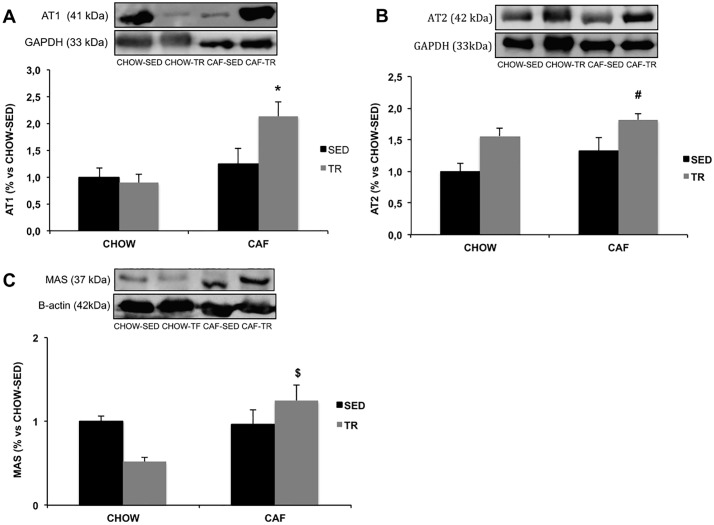
We investigate the effects of aerobic exercise training (AET) on the thermogenic response, substrate metabolism and renin angiotensin system (RAS) in the subcutaneous white adipose tissue (SC-WAT) of mice fed cafeteria diet (CAF). Male C57BL/6J mice were assigned into groups CHOW-SED (chow diet, sedentary; n = 10), CHOW-TR (chow diet, trained; n = 10), CAF-SED (CAF, sedentary; n = 10) and CAF-TR (CAF, trained; n = 10). AET consisted in running sessions of 60 min at 60% of maximal speed, five days per week for eight weeks. The CAF-SED group showed higher body weight and adiposity, glucose intolerance and insulin resistance (IR), while AET prevented such damages in CAF-TR group. AET reduced the p-AKT/t-AKT ratio and increased ATGL expression in CHOW-TR and CAF-TR groups and increased t-HSL and p-HSL/t-HSL ratio in CAF-TR. AET prevented adipocyte hypertrophy in CAF-TR group and increased UCP-1 protein expression only in CHOW-TR. Serum ACE2 increased in CHOW-TR and CAF-TR groups, and Ang (1-7) increased in the CHOW-TR group. In the SC-WAT, CAF-TR group increased the expression of AT1, AT2 and Mas receptors, whereas CHOW-TR increased Ang (1-7) and Ang (1-7)/Ang II ratio in SC-WAT. No changes were observed in ACE and Ang II. Positive correlations were observed between UCP-1 and kITT (r = 0.6), between UCP-1 and Ang (1-7) concentration (r = 0.6), and between UCP-1 and Ang (1-7)/Ang II ratio (r = 0.7). In conclusion, the AET prevented obesity and IR, reduced insulin signaling proteins and increased lipolysis signaling proteins in the SC-WAT. In addition, the CAF diet precludes the AET-induced thermogenic response and the partial modulation of the RAS suggests that the protective effect of AET against obesity and IR could not be associated with SC-WAT RAS.
我们研究了有氧运动训练(AET)对喂食自助餐饮食(CAF)的小鼠皮下白色脂肪组织(SC-WAT)的产热反应、底物代谢和肾素血管紧张素系统(RAS)的影响。雄性 C57BL/6J 小鼠被分为以下几组:CHOW-SED(标准饮食,安静;n = 10)、CHOW-TR(标准饮食,训练;n = 10)、CAF-SED(CAF,安静;n = 10)和 CAF-TR(CAF,训练;n = 10)。AET 包括每周五天、每次 60 分钟、以 60%最大速度进行跑步训练,持续八周。CAF-SED 组表现出更高的体重和肥胖度、葡萄糖不耐受和胰岛素抵抗(IR),而 AET 则防止了 CAF-TR 组的这些损伤。AET 降低了 CHOW-TR 和 CAF-TR 组中 p-AKT/t-AKT 比值和 ATGL 表达,增加了 CAF-TR 组中 t-HSL 和 p-HSL/t-HSL 比值。AET 防止了 CAF-TR 组脂肪细胞肥大,并仅在 CHOW-TR 组中增加了 UCP-1 蛋白表达。血清 ACE2 在 CHOW-TR 和 CAF-TR 组中增加,CHOW-TR 组中 Ang(1-7)增加。在 SC-WAT 中,CAF-TR 组增加了 AT1、AT2 和 Mas 受体的表达,而 CHOW-TR 组增加了 Ang(1-7)和 Ang(1-7)/Ang II 比值。ACE 和 Ang II 没有变化。UCP-1 与 kITT(r = 0.6)、UCP-1 与 Ang(1-7)浓度(r = 0.6)和 UCP-1 与 Ang(1-7)/Ang II 比值(r = 0.7)之间存在正相关。总之,AET 可预防肥胖和 IR,减少 SC-WAT 中胰岛素信号蛋白,并增加脂肪分解信号蛋白。此外,CAF 饮食排除了 AET 诱导的产热反应,RAS 的部分调节表明,AET 对肥胖和 IR 的保护作用可能与 SC-WAT 的 RAS 无关。