Department of Medicine, Dalin Tzu Chi Hospital, Buddhist Tzu Chi Medical Foundation, Chiayi, Taiwan.
School of Medicine, Tzu Chi University, Hualien, Taiwan.
PLoS One. 2019 Apr 25;14(4):e0216041. doi: 10.1371/journal.pone.0216041. eCollection 2019.
Pneumonia is life-threatening in patients with liver cirrhosis. Proton pump inhibitors (PPIs) may increase the risk of these patients developing pneumonia. However, whether PPIs increase mortality in patients with cirrhosis and pneumonia remain unknown.
We used the Taiwan National Health Insurance Database to enroll 1,201 cirrhotic patients with pneumonia without active gastrointestinal bleeding who were receiving PPIs and were hospitalized between January 1, 2010 and December 31, 2013. A one-to-three propensity score match was performed to select a comparison group based on age, gender, and comorbid disorders.
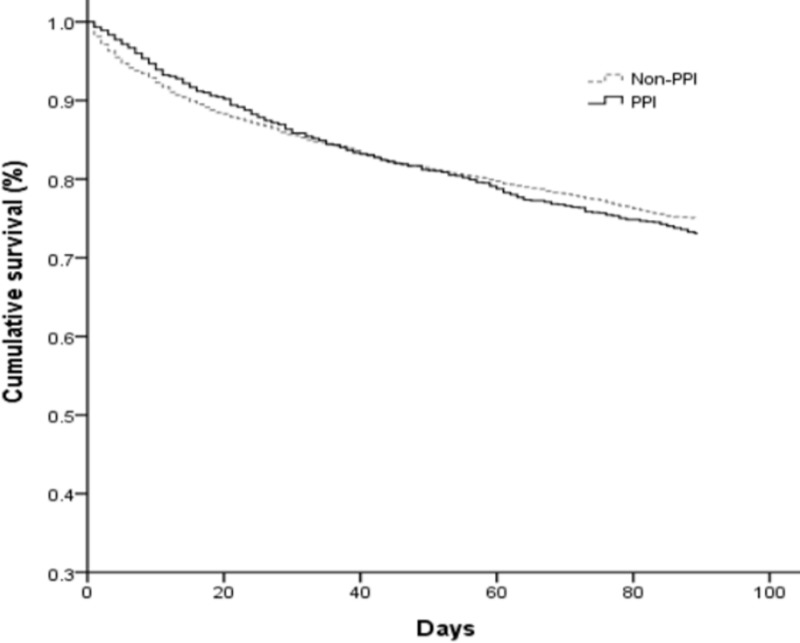
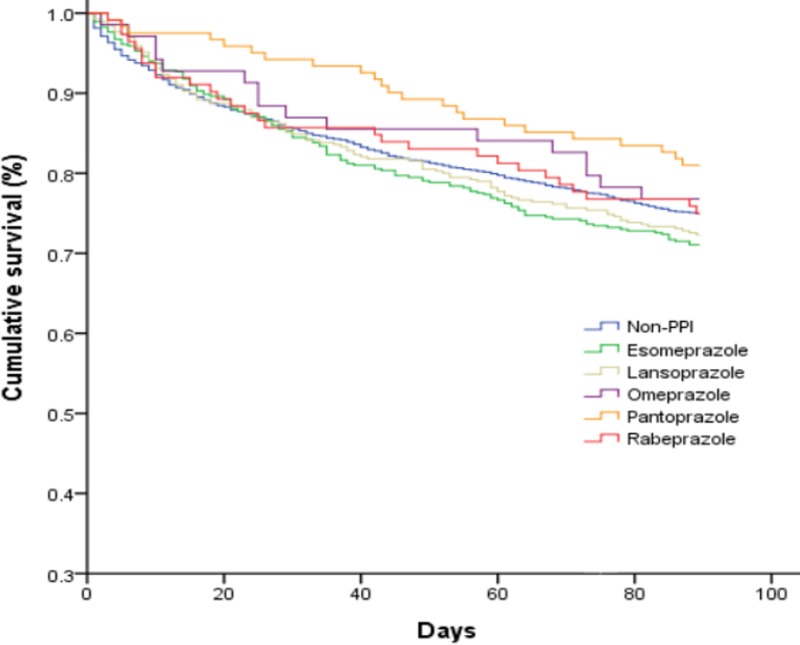
The overall 30-day and 90-day all-cause mortality rates were 13.7% and 26.9% in the PPI group, and 14.3% and 25.1% in the non-PPI group, respectively. After Cox regression model adjusting for age, gender, and comorbid disorders, the hazard ratios of the effect of PPIs on 30-day and 30 to 90-day mortality were 0.94 (95% Confidence Interval [CI], 0.79-1.12, P = 0.468) and 1.26 (95% CI, 1.05-1.52; P = 0.013), respectively.
PPIs were not associated with 30-day mortality among cirrhotic patients with pneumonia but not active gastrointestinal bleeding. However, prolonged PPI therapy may be associated with higher mortality.
肺炎对肝硬化患者具有生命威胁。质子泵抑制剂(PPIs)可能会增加此类患者发生肺炎的风险。但是,PPIs 是否会增加合并肺炎的肝硬化患者的死亡率尚不清楚。
我们使用台湾全民健康保险数据库,纳入了 2010 年 1 月 1 日至 2013 年 12 月 31 日期间收治的 1201 例无活动性胃肠道出血但正在接受 PPI 治疗且合并肺炎的肝硬化患者。基于年龄、性别和合并症进行了 1:3 倾向评分匹配,以选择对照组。
在 PPI 组中,30 天和 90 天全因死亡率分别为 13.7%和 26.9%,而非 PPI 组分别为 14.3%和 25.1%。在调整年龄、性别和合并症后,Cox 回归模型显示,PPIs 对 30 天和 30-90 天死亡率的影响的风险比分别为 0.94(95%置信区间 [CI],0.79-1.12,P=0.468)和 1.26(95% CI,1.05-1.52;P=0.013)。
在无活动性胃肠道出血的合并肺炎的肝硬化患者中,PPI 与 30 天死亡率无关,但长期使用 PPI 治疗可能与更高的死亡率相关。