• 文献检索
  • 文档翻译
  • 深度研究
  • 学术资讯
  • Suppr Zotero 插件Zotero 插件
  • 邀请有礼
  • 套餐&价格
  • 历史记录
应用&插件
Suppr Zotero 插件Zotero 插件浏览器插件Mac 客户端Windows 客户端微信小程序
定价
高级版会员购买积分包购买API积分包
服务
文献检索文档翻译深度研究API 文档MCP 服务
关于我们
关于 Suppr公司介绍联系我们用户协议隐私条款
关注我们

Suppr 超能文献

核心技术专利:CN118964589B侵权必究
粤ICP备2023148730 号-1Suppr @ 2026

文献检索

告别复杂PubMed语法,用中文像聊天一样搜索,搜遍4000万医学文献。AI智能推荐,让科研检索更轻松。

立即免费搜索

文件翻译

保留排版,准确专业,支持PDF/Word/PPT等文件格式,支持 12+语言互译。

免费翻译文档

深度研究

AI帮你快速写综述,25分钟生成高质量综述,智能提取关键信息,辅助科研写作。

立即免费体验

母亲健身小组治疗对有压力性尿失禁的产前(母亲健身 1 期)和产后女性(母亲健身 2 期)的长期影响与常规护理相比:两项多中心、随机对照试验的研究方案。

Long-term effects of motherfit group therapy in pre-(MOTHERFIT1) and post-partum women (MOTHERFIT2) with stress urinary incontinence compared to care-as-usual: study protocol of two multi-centred, randomised controlled trials.

机构信息

Faculty of Health, Medicine and Life Sciences, Department Epidemiology, CAPHRI Care and Public Health Research Institute, Maastricht University, P.O. Box 616, 6200, MD, Maastricht, The Netherlands.

Maastricht University Medical Centre, P.O. Box 5800, 6202, AZ, Maastricht, The Netherlands.

出版信息

Trials. 2019 Apr 25;20(1):237. doi: 10.1186/s13063-019-3331-6.

DOI:10.1186/s13063-019-3331-6
PMID:31023381
原文链接:https://pmc.ncbi.nlm.nih.gov/articles/PMC6485130/
Abstract

BACKGROUND

Stress urinary incontinence (SUI) is highly prevalent during pregnancy and after delivery. It is often associated with a failing pelvic floor, sphincteric and/or supportive system. Pelvic-floor-muscle training (PFMT) peri-partum has been proven effective for up to 1 year post-partum; however, its long-term effects are unknown. Group PFMT, given by a physiotherapist, has been proven to be as equally effective as individual therapy. Motherfit is a group-PFMT therapy with an emphasis on pelvic floor exercises, adherence and general fitness. Care-as-usual (CAU), if guideline driven, should, as first treatment option, consist of PFMT. Cost-effective strategies are of relevance, given the rise of health care costs. Motherfit group therapy has the potential to be cost-effective in women with urinary incontinence. Therefore, the objectives of the two current studies are: (1) to investigate whether intensive, supervised, pre-partum (MOTHERFIT1) or post-partum (MOTHERFIT2) pelvic-floor-muscle group therapy reduces 18-month post-partum severity of SUI compared to CAU and (2) whether MOTHERFIT1 OR MOTHERFIT 2 is more (cost-)effective compared to CAU.

METHODS

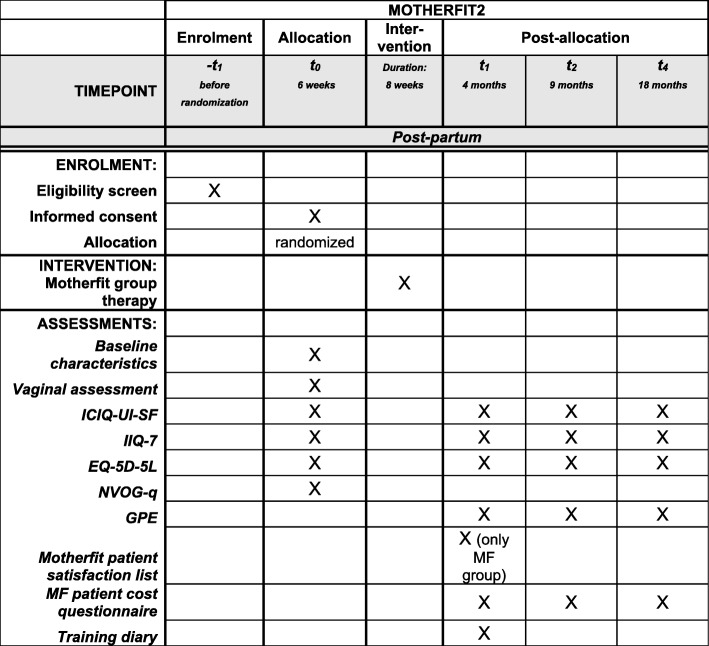
Two multi-centred, randomised controlled trials (MOTHERFIT1, n = 150, MOTHERFIT2, n = 90) will be performed. Participants will be recruited by their midwife or gynaecologist during their routine check. Participants with SUI will receive either motherfit group therapy or CAU. Motherfit group therapy consists of eight group sessions of 60 min each, instructed and supervised by a registered pelvic physiotherapist. Motherfit group therapy includes instructions on pelvic floor anatomy and how to contract, relax and train the pelvic-floor muscles correctly and is combined with general physical exercises. Adherence during and after motherfit will be stimulated by reinforcement techniques and a mobile app. The primary outcome measure is the absence of self-reported SUI based on the severity sum score of the International Consultation on Incontinence Questionnaire Short Form (ICIQ-UI-SF) at 18 months post-partum. Secondary outcomes evaluate quality of life, subjective improvement and health care costs.

DISCUSSION

The motherfit studies are, to our knowledge, the first studies that evaluate both long-term results and health care costs compared to CAU in pregnant and post-partum women with SUI. If motherfit is shown to be (cost-)effective, implementation in peri-partum care should be considered.

TRIAL REGISTRATION

Netherlands Trial Register, ID: NL5816 . Registered on 18 July 2016.

摘要

背景

压力性尿失禁(SUI)在妊娠和分娩后非常普遍。它通常与盆底功能障碍、括约肌和/或支持系统有关。围产期盆底肌训练(PFMT)已被证明在产后 1 年内有效;然而,其长期效果尚不清楚。由物理治疗师进行的小组 PFMT 已被证明与个体治疗同样有效。Motherfit 是一种强调盆底运动、坚持和一般健康的小组-PFMT 治疗方法。如果遵循指南,常规护理(CAU)应将 PFMT 作为首选治疗方案。鉴于医疗保健成本的上升,具有成本效益的策略具有重要意义。Motherfit 小组治疗有可能对尿失禁女性具有成本效益。因此,目前两项研究的目的是:(1)比较产前(MOTHERFIT1)或产后(MOTHERFIT2)密集、监督的盆底肌肉小组治疗与 CAU 相比,是否能降低产后 18 个月时 SUI 的严重程度;(2)比较 Motherfit1 或 Motherfit2 是否比 CAU 更具(成本)效益。

方法

将进行两项多中心、随机对照试验(MOTHERFIT1,n=150,MOTHERFIT2,n=90)。参与者将由他们的助产士或妇科医生在常规检查期间招募。患有 SUI 的参与者将接受 Motherfit 小组治疗或 CAU。Motherfit 小组治疗包括八节 60 分钟的小组课程,由注册的盆底物理治疗师指导和监督。Motherfit 小组治疗包括盆底解剖学的说明以及如何正确收缩、放松和训练盆底肌肉,并结合一般体育锻炼。通过强化技术和移动应用程序来促进 Motherfit 期间和之后的依从性。主要结局测量指标是产后 18 个月时根据国际尿失禁咨询问卷短表(ICIQ-UI-SF)严重程度总和评分评估的自我报告 SUI 缺失。次要结局评估生活质量、主观改善和医疗保健成本。

讨论

据我们所知,Motherfit 研究是首次在患有 SUI 的孕妇和产后妇女中评估与 CAU 相比的长期结果和医疗保健成本的研究。如果 Motherfit 被证明具有(成本)效益,应考虑在围产期护理中实施。

试验注册

荷兰试验注册处,ID:NL5816。于 2016 年 7 月 18 日注册。

https://cdn.ncbi.nlm.nih.gov/pmc/blobs/5a7d/6485130/4f3487569322/13063_2019_3331_Fig3_HTML.jpg
https://cdn.ncbi.nlm.nih.gov/pmc/blobs/5a7d/6485130/8f5fd8d005d0/13063_2019_3331_Fig1_HTML.jpg
https://cdn.ncbi.nlm.nih.gov/pmc/blobs/5a7d/6485130/7f16e6c1194b/13063_2019_3331_Fig2_HTML.jpg
https://cdn.ncbi.nlm.nih.gov/pmc/blobs/5a7d/6485130/4f3487569322/13063_2019_3331_Fig3_HTML.jpg
https://cdn.ncbi.nlm.nih.gov/pmc/blobs/5a7d/6485130/8f5fd8d005d0/13063_2019_3331_Fig1_HTML.jpg
https://cdn.ncbi.nlm.nih.gov/pmc/blobs/5a7d/6485130/7f16e6c1194b/13063_2019_3331_Fig2_HTML.jpg
https://cdn.ncbi.nlm.nih.gov/pmc/blobs/5a7d/6485130/4f3487569322/13063_2019_3331_Fig3_HTML.jpg

相似文献

1
Long-term effects of motherfit group therapy in pre-(MOTHERFIT1) and post-partum women (MOTHERFIT2) with stress urinary incontinence compared to care-as-usual: study protocol of two multi-centred, randomised controlled trials.母亲健身小组治疗对有压力性尿失禁的产前(母亲健身 1 期)和产后女性(母亲健身 2 期)的长期影响与常规护理相比:两项多中心、随机对照试验的研究方案。
Trials. 2019 Apr 25;20(1):237. doi: 10.1186/s13063-019-3331-6.
2
Pelvic floor muscle training for prevention and treatment of urinary and faecal incontinence in antenatal and postnatal women.盆底肌肉训练用于预防和治疗产前及产后女性的尿失禁和粪失禁。
Cochrane Database Syst Rev. 2008 Oct 8(4):CD007471. doi: 10.1002/14651858.CD007471.
3
Efficacy of supervised pelvic floor muscle training with a home-based biofeedback device for urinary incontinence in postpartum women: protocol for a multicentre randomised controlled trial.监督式盆底肌肉训练联合家庭生物反馈治疗产后女性压力性尿失禁的疗效:一项多中心随机对照试验方案。
BMJ Open. 2023 Apr 25;13(4):e069874. doi: 10.1136/bmjopen-2022-069874.
4
Basic versus biofeedback-mediated intensive pelvic floor muscle training for women with urinary incontinence: the OPAL RCT.基础与生物反馈介导的强化盆底肌训练治疗女性尿失禁:OPAL RCT 研究。
Health Technol Assess. 2020 Dec;24(70):1-144. doi: 10.3310/hta24700.
5
Mobile app for treatment of stress urinary incontinence: A randomized controlled trial.用于治疗压力性尿失禁的移动应用程序:一项随机对照试验。
Neurourol Urodyn. 2017 Jun;36(5):1369-1376. doi: 10.1002/nau.23116. Epub 2016 Sep 9.
6
Pelvic floor muscle training for prevention and treatment of urinary and faecal incontinence in antenatal and postnatal women.盆底肌训练用于预防和治疗产前及产后女性的尿失禁和大便失禁。
Cochrane Database Syst Rev. 2012 Oct 17;10:CD007471. doi: 10.1002/14651858.CD007471.pub2.
7
Pelvic floor muscle training added to another active treatment versus the same active treatment alone for urinary incontinence in women.对于女性尿失禁,盆底肌训练联合另一种积极治疗与单纯采用同一种积极治疗的比较。
Cochrane Database Syst Rev. 2013 Nov 20(11):CD010551. doi: 10.1002/14651858.CD010551.pub2.
8
Pelvic floor muscle training for preventing and treating urinary and faecal incontinence in antenatal and postnatal women.盆底肌训练预防和治疗产前及产后女性的尿失禁和粪失禁
Cochrane Database Syst Rev. 2020 May 6;5(5):CD007471. doi: 10.1002/14651858.CD007471.pub4.
9
Internet-based treatment of stress urinary incontinence: 1- and 2-year results of a randomized controlled trial with a focus on pelvic floor muscle training.基于互联网的压力性尿失禁治疗:一项聚焦盆底肌训练的随机对照试验的1年和2年结果
BJU Int. 2015 Dec;116(6):955-64. doi: 10.1111/bju.13091. Epub 2015 Jun 3.
10
Pelvic floor muscle training for prevention and treatment of urinary and faecal incontinence in antenatal and postnatal women.盆底肌训练用于预防和治疗产前及产后女性的尿失禁和粪失禁。
Cochrane Database Syst Rev. 2017 Dec 22;12(12):CD007471. doi: 10.1002/14651858.CD007471.pub3.

引用本文的文献

1
Digital Technologies for Women's Pelvic Floor Muscle Training to Manage Urinary Incontinence Across Their Life Course: Scoping Review.数字技术在女性盆底肌训练中的应用,以管理其整个生命周期中的尿失禁:范围综述。
JMIR Mhealth Uhealth. 2023 Jul 5;11:e44929. doi: 10.2196/44929.
2
An Study on Extracellular Vesicles From Adipose-Derived Mesenchymal Stem Cells in Protecting Stress Urinary Incontinence Through MicroRNA-93/F3 Axis.脂肪间充质干细胞外泌体通过 microRNA-93/F3 轴在保护应激性尿失禁中的研究。
Front Endocrinol (Lausanne). 2021 Aug 16;12:693977. doi: 10.3389/fendo.2021.693977. eCollection 2021.
3
Pelvic floor muscle training for preventing and treating urinary and faecal incontinence in antenatal and postnatal women.

本文引用的文献

1
An ideal e-health system for pelvic floor muscle training adherence: Systematic review.理想的盆底肌训练依从性电子健康系统:系统评价。
Neurourol Urodyn. 2019 Jan;38(1):63-80. doi: 10.1002/nau.23835. Epub 2018 Oct 30.
2
Pelvic floor muscle training in groups versus individual or home treatment of women with urinary incontinence: systematic review and meta-analysis.尿失禁女性的盆底肌肉训练:小组训练与个体训练或家庭治疗的比较:系统评价与荟萃分析
Int Urogynecol J. 2017 Mar;28(3):351-359. doi: 10.1007/s00192-016-3133-2. Epub 2016 Sep 9.
3
Dutch Tariff for the Five-Level Version of EQ-5D.
盆底肌训练预防和治疗产前及产后女性的尿失禁和粪失禁
Cochrane Database Syst Rev. 2020 May 6;5(5):CD007471. doi: 10.1002/14651858.CD007471.pub4.
EQ-5D五级版本的荷兰关税。
Value Health. 2016 Jun;19(4):343-52. doi: 10.1016/j.jval.2016.01.003. Epub 2016 Mar 30.
4
Pelvic-Floor-Muscle Training Adherence: Tools, Measurements and Strategies-2011 ICS State-of-the-Science Seminar Research Paper II of IV.盆底肌训练依从性:工具、测量方法与策略——2011年国际尿控学会科学现状研讨会研究论文四篇之二。
Neurourol Urodyn. 2015 Sep;34(7):615-21. doi: 10.1002/nau.22794. Epub 2015 May 21.
5
Urinary incontinence persisting after childbirth: extent, delivery history, and effects in a 12-year longitudinal cohort study.产后持续性尿失禁:一项 12 年纵向队列研究中的程度、分娩史和影响。
BJOG. 2016 May;123(6):1022-9. doi: 10.1111/1471-0528.13395. Epub 2015 Apr 2.
6
Prevalence of female urinary incontinence and its impact on quality of life in a cluster population in the United Kingdom (UK): a community survey.英国一组人群中女性尿失禁的患病率及其对生活质量的影响:一项社区调查。
Prim Health Care Res Dev. 2015 Jul;16(4):377-82. doi: 10.1017/S1463423614000371. Epub 2014 Oct 2.
7
ICIQ symptom and quality of life instruments measure clinically relevant improvements in women with stress urinary incontinence.ICIQ症状与生活质量评估工具可衡量压力性尿失禁女性临床上的相关改善情况。
Neurourol Urodyn. 2015 Nov;34(8):747-51. doi: 10.1002/nau.22657. Epub 2014 Aug 22.
8
Consultation about urinary and faecal incontinence in the year after childbirth: a cohort study.产后一年咨询尿失禁和粪便失禁:队列研究。
BJOG. 2015 Jun;122(7):954-62. doi: 10.1111/1471-0528.12963. Epub 2014 Jul 9.
9
Budget impact analysis-principles of good practice: report of the ISPOR 2012 Budget Impact Analysis Good Practice II Task Force.预算影响分析——良好实践原则:ISPOR 2012 预算影响分析良好实践 II 工作组报告。
Value Health. 2014 Jan-Feb;17(1):5-14. doi: 10.1016/j.jval.2013.08.2291. Epub 2013 Dec 13.
10
Validation of use of the International Consultation on Incontinence Questionnaire-Urinary Incontinence-Short Form (ICIQ-UI-SF) for impairment rating: a transversal retrospective study of 120 patients.国际尿失禁咨询问卷-尿失禁简短问卷(ICIQ-UI-SF)用于损伤评定的有效性验证:120 例患者的横断面回顾性研究。
Neurourol Urodyn. 2013 Sep;32(7):974-9. doi: 10.1002/nau.22363. Epub 2012 Dec 31.