Olsson Ola, Nuñez-Iturri Gabriela, Smith Henrik G, Ottosson Ulf, Effiom Edu O
Department of Biology, Biodiversity Unit, Lund University, Ecology Building, Lund, Sweden.
Herbario MOL de la Facultad de Ciencias Forestales, Universidad Nacional Agraria La Molina, Lima, Peru.
AoB Plants. 2019 Mar 28;11(2):plz018. doi: 10.1093/aobpla/plz018. eCollection 2019 Apr.
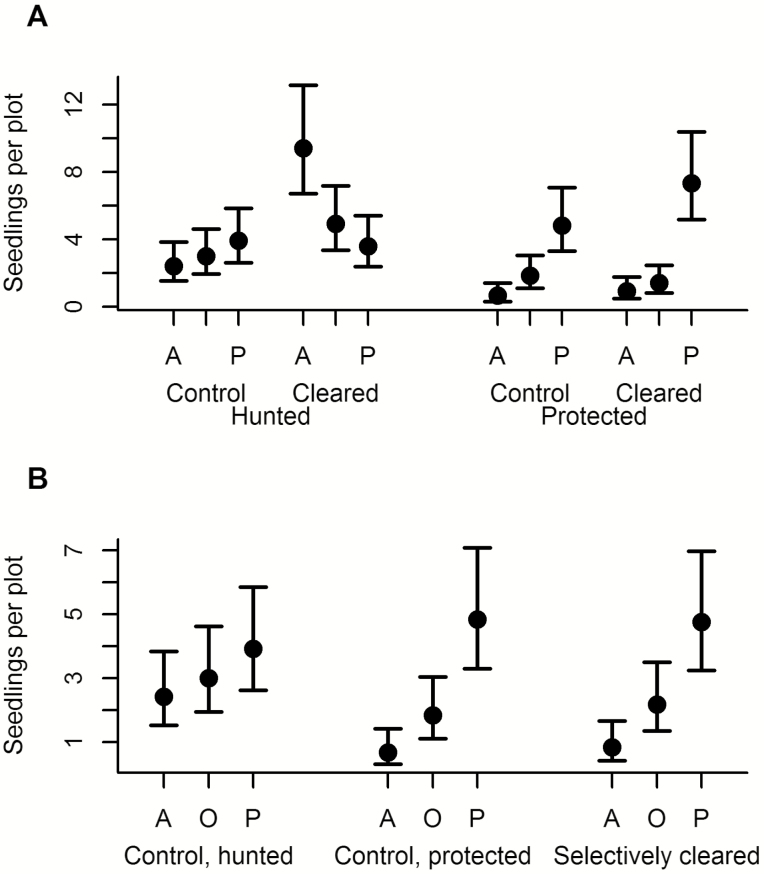
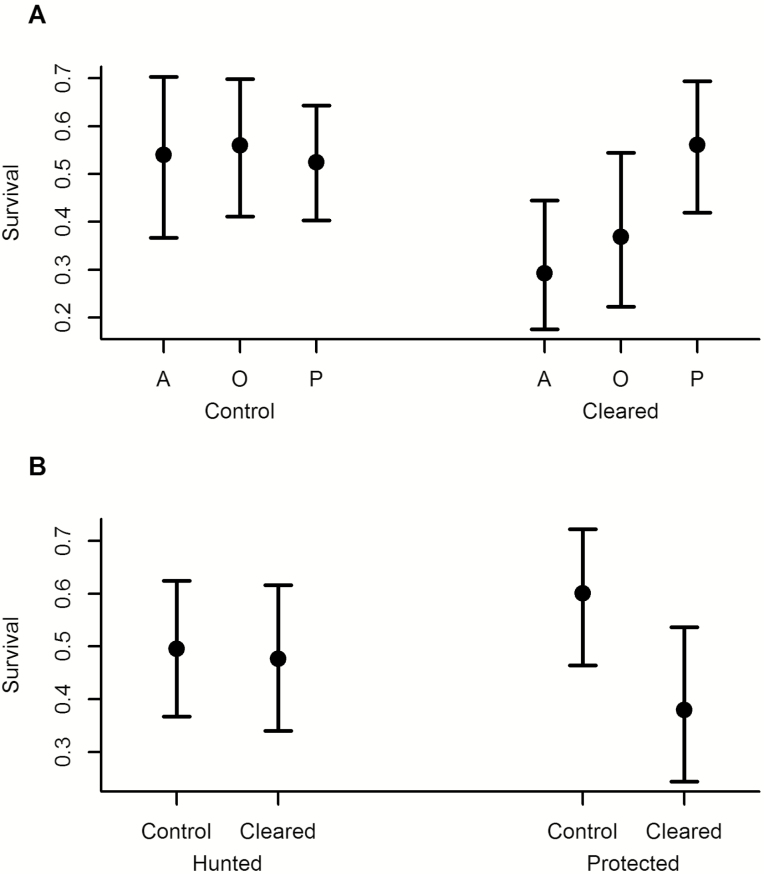
Disentangling the contributions of different processes that influence plant recruitment, such as competition and seed dispersal, is important given the increased human-mediated changes in tropical forest ecosystems. Previous studies have shown that seedling communities in an Afrotropical rainforest in southeastern Nigeria are strongly affected by the loss of important seed-dispersing primates, including Cross River gorillas (), chimpanzee () and drill (). Here we study how germination and survival of tree seedlings are affected by competition and reduced seed dispersal in three contiguous forest reserves, in southeastern Nigeria, with similar mature tree species composition and structure. We use an experimental design aimed at manipulating the effect of competition among seedlings in three protected and three hunted sites within the reserves. We use a total of sixty 5 × 5 m plots of three types: plots cleared of all seedlings, plots selectively cleared of all primate-dispersed seedlings and control plots. All seedlings were identified, measured, assigned to dispersal mode and tagged, and after 1 year we evaluated survival, mortality and new recruits. We found that in hunted sites germination of abiotically dispersed species was over four times higher in cleared plots compared to control plots, whereas germination of primate-dispersed species was the same, which indicated that dispersal limitation was the dominant force in seedling recruitment in hunted sites. This was supported by the fact that the germination of all dispersal modes in the selectively cleared plots in protected sites was similar to the control plots in the same sites, but germination of abiotically dispersed species was significantly lower than in cleared plots in hunted sites. Competition among seedlings was mostly evident from the fact that 75 % more seedlings of primate-dispersed species germinated in cleared compared to control plots in protected sites. We conclude that inter-seedling competition may be irrelevant to seedling recruitment in hunted sites, where dispersal limitation appears to be a much stronger force shaping the seedling plant community, and thus hunting indirectly reverses the importance of competition and dispersal limitation in structuring seedling communities.
鉴于热带森林生态系统中人为介导的变化日益增加,厘清影响植物更新的不同过程(如竞争和种子传播)所起的作用至关重要。此前的研究表明,尼日利亚东南部一片非洲热带雨林中的幼苗群落受到重要种子传播灵长类动物消失的强烈影响,这些灵长类动物包括克罗斯河大猩猩()、黑猩猩()和西非黑白疣猴()。在此,我们研究了尼日利亚东南部三个相邻森林保护区内,竞争和种子传播减少如何影响树木幼苗的萌发和存活,这三个保护区具有相似的成熟树种组成和结构。我们采用了一种实验设计,旨在操控保护区内三个受保护地点和三个狩猎地点幼苗之间的竞争效应。我们总共使用了60个5×5米的样地,分为三种类型:清除所有幼苗的样地、选择性清除所有灵长类动物传播的幼苗的样地和对照样地。所有幼苗都进行了识别、测量、确定传播方式并标记,1年后我们评估了存活率、死亡率和新幼苗数量。我们发现,在狩猎地点,与对照样地相比,清除样地中非生物传播物种的萌发率高出四倍多,而灵长类动物传播物种的萌发率相同,这表明传播限制是狩猎地点幼苗更新的主导力量。这一观点得到了以下事实的支持:在受保护地点的选择性清除样地中,所有传播方式的萌发率与同地点的对照样地相似,但非生物传播物种的萌发率显著低于狩猎地点的清除样地。幼苗之间的竞争主要体现在以下事实上:在受保护地点,与对照样地相比,清除样地中灵长类动物传播物种的幼苗萌发率高出75%。我们得出结论,在狩猎地点,幼苗间竞争可能与幼苗更新无关,在这些地方,传播限制似乎是塑造幼苗植物群落的更强有力因素,因此狩猎间接颠倒了竞争和传播限制在构建幼苗群落中的重要性。