Xu Yanqing, Sajja Mounika, Kumar Ashok
Department of Geography and Planning, The University of Toledo, Toledo, OH, United States.
Department of Civil and Environmental Engineering, The University of Toledo, Toledo, OH, United States.
Front Public Health. 2019 Apr 10;7:76. doi: 10.3389/fpubh.2019.00076. eCollection 2019.
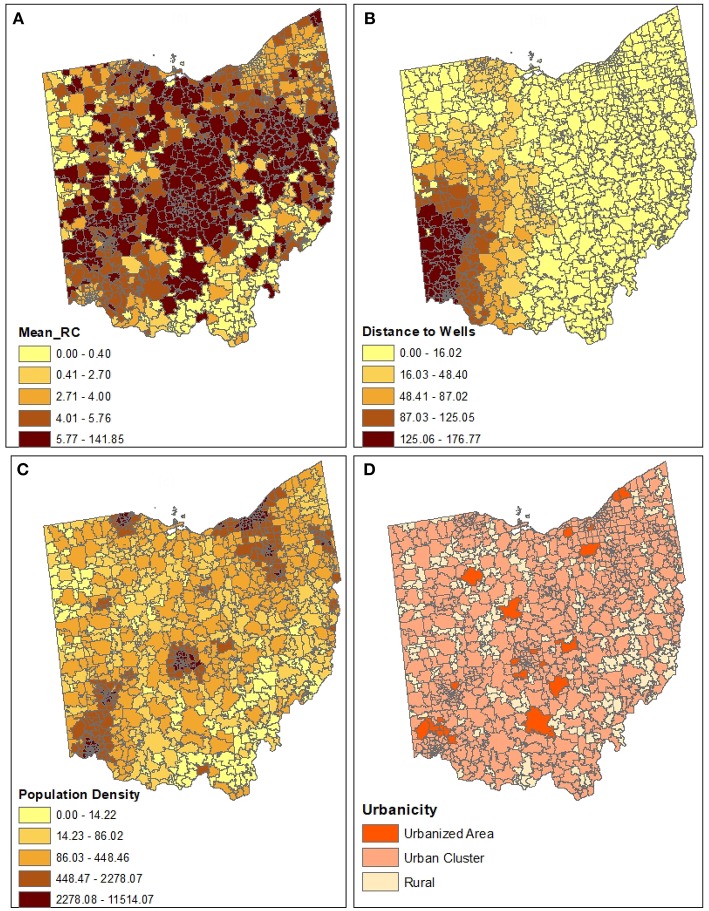
According to the United States Environmental Protection Agency (U.S. EPA), exposure to radon gas is the second leading cause of lung cancer after smoking. Extant research that has reported that fracking activity increases the radon levels. "Fracking" also known as hydraulic fracturing, which is a technology that is used to extract naturally occurring shale gas from the Marcellus and the Utica shales. Based on the data from the Ohio Radon Information System (ORIS) from 2007 to 2014 in Ohio, this research uses multilevel modeling (MLM) to examine the association between the incidences of hydraulic fracturing and elevated airborne radon levels. The ORIS data include information on 118,421 individual records of households geocoded to zip code areas. Individual records include radon concentrations, device types of the test, and seasons. Euclidean distances between zip code centroid to the 1,162 fracking wells are measured at the zip code level. Two additional zip code variables, namely the population density and urbanicity, are also included as control variables. Multilevel modeling results show that at the zip code level, distance to fracking wells and population density are significant and negative covariate of the radon concentration. By comparing with urban areas, urban clusters, and rural areas are significant which linked to higher radon concentrations. These findings lend support to the effect of hydraulic fracturing in influencing radon concentrations, and promote public policies that need to be geographically adaptable.
根据美国环境保护局(U.S. EPA)的数据,接触氡气是仅次于吸烟的第二大肺癌致病因素。现有研究表明,水力压裂活动会提高氡气水平。“水力压裂”也被称为水压致裂法,是一种用于从马塞勒斯页岩层和尤蒂卡页岩层中提取天然页岩气的技术。基于俄亥俄州2007年至2014年的俄亥俄氡气信息系统(ORIS)的数据,本研究采用多层建模(MLM)来检验水力压裂发生率与空气中氡气水平升高之间的关联。ORIS数据包含118421条家庭个体记录的信息,这些记录按邮政编码区域进行了地理编码。个体记录包括氡气浓度、测试设备类型和季节。在邮政编码层面测量了邮政编码中心点到1162口水力压裂井的欧几里得距离。另外两个邮政编码变量,即人口密度和城市化程度,也作为控制变量纳入。多层建模结果表明,在邮政编码层面,到水力压裂井的距离和人口密度是氡气浓度的显著负协变量。与城市地区相比,城市集群和农村地区与较高的氡气浓度存在显著关联。这些发现支持了水力压裂对氡气浓度的影响,并推动了需要因地制宜的公共政策。