Poli Emiliano, Elliott Joshua D, Chulkov Sergey K, Watkins Matthew B, Teobaldi Gilberto
The Abdus Salam Center for Theoretical Physics, Condensed Matter and Statistical Physics Department, Trieste, Italy.
Dipartimento di Fisica e Astronomia "Galileo Galilei", Università degli Studi di Padova, Padova, Italy.
Front Chem. 2019 Apr 10;7:210. doi: 10.3389/fchem.2019.00210. eCollection 2019.
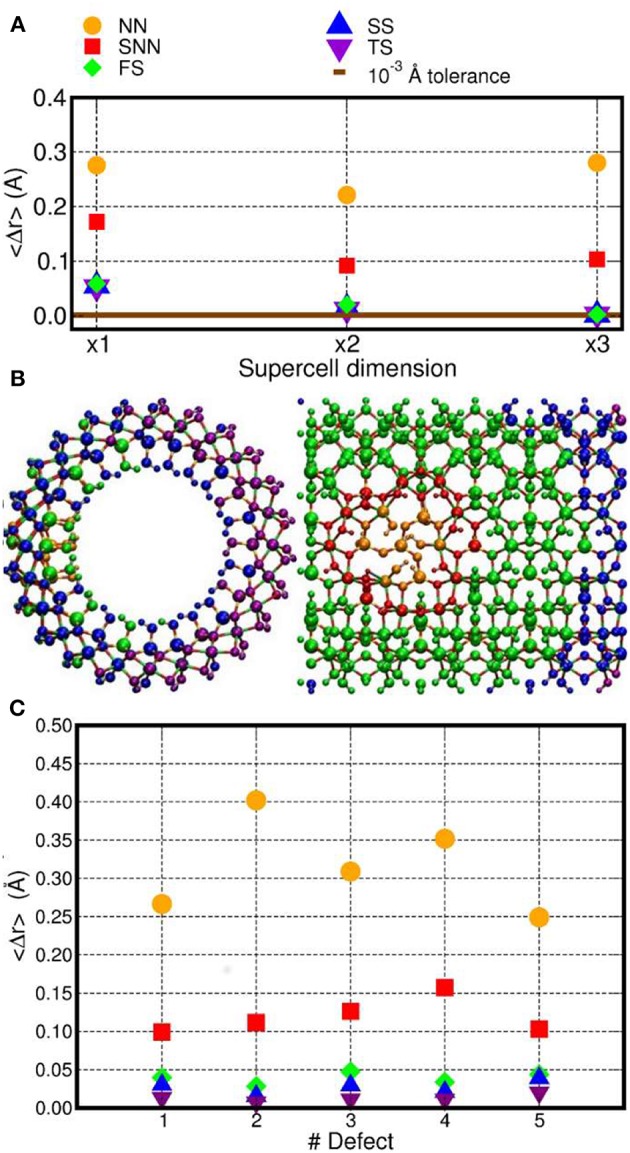
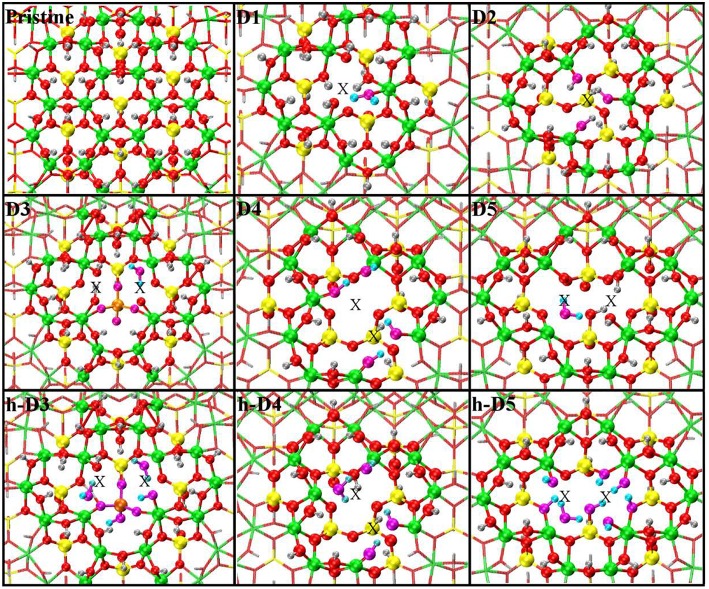
We report a combined non-local (PBE-TC-LRC) Density Functional Theory (DFT) and linear-response time-dependent DFT (LR-TDDFT) study of the structural, electronic, and optical properties of the cation-vacancy based defects in aluminosilicate (AlSi) imogolite nanotubes (Imo-NTs) that have been recently proposed on the basis of Nuclear Magnetic Resonance (NMR) experiments. Following numerical determination of the smallest AlSi Imo-NT model capable of accommodating the defect-induced relaxation with negligible finite-size errors, we analyse the defect-induced structural deformations in the NTs and ensuing changes in the NTs' electronic structure. The NMR-derived defects are found to introduce both shallow and deep occupied states in the pristine NTs' band gap (BG). These BG states are found to be highly localized at the defect site. No empty defect-state is modeled for any of the considered systems. LR-TDDFT simulation of the defects reveal increased low-energy optical absorbance for all but one defects, with the appearance of optically active excitations at energies lower than for the defect-free NT. These results enable interpretation of the low-energy tail in the experimental UV-vis spectra for AlSi NTs as being due to the defects. Finally, the PBE-TC-LRC-approximated exciton binding energy for the defects' optical transitions is found to be substantially lower (up to 0.8 eV) than for the pristine defect-free NT's excitations (1.1 eV).
我们报告了一项结合非局部(PBE-TC-LRC)密度泛函理论(DFT)和线性响应含时密度泛函理论(LR-TDDFT)的研究,该研究针对基于核磁共振(NMR)实验最近提出的硅铝酸盐(AlSi)伊莫石纳米管(Imo-NTs)中基于阳离子空位的缺陷的结构、电子和光学性质。在通过数值确定能够容纳缺陷诱导弛豫且有限尺寸误差可忽略不计的最小AlSi Imo-NT模型后,我们分析了纳米管中缺陷诱导的结构变形以及纳米管电子结构随之发生的变化。发现源自NMR的缺陷在原始纳米管的带隙(BG)中引入了浅的和深的占据态。这些BG态在缺陷位置高度局域化。对于所有考虑的系统,均未模拟出空的缺陷态。对缺陷的LR-TDDFT模拟表明,除一个缺陷外,所有缺陷的低能光吸收均增加,且在低于无缺陷纳米管的能量处出现光学活性激发。这些结果使得能够将AlSi纳米管实验紫外可见光谱中的低能尾部解释为是由缺陷引起的。最后,发现缺陷的光学跃迁的PBE-TC-LRC近似激子结合能比原始无缺陷纳米管的激发(1.1 eV)显著更低(高达0.8 eV)。