Sromek Ludmila, Forcioli Didier, Lasota Rafal, Furla Paola, Wolowicz Maciej
Department of Marine Ecosystems Functioning, Institute of Oceanography, Faculty of Oceanography and Geography University of Gdansk Gdynia Poland.
UPMC Université Paris 06, Université Antilles, Université Nice Sophia Antipolis, CNRS, Laboratoire Evolution Paris Seine, Institut de Biologie Paris Seine (EPS-IBPS) Sorbonne Universités Paris France.
Ecol Evol. 2019 Mar 27;9(8):4667-4682. doi: 10.1002/ece3.5070. eCollection 2019 Apr.
Coastal lagoons form an intriguing example of fragmented marine habitats. Restricted gene flow among isolated populations of lagoon species may promote their genetic divergence and may thus provide a first step toward speciation. In the present study, the population genetic structure of the lagoon cockle has been investigated to clarify the complex phylogeographic pattern found in previous studies, to localize major genetic breaks, and to discuss their origin and maintenance.
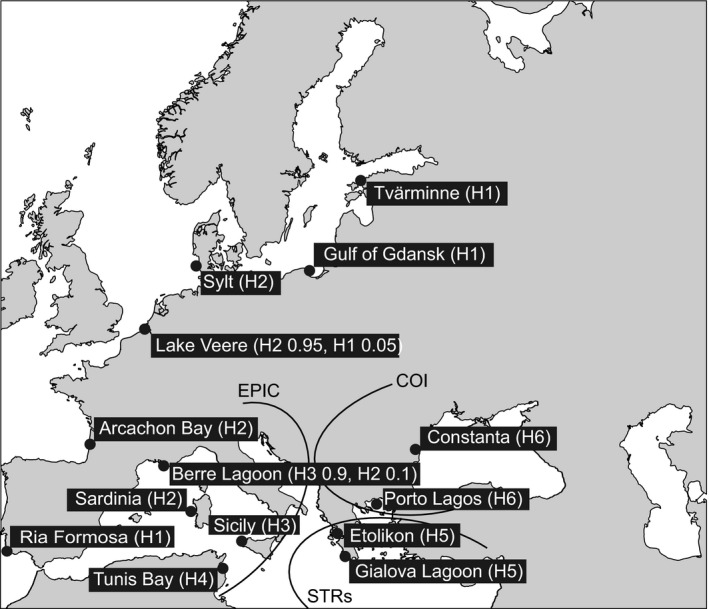
The Atlantic and Mediterranean coasts, including the Baltic, North Sea, and Black Sea.
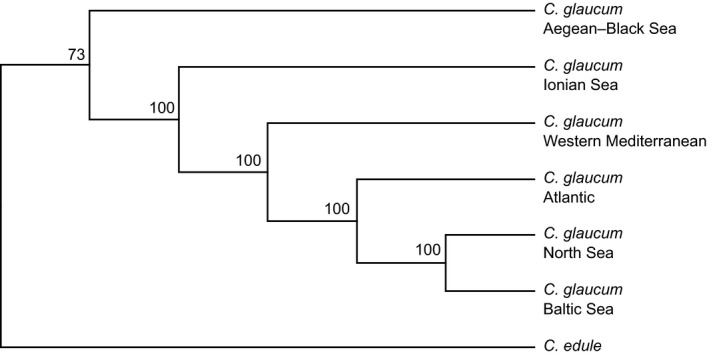
A total of 204 individuals from 14 populations were genotyped using restriction site-associated DNA sequencing (RADseq). The genetic diversity, divergence, and structure were analyzed using genome-wide single nucleotide polymorphisms (SNPs). Phylogenetic relationships were inferred under a coalescent model using svdquartets.
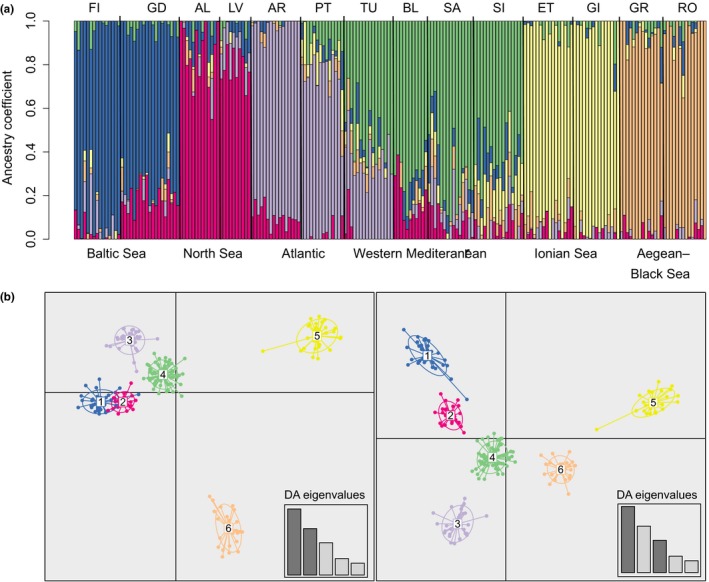
The RADseq approach allowed inferring phylogeographic relationships with an unprecedented resolution. Three deeply divergent lineages were identified within that are separated by many genetic barriers: one lineage in the Aegean-Black Sea region, one in the Ionian Sea, and the last one widely distributed from the Western Mediterranean to the Baltic Sea. The nested branching pattern displayed on the species tree largely agrees with the likely scenario of postglacial expansion from the Mediterranean to the Baltic Sea.
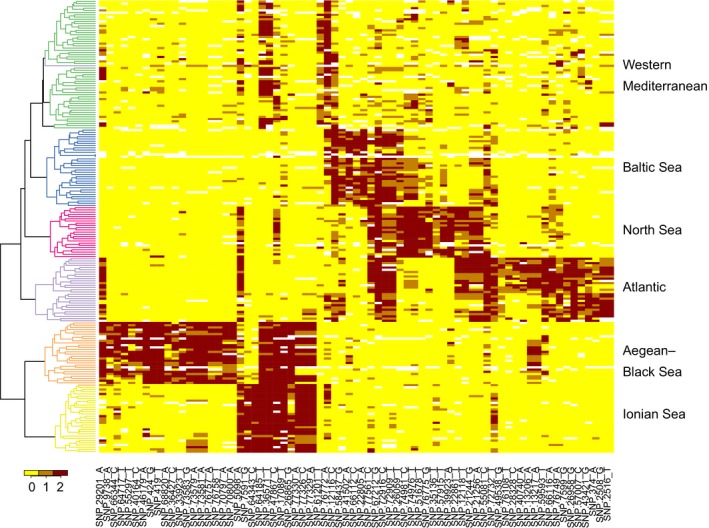
The genetic differentiations between geographically separated lagoons proved to be strong, highlighting the evolutionary influence of these naturally fragmented habitats. The postglacial expansion created complex patterns of spatial segregation of genetic diversity with allele frequency gradients in many outlier loci, but also discrepancies between the nuclear and mitochondrial genetic markers that probably arose from genetic surfing of mitochondrial variation.
沿海泻湖构成了破碎海洋栖息地的一个有趣例子。泻湖物种孤立种群之间有限的基因流动可能会促进它们的遗传分化,从而可能为物种形成迈出第一步。在本研究中,对泻湖蚶的种群遗传结构进行了调查,以阐明先前研究中发现的复杂系统地理格局,确定主要的遗传间断点,并讨论其起源和维持。
大西洋和地中海沿岸,包括波罗的海、北海和黑海。
使用限制性位点关联DNA测序(RADseq)对来自14个种群的204个个体进行基因分型。使用全基因组单核苷酸多态性(SNP)分析遗传多样性、分化和结构。在合并模型下使用svdquartets推断系统发育关系。
RADseq方法能够以前所未有的分辨率推断系统地理关系。在该物种内鉴定出三个深度分化的谱系,它们被许多遗传屏障分隔开:一个谱系在爱琴海-黑海地区,一个在爱奥尼亚海,最后一个从西地中海广泛分布到波罗的海。物种树上显示的嵌套分支模式在很大程度上与从地中海到波罗的海的冰期后扩张的可能情况一致。
地理上分隔的泻湖之间的遗传分化被证明是强烈的,突出了这些自然破碎栖息地的进化影响。冰期后扩张形成了遗传多样性空间隔离的复杂模式,在许多异常位点存在等位基因频率梯度,但核基因和线粒体基因标记之间也存在差异,这可能是由线粒体变异的遗传漂变引起的。