Museo Nacional de Ciencias Naturales-CSIC, Madrid, Spain.
Department of Plant Biology and Ecology, Faculty of Science and Technology, University of the Basque Country (UPV/EHU), Leioa, Spain.
PLoS One. 2019 Apr 29;14(4):e0216090. doi: 10.1371/journal.pone.0216090. eCollection 2019.
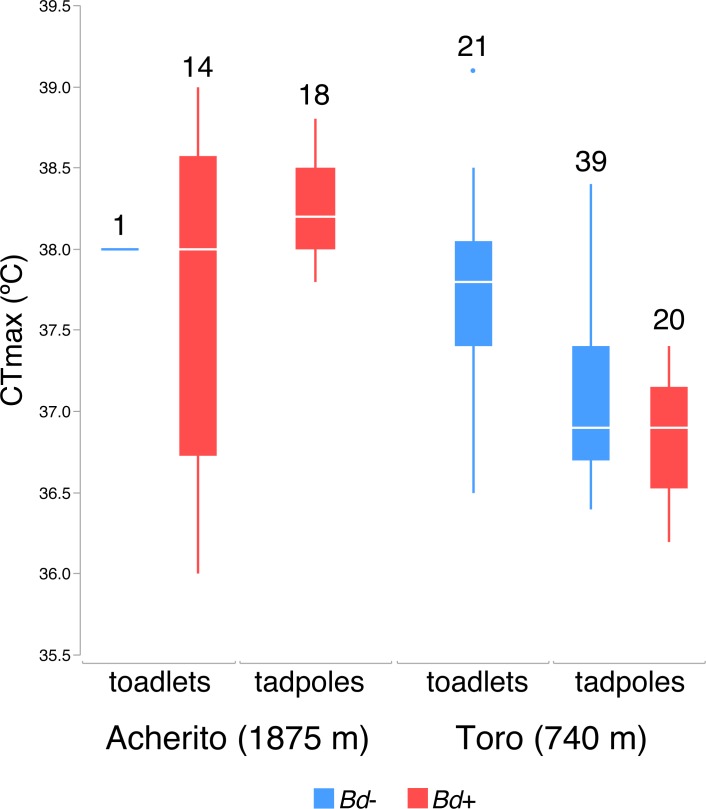
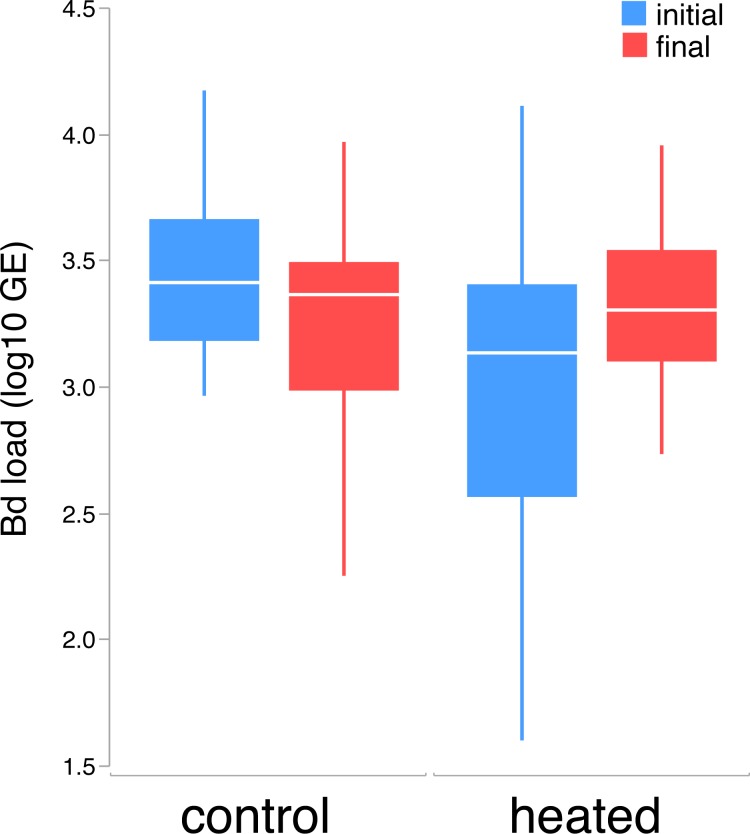
Climate change and infectious disease by the chytrid fungus Batrachochytrium dendrobatidis (Bd) are major drivers of amphibian extinctions, but the potential interactions of these two factors are not fully understood. Temperature is known to influence (1) the infectivity, pathogenicity and virulence of Bd; (2) host-parasite dynamics, especially when both hosts and parasites are ectothermic organisms exhibiting thermal sensitivities that may or may not differ; and (3) amphibian vulnerability to extinction depending on their heat tolerance, which may decrease with infection. Thus, in a global warming scenario, with rising temperatures and more frequent and extreme weather events, amphibians infected by Bd could be expected to be more vulnerable if temperatures approach their critical thermal maximum (CTmax). However, it is also possible that predicted high temperatures could clear the Bd infection, thus enhancing amphibian survival. We tested these hypotheses by measuring CTmax values of Bd-infected and Bd-free aquatic tadpoles and terrestrial toadlets/juveniles of the common midwife toad (Alytes obstetricans) and examining whether exposure of A. obstetricans individuals to peak temperatures reaching their CTmax clears them from Bd infection. We show that (1) Bd has a wide thermal tolerance range; (2) Bd is capable of altering the thermal physiology of A. obstetricans, which is stage-dependent, lowering CTmax in tadpoles but not in toadlets; and (3) Bd infection is not cleared after exposure of tadpoles or toadlets to CTmax. Living under climatic change with rising temperatures, the effect of Bd infection might tip the balance and lead some already threatened amphibian communities towards extinction.
气候变化和蛙壶菌(Batrachochytrium dendrobatidis,Bd)等传染性真菌是导致两栖动物灭绝的主要因素,但这两个因素的潜在相互作用尚未完全了解。众所周知,温度会影响(1)Bd 的感染力、致病性和毒力;(2)宿主-寄生虫动态,特别是当宿主和寄生虫都是表现出可能相同或不同热敏感性的变温动物时;(3)取决于其耐热性的两栖动物对灭绝的脆弱性,而感染可能会降低其耐热性。因此,在全球变暖的情况下,随着温度的升高和更频繁、更极端的天气事件的发生,如果温度接近临界热最大值(CTmax),感染 Bd 的两栖动物可能更容易受到影响。然而,也有可能预测的高温可以清除 Bd 感染,从而提高两栖动物的存活率。我们通过测量受 Bd 感染和未感染的水生蝌蚪以及普通蟾蜍(Alytes obstetricans)的陆生蟾蜍幼体/青少年的 CTmax 值来检验这些假设,并检查 A. obstetricans 个体暴露于达到其 CTmax 的峰值温度是否可以清除 Bd 感染。结果表明:(1)Bd 具有广泛的热耐受范围;(2)Bd 能够改变 A. obstetricans 的热生理特性,这种影响与发育阶段有关,降低了蝌蚪的 CTmax,但对蟾蜍幼体没有影响;(3)Bd 感染在暴露于 CTmax 后不会被清除。在气温升高的气候变化下,Bd 感染的影响可能会打破平衡,导致一些已经受到威胁的两栖动物群落走向灭绝。