School of Marine and Tropical Biology, James Cook University, Townsville, Queensland, Australia.
PLoS One. 2013 Sep 4;8(9):e73830. doi: 10.1371/journal.pone.0073830. eCollection 2013.
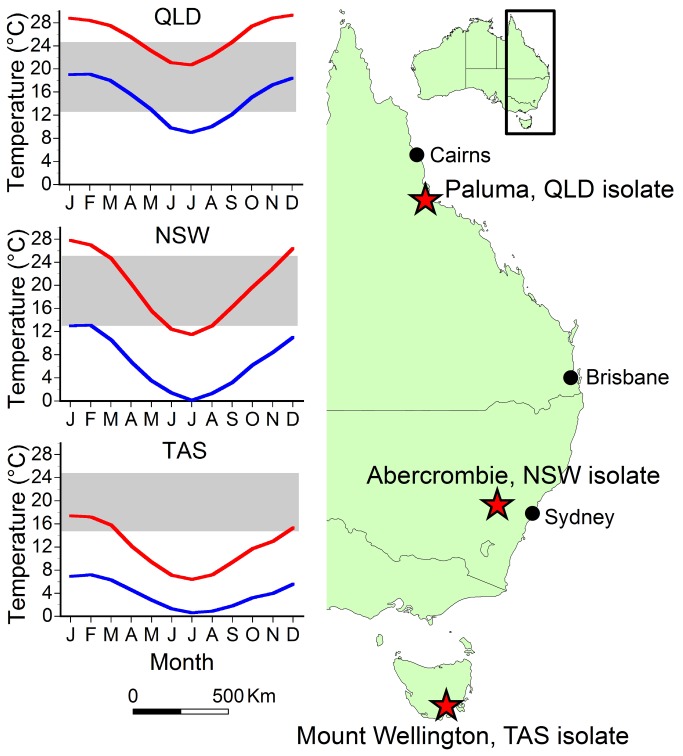
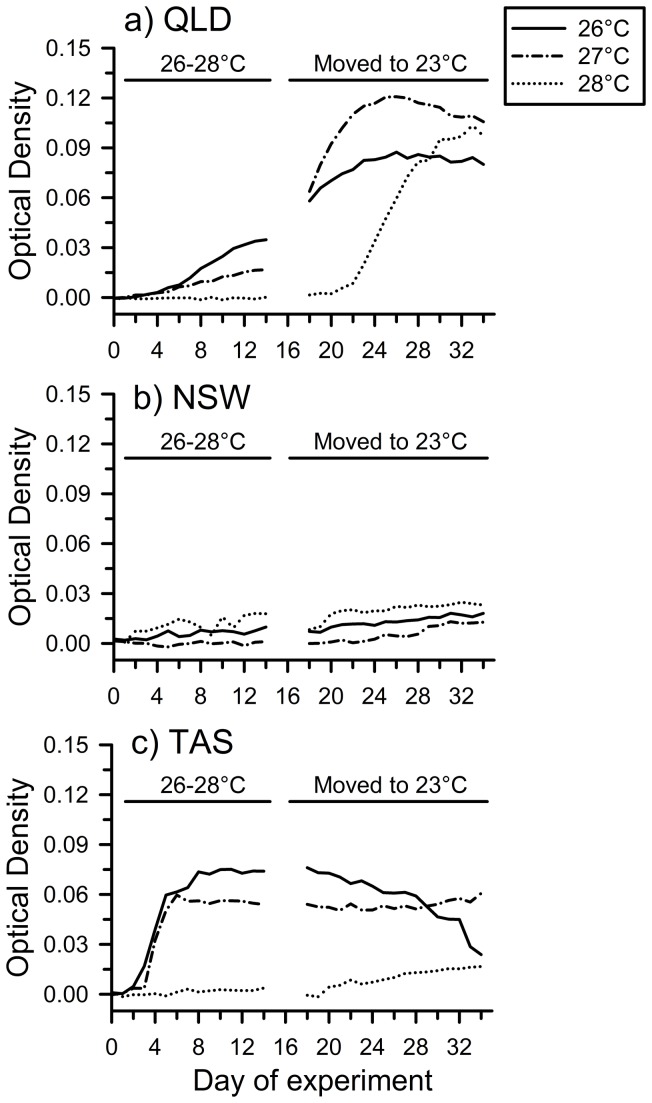
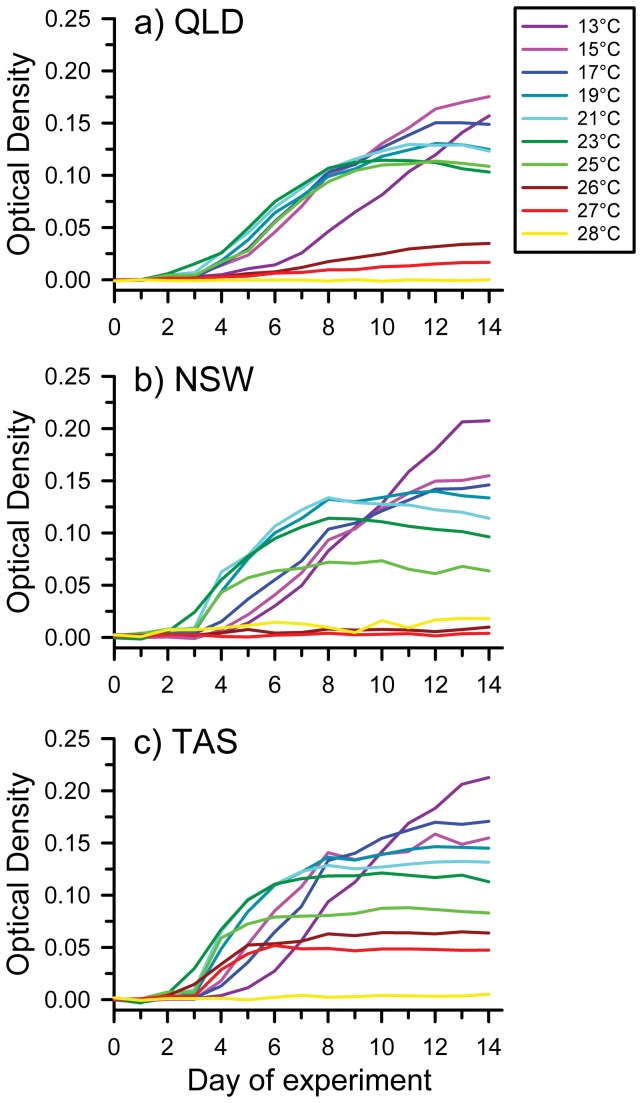
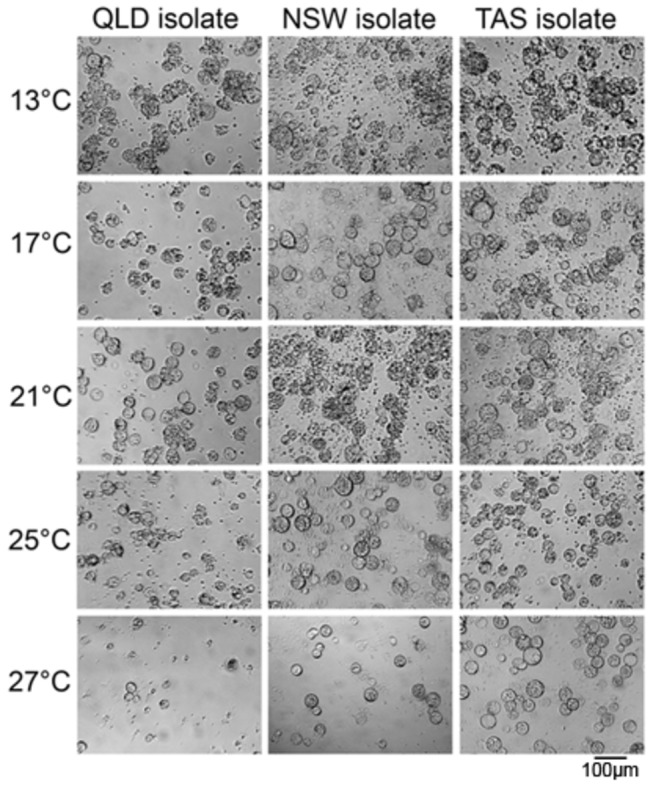
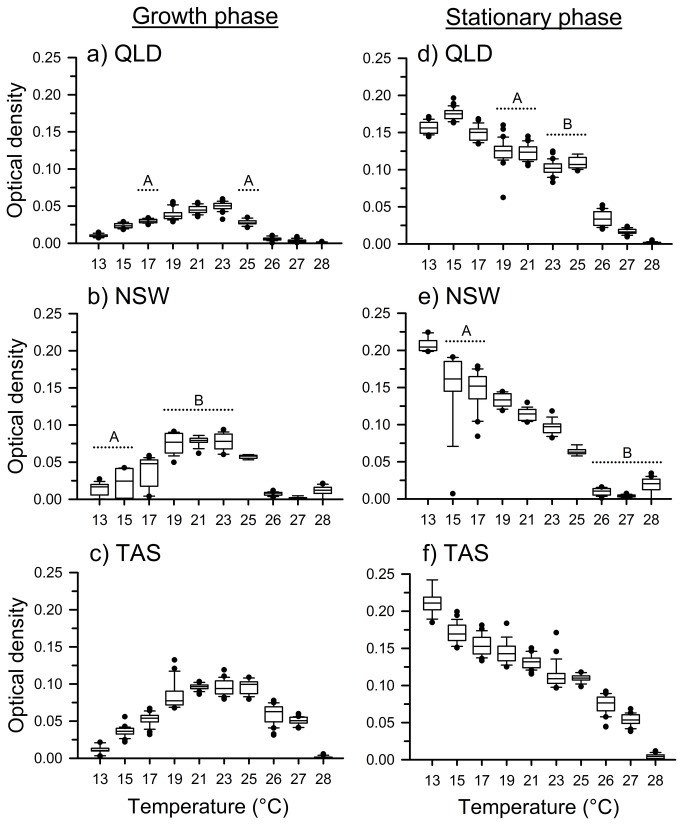
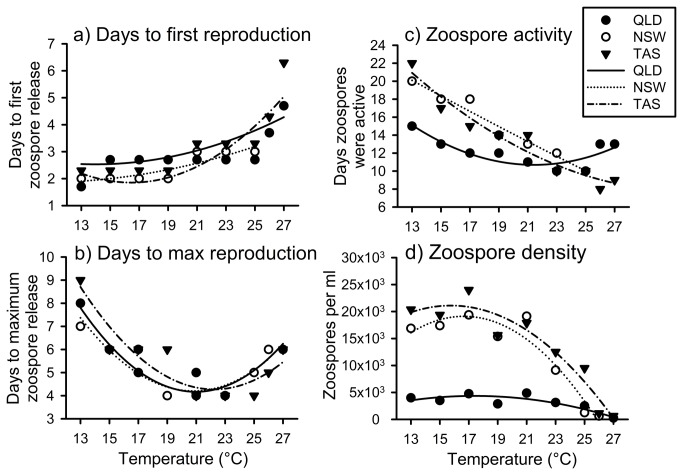
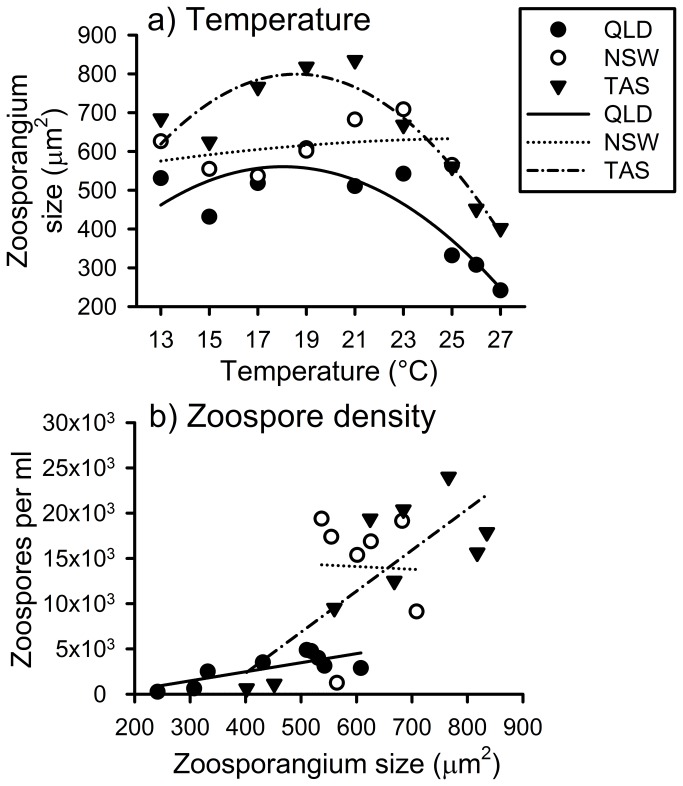
Rates of growth and reproduction of the pathogens that cause emerging infectious diseases can be affected by local environmental conditions; these conditions can thus influence the strength and nature of disease outbreaks. An understanding of these relationships is important for understanding disease ecology and developing mitigation strategies. Widespread emergence of the fungal disease chytridiomycosis has had devastating effects on amphibian populations. The causative pathogen, Batrachochytriumdendrobatidis (Bd), is sensitive to temperature, but its thermal tolerances are not well studied. We examined the thermal responses of three Bd isolates collected across a latitudinal gradient in eastern Australia. Temperature affected all aspects of Bd growth and reproduction that we measured, in ways that often differed among Bd isolates. Aspects of growth, reproduction, and their relationships to temperature that differed among isolates included upper thermal maxima for growth (26, 27, or 28 °C, depending on the isolate), relationships between zoospore production and temperature, and zoospore activity and temperature. Two isolates decreased zoospore production as temperature increased, whereas the third isolate was less fecund overall, but did not show a strong response to temperature until reaching the upper limit of its thermal tolerance. Our results show differentiation in life-history traits among isolates within Australia, suggesting that the pathogen may exhibit local adaptation. An understanding of how environmental temperatures can limit pathogens by constraining fitness will enhance our ability to assess pathogen dynamics in the field, model pathogen spread, and conduct realistic experiments on host susceptibility and disease transmission.
引起新发传染病的病原体的增长率和繁殖率可能受到当地环境条件的影响;这些条件因此可以影响疾病爆发的强度和性质。了解这些关系对于理解疾病生态学和制定缓解策略非常重要。真菌病壶菌病的广泛出现对两栖动物种群造成了毁灭性影响。致病病原体蛙壶菌(Bd)对温度敏感,但对其热耐受性的研究还不够。我们研究了在澳大利亚东部纬度梯度上收集的三个 Bd 分离株的热响应。温度影响了我们测量的 Bd 生长和繁殖的所有方面,这些方面在不同的 Bd 分离株中常常有所不同。生长、繁殖及其与温度的关系在分离株之间存在差异,包括生长的最高温度(取决于分离株,为 26、27 或 28°C)、游动孢子产生与温度的关系,以及游动孢子的活性和温度。两个分离株随着温度的升高而减少游动孢子的产生,而第三个分离株总体上繁殖力较弱,但直到达到热耐受极限时才表现出对温度的强烈反应。我们的结果表明,澳大利亚境内的分离株在生活史特征上存在分化,表明病原体可能表现出局部适应性。了解环境温度如何通过限制适应性来限制病原体,将提高我们在现场评估病原体动态、模拟病原体传播以及进行宿主易感性和疾病传播的现实实验的能力。