Department of Medicine, Division of Pulmonary, Critical Care and Sleep Medicine, New York University, School of Medicine, New York, NY 10016, USA.
Bureau of Health Services and Office of Medical Affairs, Fire Department of New York, Brooklyn, NY 11201, USA.
Int J Environ Res Public Health. 2019 Apr 26;16(9):1486. doi: 10.3390/ijerph16091486.
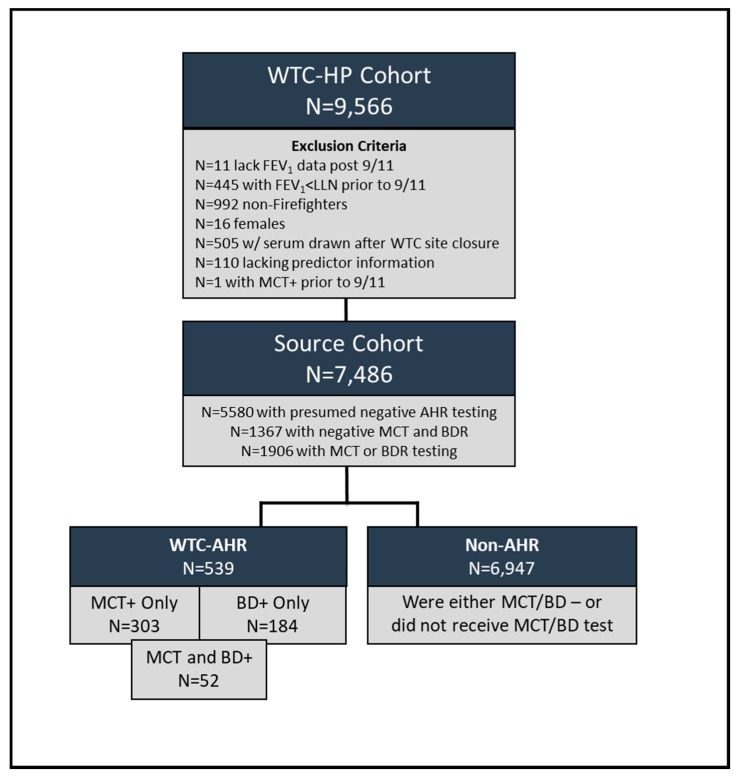
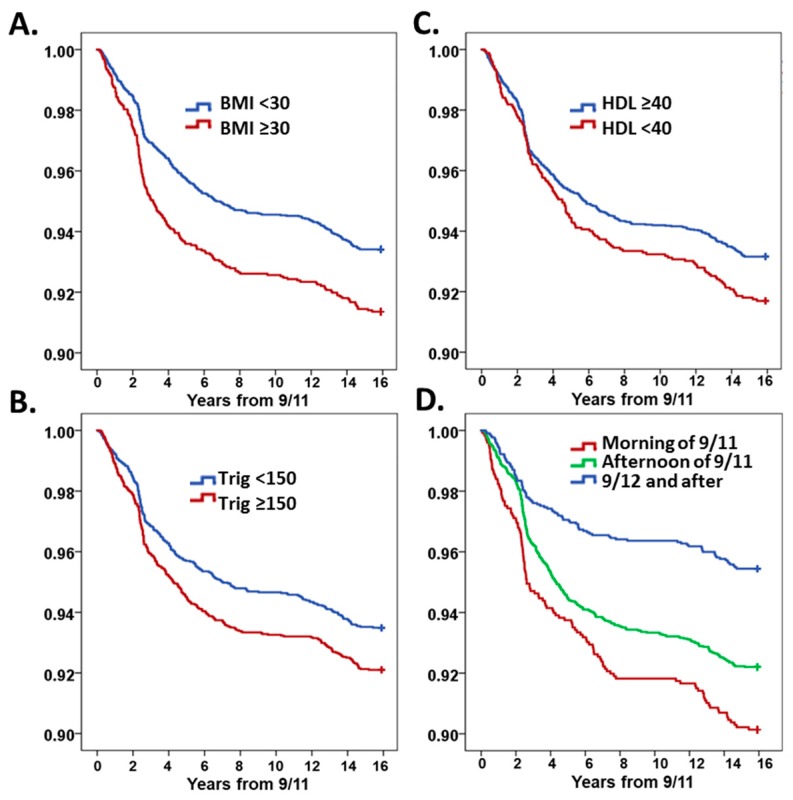
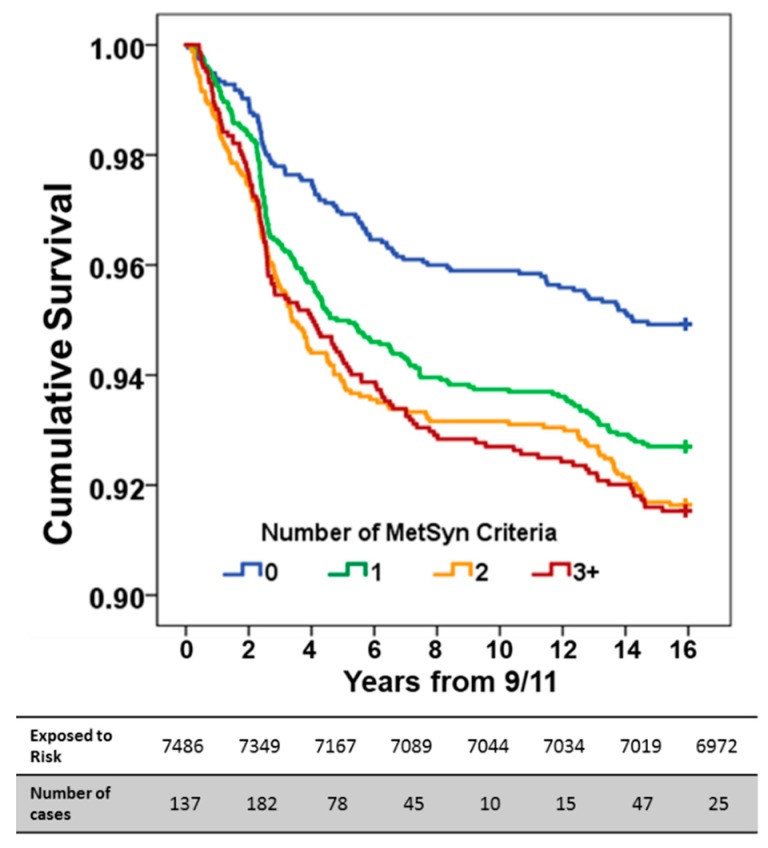
Airway hyperreactivity (AHR) related to environmental exposure is a significant public health risk worldwide. Similarly, metabolic syndrome (MetSyn), a risk factor for obstructive airway disease (OAD) and systemic inflammation, is a significant contributor to global adverse health. This prospective cohort study followed = 7486 World Trade Center (WTC)-exposed male firefighters from 11 September 2001 (9/11) until 1 August 2017 and investigated = 539 with newly developed AHR for clinical biomarkers of MetSyn and compared them to the non-AHR group. Male firefighters with normal lung function and no AHR pre-9/11 who had blood drawn from 9 September 2001-24 July 2002 were assessed. World Trade Center-Airway Hyperreactivity (WTC-AHR) was defined as either a positive bronchodilator response (BDR) or methacholine challenge test (MCT). The electronic medical record (EMR) was queried for their MetSyn characteristics (lipid profile, body mass index (BMI), glucose), and routine clinical biomarkers (such as complete blood counts). We modeled the association of MetSyn characteristics at the first post-9/11 exam with AHR. Those with AHR were significantly more likely to be older, have higher BMIs, have high intensity exposure, and have MetSyn. Smoking history was not associated with WTC-AHR. Those present on the morning of 9/11 had 224% increased risk of developing AHR, and those who arrived in the afternoon of 9/11 had a 75.9% increased risk. Having ≥3 MetSyn parameters increased the risk of WTC-AHR by 65.4%. Co-existing MetSyn and high WTC exposure are predictive of future AHR and suggest that systemic inflammation may be a contributor.
环境暴露相关的气道高反应性(AHR)是全球范围内的重大公共健康风险。同样,代谢综合征(MetSyn)是阻塞性气道疾病(OAD)和全身炎症的危险因素,也是全球不良健康的重要因素。这项前瞻性队列研究跟踪了 7486 名 2001 年 9 月 11 日(9/11)之前在世界贸易中心(WTC)工作的男性消防员,直到 2017 年 8 月 1 日,并调查了 539 名新出现的 AHR 患者,以了解他们的代谢综合征的临床生物标志物,并将其与非 AHR 组进行比较。研究对象为 9/11 前肺功能正常且无 AHR 的男性消防员,他们在 2001 年 9 月 9 日至 2002 年 7 月 24 日期间采集了血液。世界贸易中心气道高反应性(WTC-AHR)的定义为支气管扩张剂反应(BDR)或乙酰甲胆碱挑战试验(MCT)阳性。电子病历(EMR)被用来查询他们的代谢综合征特征(血脂谱、体重指数(BMI)、血糖)和常规临床生物标志物(如全血细胞计数)。我们建立了模型,以研究首次在 9/11 后检查时的代谢综合征特征与 AHR 的关联。患有 AHR 的患者更可能年龄较大、BMI 较高、暴露强度较高,并且患有代谢综合征。吸烟史与 WTC-AHR 无关。9/11 当天早上在场的人患 AHR 的风险增加了 224%,而当天下午到达的人患 AHR 的风险增加了 75.9%。患有≥3 个代谢综合征参数会使患 WTC-AHR 的风险增加 65.4%。共存的代谢综合征和高 WTC 暴露是未来 AHR 的预测因素,表明全身炎症可能是一个促成因素。