Observational & Pragmatic Research Institute Pte Ltd, Singapore, Singapore.
AstraZeneca, Gaithersburg, MD, United States of America.
PLoS One. 2018 Jul 25;13(7):e0201143. doi: 10.1371/journal.pone.0201143. eCollection 2018.
Recent studies have demonstrated an association between high blood eosinophil counts and greater risk of asthma exacerbations. We sought to determine whether patients hospitalized for an asthma exacerbation were at greater risk of readmission if they had a high blood eosinophil count documented before the first hospitalization.
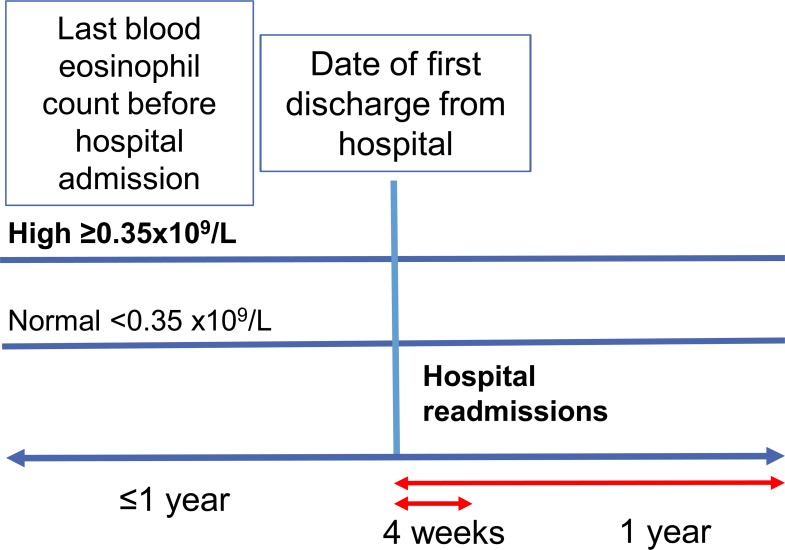
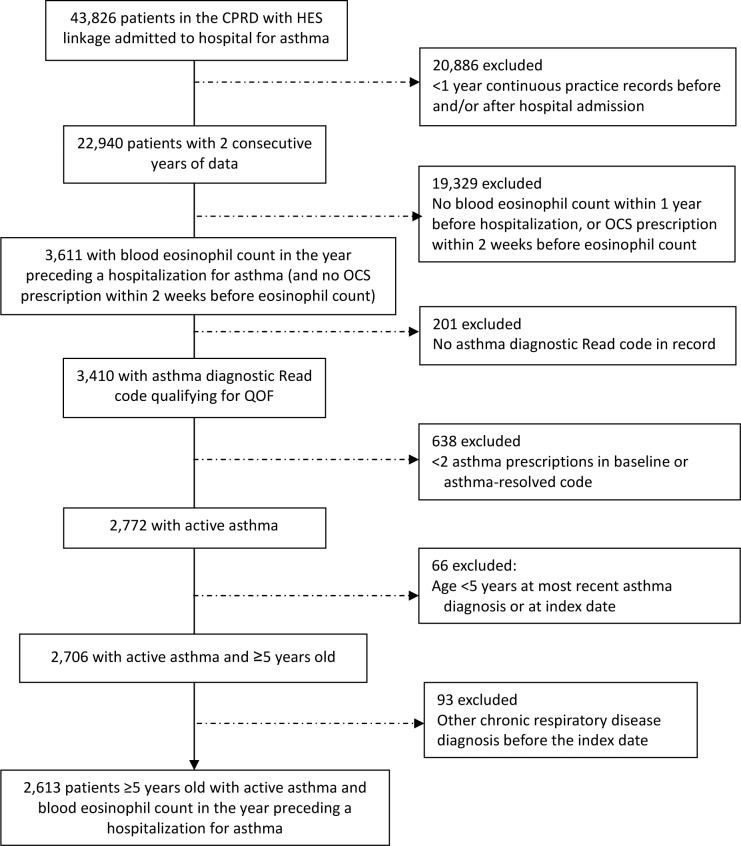
This historical cohort study drew on 2 years of medical record data (Clinical Practice Research Datalink with Hospital Episode Statistics linkage) of patients (aged ≥5 years) admitted to hospital in England for asthma, with recorded blood eosinophil count within 1 baseline year before admission. We analyzed the association between high blood eosinophil count (≥0.35x10⁹ cells/L) and readmission risk during 1 year of follow-up after hospital discharge, with adjustment for predefined, relevant confounders using forward selection.
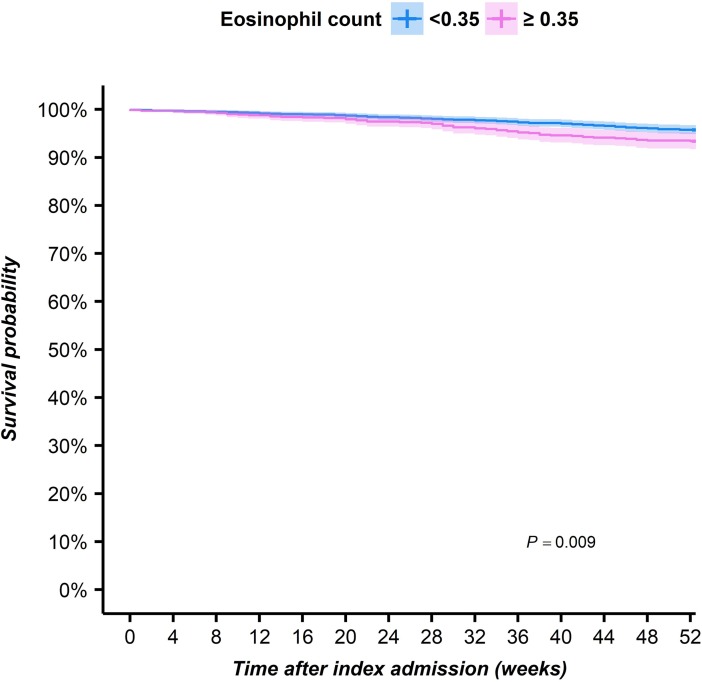
We identified 2,613 eligible patients with asthma-related admission, of median age 51 years (interquartile range, 36-69) and 76% women (1,997/2,613). Overall, 835/2,613 (32.0%) had a preadmission high blood eosinophil count. During the follow-up year, 130/2,613 patients (5.0%) were readmitted for asthma, including 55/835 (6.6%) with vs. 75/1,778 (4.2%) without high blood eosinophil count at baseline (adjusted hazard ratio [HR] 1.49; 95% CI 1.04-2.13, p = 0.029). The association was strongest in never-smokers (n = 1,296; HR 2.16, 95% CI 1.27-3.68, p = 0.005) and absent in current smokers (n = 547; HR 1.00, 95% CI 0.49-2.04, p = 0.997).
A high blood eosinophil count in the year before an asthma-related hospitalization is associated with increased risk of readmission within the following year. These findings suggest that patients with asthma and preadmission high blood eosinophil count require careful follow-up, with treatment optimization, after discharge.
最近的研究表明,血液嗜酸性粒细胞计数高与哮喘恶化风险增加有关。我们试图确定,如果在首次住院前记录到血液嗜酸性粒细胞计数高,因哮喘住院的患者是否有更高的再入院风险。
本历史队列研究利用了英格兰住院治疗哮喘的患者(年龄≥5 岁)的 2 年病历数据(临床实践研究数据链与医院病例统计链接),在入院前 1 年内有记录的血液嗜酸性粒细胞计数。我们使用向前选择法分析了在出院后 1 年的随访期间,高血液嗜酸性粒细胞计数(≥0.35×10⁹ 细胞/L)与再入院风险之间的关联,并针对预定义的相关混杂因素进行了调整。
我们确定了 2613 名符合条件的哮喘相关入院患者,中位年龄为 51 岁(四分位距,36-69),76%为女性(1997/2613)。总体而言,2613 名患者中有 835 名(32.0%)在入院前有高血液嗜酸性粒细胞计数。在随访的一年中,2613 名患者中有 130 名(5.0%)因哮喘再次入院,其中 835 名中有 55 名(6.6%)与基线时无高血液嗜酸性粒细胞计数的 1778 名中有 75 名(4.2%)相比(调整后的危险比[HR]1.49;95%置信区间[CI]1.04-2.13,p=0.029)。该关联在从不吸烟者(n=1296;HR2.16,95%CI1.27-3.68,p=0.005)中最强,而在当前吸烟者(n=547;HR1.00,95%CI0.49-2.04,p=0.997)中不存在。
在因哮喘相关住院前的一年中,血液嗜酸性粒细胞计数高与随后一年的再入院风险增加有关。这些发现表明,患有哮喘和入院前血液嗜酸性粒细胞计数高的患者需要在出院后进行仔细随访,并优化治疗。