Institute for Crop Science and Resource Conservation, Crop Functional Genomics, University of Bonn, 53113, Bonn, Germany.
Institute for Crop Science, Biostatistics Unit, University of Hohenheim, 70599, Stuttgart, Germany.
BMC Genomics. 2019 Apr 29;20(1):325. doi: 10.1186/s12864-019-5634-0.
Water deficit and soil salinity substantially influence plant growth and productivity. When occurring individually, plants often exhibit reduced growth resulting in yield losses. The simultaneous occurrence of these stresses enhances their negative effects. Unraveling the molecular mechanisms of combined abiotic stress responses is essential to secure crop productivity under unfavorable environmental conditions.
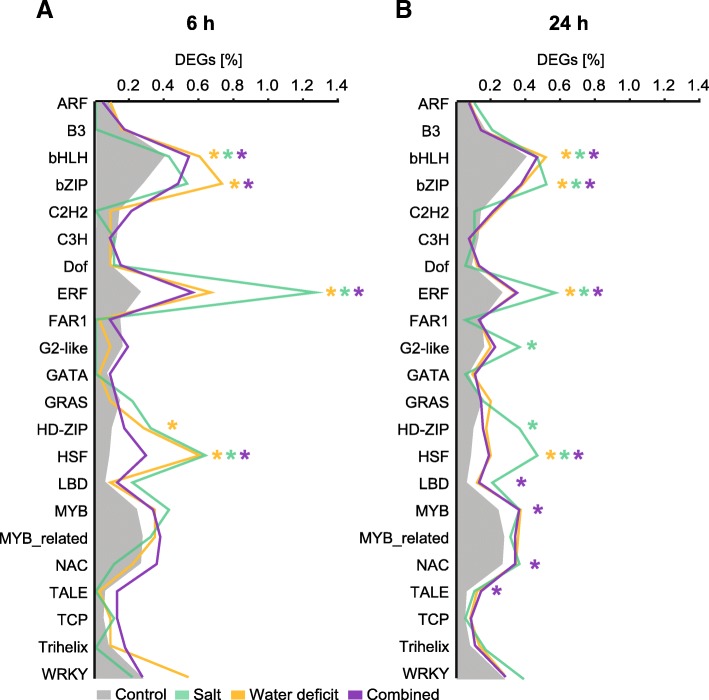
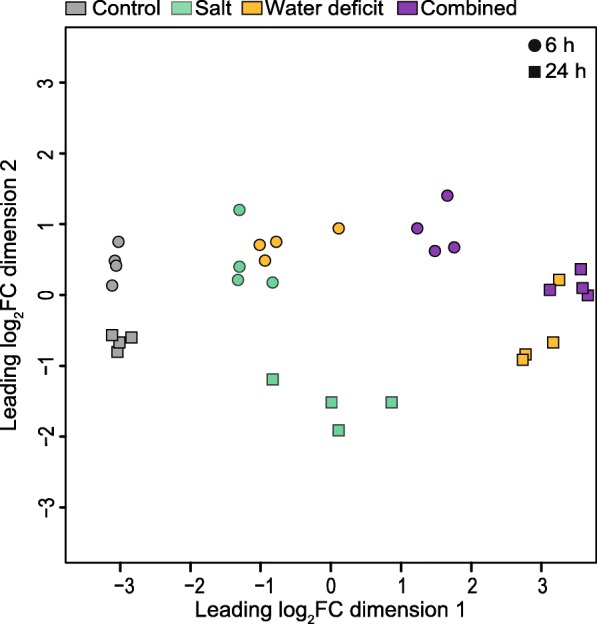
This study examines the effects of water deficit, salinity and a combination of both on growth and transcriptome plasticity of barley seminal roots by RNA-Seq. Exposure to water deficit and combined stress for more than 4 days significantly reduced total seminal root length. Transcriptome sequencing demonstrated that 60 to 80% of stress type-specific gene expression responses observed 6 h after treatment were also present after 24 h of stress application. However, after 24 h of stress application, hundreds of additional genes were stress-regulated compared to the short 6 h treatment. Combined salt and water deficit stress application results in a unique transcriptomic response that cannot be predicted from individual stress responses. Enrichment analyses of gene ontology terms revealed stress type-specific adjustments of gene expression. Further, global reprogramming mediated by transcription factors and consistent over-representation of basic helix-loop-helix (bHLH) transcription factors, heat shock factors (HSF) and ethylene response factors (ERF) was observed.
This study reveals the complex transcriptomic responses regulating the perception and signaling of multiple abiotic stresses in barley.
水分亏缺和土壤盐度会极大地影响植物的生长和生产力。当单独发生时,植物的生长通常会受到抑制,导致产量损失。这些胁迫同时发生时,会增强它们的负面影响。揭示植物对复合非生物胁迫反应的分子机制对于在不利的环境条件下确保作物生产力至关重要。
本研究通过 RNA-Seq 技术研究了水分亏缺、盐度以及两者同时存在对大麦胚根生长和转录组可塑性的影响。暴露于水分亏缺和复合胁迫超过 4 天后,总胚根长度显著减少。转录组测序表明,处理后 6 小时观察到的 60%至 80%的胁迫类型特异性基因表达响应,在胁迫处理 24 小时后也存在。然而,与短期 6 小时处理相比,在 24 小时的胁迫处理后,有数百个额外的基因受到胁迫调控。与单独的水分亏缺或盐度胁迫相比,盐度和水分亏缺的复合胁迫会导致独特的转录组反应,这是无法从单一胁迫反应中预测到的。基因本体术语的富集分析揭示了基因表达的胁迫类型特异性调整。此外,观察到转录因子介导的全局重编程以及基本螺旋-环-螺旋(bHLH)转录因子、热休克因子(HSF)和乙烯响应因子(ERF)的一致过表达。
本研究揭示了大麦中调节多种非生物胁迫感知和信号转导的复杂转录组反应。