Division of Community and Systems Health Science, College of Nursing, University of Arizona, 1305 N Martin Ave, Tucson, AZ, 85721, USA.
Department of Psychiatry, College of Medicine, University of Arizona, Tucson, AZ, USA.
Trials. 2019 Apr 29;20(1):247. doi: 10.1186/s13063-019-3320-9.
Cancer survivors and their informal caregivers (family members, close friends) often experience significant impairments in health-related quality of life (HRQOL), including disruptions in psychological, physical, social, and spiritual well-being both during and after primary cancer treatment. The purpose of this in-progress pilot trial is to determine acceptability and preliminary efficacy (as reflected by effect sizes) of CBCT® (Cognitively-Based Compassion Training) compared with a cancer health education (CHE) attention control to improve the primary outcome of depressive symptoms and secondary outcomes of other HRQOL domains (e.g., anxiety, fatigue), biomarkers of inflammation and diurnal cortisol rhythm, and healthcare utilization-related outcomes in both cancer survivors and informal caregivers.
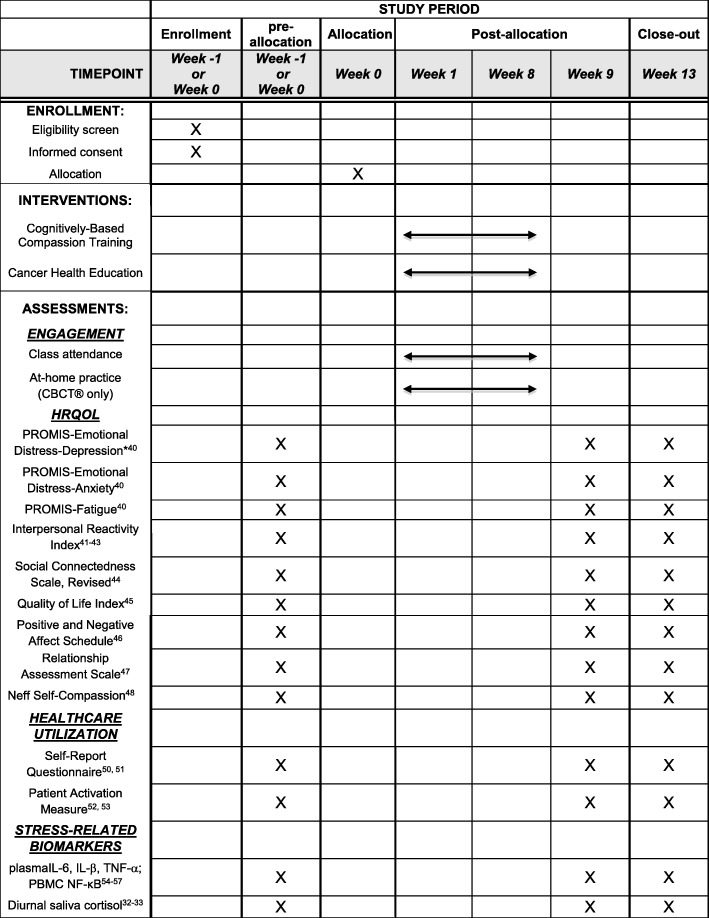
Forty dyads consisting of solid tumor survivors who have completed primary treatments (chemotherapy, radiation, surgery) and their informal caregivers, with at least one dyad member with ≥ mild depressive symptoms or anxiety, will be recruited from Tucson, Arizona, USA. Survivor-caregiver dyads will be randomized together to complete either CBCT or CHE. CBCT is a manualized, 8-week, group meditation-based intervention that starts with attention and mindfulness and builds to contemplative practices aimed at cultivating compassion to the self and others. The goal of CBCT is to challenge unexamined assumptions about feelings and behaviors, with a focus on generating spontaneous self-compassion and increased empathic responsiveness and compassion for others. CHE is an 8-week, manualized group intervention that provides cancer-specific education on various topics (e.g., cancer advocacy, survivorship wellness). Patient-reported HRQOL outcomes will be assessed before, immediately after (week 9), and 1 month after CBCT or CHE (week 13). At the same time points, stress-related biomarkers of inflammation (e.g., plasma interleukin-6) and saliva cortisol relevant for survivor and informal caregiver wellness and healthcare utilization will be measured.
If CBCT shows acceptability, a larger trial will be warranted and appropriately powered to formally test the efficacy of this dyadic intervention. Interventions such as CBCT directed toward both survivors and caregivers may eventually fill a gap in supportive oncology care programs to improve HRQOL and healthcare utilization in both dyad members.
Clinicaltrials.gov, NCT03459781 . Prospectively registered on 9 March 2018.
癌症幸存者及其非正式照顾者(家庭成员、亲密朋友)在原发性癌症治疗期间和之后经常经历健康相关生活质量(HRQOL)的显著受损,包括心理、身体、社会和精神福祉的中断。本进行中的试验旨在确定 CBCT®(基于认知的同情训练)与癌症健康教育(CHE)注意力对照相比的可接受性和初步疗效(反映为效应大小),以改善主要结局抑郁症状和次要结局其他 HRQOL 领域(例如焦虑、疲劳)、炎症和日间皮质醇节律的生物标志物,以及癌症幸存者和非正式照顾者的医疗保健利用相关结局。
将从美国亚利桑那州图森招募 40 对由已完成原发性治疗(化疗、放疗、手术)的实体瘤幸存者及其非正式照顾者组成的肿瘤幸存者-照顾者对,至少有一对肿瘤幸存者-照顾者对成员有≥轻度抑郁症状或焦虑。将幸存者-照顾者对随机分组完成 CBCT 或 CHE。CBCT 是一种 8 周的基于小组冥想的手册化干预,从注意力和正念开始,建立到沉思实践,旨在培养对自己和他人的同情心。CBCT 的目标是挑战对感受和行为的未经审查的假设,重点是自发产生自我同情,并提高对他人的同理心和同情心。CHE 是一种 8 周的手册化小组干预,提供各种主题的癌症特定教育(例如,癌症倡导、生存者健康)。将在 CBCT 或 CHE 之前(第 9 周)、之后(第 9 周)和 1 个月后(第 13 周)评估患者报告的 HRQOL 结局。在同一时间点,将测量与幸存者和非正式照顾者健康和医疗保健利用相关的应激相关炎症生物标志物(例如,血浆白细胞介素-6)和唾液皮质醇。
如果 CBCT 显示出可接受性,则需要进行更大的试验,并适当调整以正式测试这种双重干预的疗效。针对幸存者和照顾者的 CBCT 等干预措施最终可能会填补支持肿瘤学护理计划中的空白,以改善两个成员的 HRQOL 和医疗保健利用。
Clinicaltrials.gov,NCT03459781。于 2018 年 3 月 9 日前瞻性注册。