Grivnin Anna, Bor Ella, Heiblum Moty, Oreg Yuval, Shtrikman Hadas
Braun Center for Submicron Research, Weizmann Institute of Science, Rehovot, 76100, Israel.
Department of Condensed Matter Physics, Weizmann Institute of Science, Rehovot, 76100, Israel.
Nat Commun. 2019 Apr 29;10(1):1940. doi: 10.1038/s41467-019-09771-0.
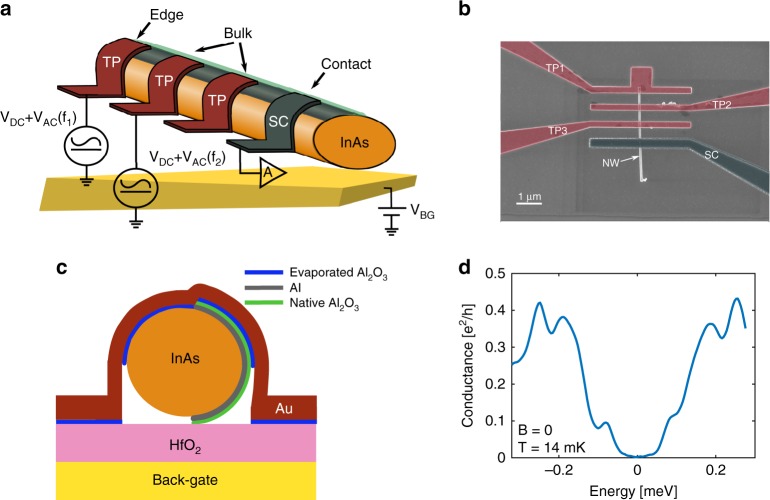
Majorana quasiparticles are generally detected in a 1D topological superconductor by tunneling electrons into its edge, with an emergent zero-bias conductance peak (ZBCP). However, such a ZBCP can also result from other mechanisms, hence, additional verifications are required. Since the emergence of a Majorana must be accompanied by an opening of a topological gap in the bulk, two simultaneous measurements are performed: one in the bulk and another at the edge of a 1D InAs nanowire coated with epitaxial aluminum. Only under certain experimental parameters, a closing of the superconducting bulk-gap that is followed by its reopening, appears simultaneously with a ZBCP at the edge. Such events suggest the occurrence of a topologically non-trivial phase. Yet, we also find that ZBCPs are observed under different tuning parameters without simultaneous reopening of a bulk-gap. This demonstrates the importance of simultaneous probing of bulk and edge in the identification of Majorana edge-states.
马约拉纳准粒子通常是通过将电子隧穿到一维拓扑超导体的边缘来进行探测的,此时会出现一个零偏置电导峰(ZBCP)。然而,这样的ZBCP也可能由其他机制导致,因此,需要进行额外的验证。由于马约拉纳准粒子的出现必然伴随着体相拓扑能隙的打开,所以要进行两项同步测量:一项针对体相,另一项针对涂有外延铝的一维砷化铟纳米线的边缘。只有在特定的实验参数下,超导体能隙先关闭然后重新打开的同时,边缘处才会出现ZBCP。这些事件表明出现了拓扑非平凡相。然而,我们还发现,在不同的调谐参数下也能观察到ZBCP,而此时体相能隙并未同时重新打开。这证明了在识别马约拉纳边缘态时同步探测体相和边缘的重要性。