Zuidema Rixt, van Dulmen Sandra, Nijhuis-van der Sanden Maria, Meek Inger, van den Ende Cornelia, Fransen Jaap, van Gaal Betsie
Scientific Institute for Quality of Healthcare, Radboud Institute for Health Sciences, Radboud University Medical Center, Nijmegen, Netherlands.
Department of Primary and Community Care, Radboud Institute for Health Sciences, Radboud University Medical Center, Nijmegen, Netherlands.
J Med Internet Res. 2019 Apr 30;21(4):e12463. doi: 10.2196/12463.
Web-based self-management enhancing programs have the potential to support patients with rheumatoid arthritis (RA) in their self-management; for example, improve their health status by increasing their self-efficacy or taking their prescribed medication. We developed a Web-based self-management enhancing program in collaboration with RA patients and professionals as co-designers on the basis of the intervention mapping framework. Although self-management programs are complex interventions, it is informative to perform an explorative randomized controlled trial (RCT) before embarking on a larger trial.
This study aimed to evaluate the efficacy of a Web-based self-management enhancing program for patients with RA and identify outcome measures most likely to capture potential benefits.
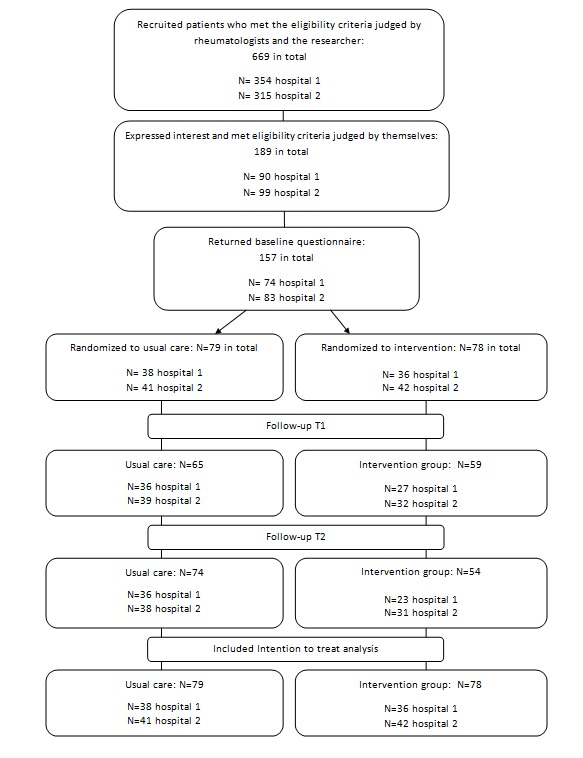
A multicenter exploratory RCT was performed with an intervention group and a control group. Both groups received care as usual. In addition, the intervention group received 12 months of access to a Web-based self-management program. Assessment occurred at baseline, 6 months, and 12 months. Outcome measures included self-management behavior (Patient Activation Measurement, Self-Management Ability Scale), self-efficacy (Rheumatoid Arthritis task-specific Self-Efficacy, Perceived Efficacy in Patient-Physician Interaction), general health status (RAND-36), focus on fatigue (Modified Pain Coping Inventory for Fatigue), and perceived pain and fatigue (Numeric Rating Scales). A linear mixed model for repeated measures, using the intention-to-treat principle, was applied to study differences between the patients in the intervention (n=78) and control (n=79) groups. A sensitivity analysis was performed in the intervention group to study the influence of patients with high (N=30) and low (N=40) use of the intervention.
No positive effects were found regarding the outcome measurements. Effect sizes were low.
Based on these results, it is not possible to conclude on the positive effects of the intervention or to select outcome measures to be regarded as the primary/main or secondary outcomes for a future trial. A process evaluation should be performed to provide more insight into the low compliance with and effectiveness of the intervention. This can determine for whom this sort of program will work and help to fine-tune the inclusion criteria.
Netherlands Trial Register NTR4871; https://www.trialregister.nl/trial/4726.
基于网络的自我管理强化项目有潜力支持类风湿关节炎(RA)患者进行自我管理;例如,通过提高自我效能或遵医嘱服药来改善他们的健康状况。我们在干预映射框架的基础上,与RA患者和专业人员作为共同设计者合作开发了一个基于网络的自我管理强化项目。尽管自我管理项目是复杂的干预措施,但在开展更大规模的试验之前进行探索性随机对照试验(RCT)是很有意义的。
本研究旨在评估一个基于网络的自我管理强化项目对RA患者的疗效,并确定最有可能捕捉潜在益处的结局指标。
进行了一项多中心探索性RCT,分为干预组和对照组。两组均接受常规护理。此外,干预组可使用一个基于网络的自我管理项目12个月。在基线、6个月和12个月时进行评估。结局指标包括自我管理行为(患者激活量表、自我管理能力量表)、自我效能(类风湿关节炎特定任务自我效能、医患互动中的感知效能)、总体健康状况(兰德36项健康调查)、对疲劳的关注(改良疲劳疼痛应对量表)以及感知到的疼痛和疲劳(数字评定量表)。采用意向性分析原则,应用重复测量的线性混合模型来研究干预组(n = 78)和对照组(n = 79)患者之间的差异。在干预组中进行了敏感性分析,以研究高(N = 30)、低(N = 40)使用干预措施的患者的影响。
在结局测量方面未发现积极效果。效应量较低。
基于这些结果,无法得出干预措施的积极效果,也无法选择作为未来试验的主要/首要或次要结局的结局指标。应进行过程评估,以更深入地了解干预措施的低依从性和有效性。这可以确定这类项目对哪些人有效,并有助于微调纳入标准。
荷兰试验注册中心NTR4871;https://www.trialregister.nl/trial/4726 。