Fu Helen Nc, Adam Terrence J, Konstan Joseph A, Wolfson Julian A, Clancy Thomas R, Wyman Jean F
Center for Aging Science and Care Innovation, School of Nursing, University of Minnesota, Minneapolis, MN, United States.
Department of Pharmaceutical Care & Health Systems, College of Pharmacy, University of Minnesota, MInneapolis, MN, United States.
JMIR Diabetes. 2019 Apr 30;4(2):e11462. doi: 10.2196/11462.
More than 1100 diabetes mobile apps are available, but app usage by patients is low. App usability may be influenced by patient factors such as age, sex, and psychological needs.
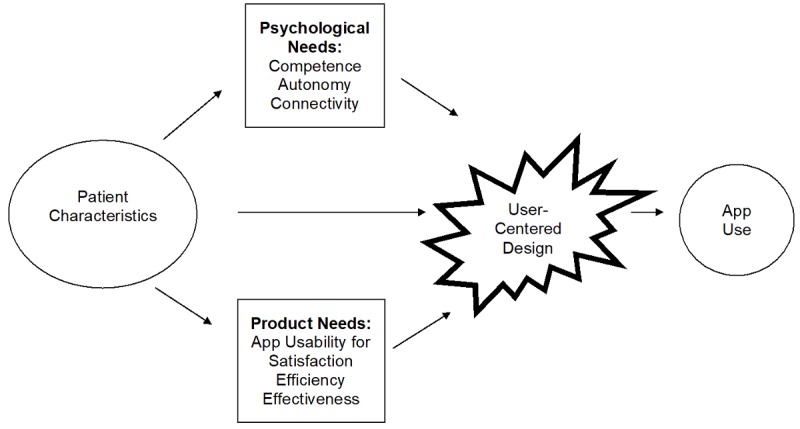
Guided by Self-Determination Theory, the purposes of this study were to (1) assess the effect of patient characteristics on app usability, and (2) determine whether patient characteristics and psychological needs (competence, autonomy, and connectivity)-important for motivation in diabetes care-are associated with app usability.
Using a crossover randomized design, 92 adults with type 1 or 2 diabetes tested two Android apps (mySugr and OnTrack) for seven tasks including data entry, blood glucose (BG) reporting, and data sharing. We used multivariable linear regression models to examine associations between patient characteristics, psychological needs, user satisfaction, and user performance (task time, success, and accuracy).
Participants had a mean age of 54 (range 19-74) years, and were predominantly white (62%, 57/92), female (59%, 54/92), with type 2 diabetes (70%, 64/92), and had education beyond high school (67%, 61/92). Participants rated an overall user satisfaction score of 62 (SD 18), which is considered marginally acceptable. The satisfaction mean score for each app was 55 (SD 18) for mySugr and 68 (SD 15) for OnTrack. The mean task completion time for all seven tasks was 7 minutes, with a mean task success of 82% and an accuracy rate of 68%. Higher user satisfaction was observed for patients with less education (P=.04) and those reporting more competence (P=.02), autonomy (P=.006), or connectivity with a health care provider (P=.03). User performance was associated with age, sex, education, diabetes duration, and autonomy. Older patients required more time (95% CI 1.1-3.2) and had less successful task completion (95% CI 3.5-14.3%). Men needed more time (P=.01) and more technical support than women (P=.04). High school education or less was associated with lower task success (P=.003). Diabetes duration of ≥10 years was associated with lower task accuracy (P=.02). Patients who desired greater autonomy and were interested in learning their patterns of BG and carbohydrates had greater task success (P=.049).
Diabetes app usability was associated with psychological needs that are important for motivation. To enhance patient motivation to use diabetes apps for self-management, clinicians should address competence, autonomy, and connectivity by teaching BG pattern recognition and lifestyle planning, customizing BG targets, and reviewing home-monitored data via email. App usability could be improved for older male users and those with less education and greater diabetes duration by tailoring app training and providing ongoing technical support.
市面上有超过1100款糖尿病移动应用程序,但患者对应用程序的使用率较低。应用程序的可用性可能会受到患者年龄、性别和心理需求等因素的影响。
以自我决定理论为指导,本研究的目的是:(1)评估患者特征对应用程序可用性的影响;(2)确定对糖尿病护理动机至关重要的患者特征和心理需求(能力、自主性和联系性)是否与应用程序可用性相关。
采用交叉随机设计,92名1型或2型糖尿病成年人对两款安卓应用程序(mySugr和OnTrack)进行了七项任务的测试,包括数据录入、血糖(BG)报告和数据共享。我们使用多变量线性回归模型来检验患者特征、心理需求、用户满意度和用户表现(任务时间、成功率和准确性)之间的关联。
参与者的平均年龄为54岁(范围19 - 74岁),主要为白人(62%,57/92),女性(59%,54/92),患有2型糖尿病(70%,64/92),且高中以上学历(67%,61/92)。参与者对用户满意度的总体评分平均为62分(标准差18),这被认为勉强可以接受。mySugr应用程序的满意度平均得分为55分(标准差18),OnTrack应用程序为68分(标准差15)。所有七项任务的平均完成时间为7分钟,平均任务成功率为82%,准确率为68%。受教育程度较低的患者(P = 0.04)以及报告能力更强(P = 0.02)、自主性更强(P = 0.006)或与医疗保健提供者联系更多(P = 0.03)的患者,其用户满意度更高。用户表现与年龄、性别、教育程度、糖尿病病程和自主性相关。老年患者需要更多时间(95%置信区间1.1 - 3.2),任务完成成功率较低(95%置信区间3.5 - 14.3%)。男性比女性需要更多时间(P = 0.01)和更多技术支持(P = 0.04)。高中及以下学历与较低的任务成功率相关(P = 0.003)。糖尿病病程≥10年与较低的任务准确率相关(P = 0.02)。渴望更大自主性且对了解自己的血糖和碳水化合物模式感兴趣有患者,其任务成功率更高(P = 0.049)。
糖尿病应用程序的可用性与对动机至关重要的心理需求相关。为提高患者使用糖尿病应用程序进行自我管理的动机,临床医生应通过教授血糖模式识别和生活方式规划、定制血糖目标以及通过电子邮件审查家庭监测数据来解决能力、自主性和联系性问题。通过定制应用程序培训并提供持续的技术支持,可以提高老年男性用户以及教育程度较低、糖尿病病程较长用户的应用程序可用性。
