Hsueh Chi-Yao, Lau Hui-Ching, Li Shengjie, Tao Lei, Zhang Ming, Gong Hongli, Zhou Liang
Department of Otolaryngology, Eye Ear Nose and Throat Hospital, Fudan University, Shanghai, China.
Shanghai Key Clinical Disciplines of Otorhinolaryngology, Shanghai, China.
Front Oncol. 2019 Apr 16;9:271. doi: 10.3389/fonc.2019.00271. eCollection 2019.
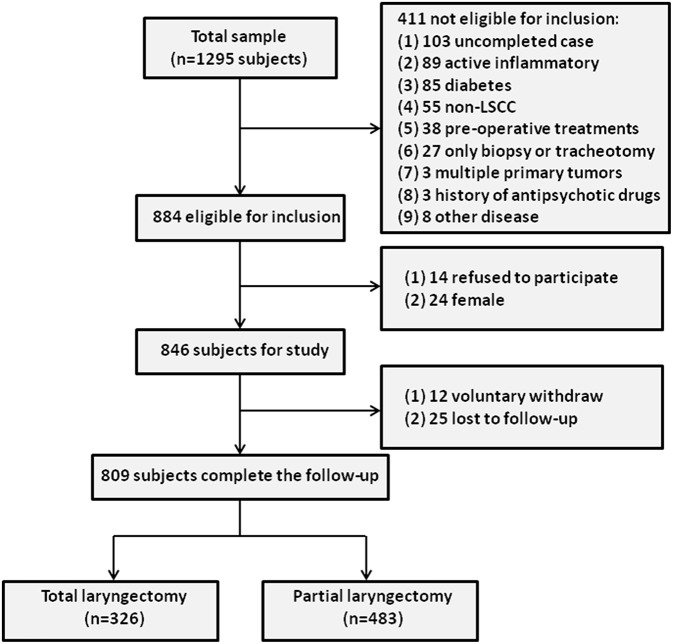
High levels of red cell distribution width (RDW) may be associated with adverse outcomes in patients with cancer. The purpose of the present study was to investigate the prognostic impact of pretreatment RDW levels on overall survival (OS), cancer-specific survival (CSS), and disease-free survival (DFS) in a large cohort of male laryngeal squamous cell cancer (LSCC) patients. A total of 809 LSCC patients who were treated between 2007 and 2011 at the Eye & ENT Hospital of Fudan University were enrolled and evaluated retrospectively. OS, CSS, and DFS were analyzed using the Kaplan-Meier method. To evaluate the prognostic significance of RDW levels, univariate, and multivariate Cox analyses were applied. Higher pretreatment RDW levels were significantly associated with high death events, red blood cell count, hemoglobin, radiotherapy, operation therapy, and advanced tumor stage ( < 0.05). From the univariate analysis, we observed that the higher (13.2-13.5%) and the highest (>13.5%) quartiles of RDW level were consistent factors for poor OS, CSS, and DFS in LSCC patients. In the multivariate analysis, after adjusting for confounding factors, the higher and highest quartiles of RDW levels were identified as independent prognostic factors in male LSCC patients. Higher pretreatment RDW levels were demonstrated to be associated with poor clinical outcome in male LSCC patients and might be novel markers for patient stratification in LSCC management.
红细胞分布宽度(RDW)升高可能与癌症患者的不良预后相关。本研究旨在调查治疗前RDW水平对一大群男性喉鳞状细胞癌(LSCC)患者总生存期(OS)、癌症特异性生存期(CSS)和无病生存期(DFS)的预后影响。对2007年至2011年期间在复旦大学附属眼耳鼻喉科医院接受治疗的809例LSCC患者进行回顾性纳入和评估。采用Kaplan-Meier法分析OS、CSS和DFS。为评估RDW水平的预后意义,应用单因素和多因素Cox分析。治疗前较高的RDW水平与高死亡事件、红细胞计数、血红蛋白、放射治疗、手术治疗以及晚期肿瘤分期显著相关(P<0.05)。单因素分析显示,RDW水平较高(13.2-13.5%)和最高(>13.5%)四分位数是LSCC患者OS、CSS和DFS不良的一致因素。多因素分析中,在调整混杂因素后,RDW水平较高和最高四分位数被确定为男性LSCC患者的独立预后因素。治疗前较高的RDW水平被证明与男性LSCC患者不良临床结局相关,可能是LSCC管理中患者分层的新标志物。