Wang Jun, Wu Jian, Lu Lu, Xu Hongjia, Trivedi Manoj, Kumar Abhinav, Liu Jianqiang, Zheng Mingbin
School of Chemistry and Environmental Engineering, Sichuan University of Science and Engineering, Zigong, China.
Guangxi Key Laboratory of Chemistry and Engineering of Forest Products, Guangxi University for Nationalities, College of Chemistry and Chemical Engineering, Nanning, China.
Front Chem. 2019 Apr 16;7:244. doi: 10.3389/fchem.2019.00244. eCollection 2019.
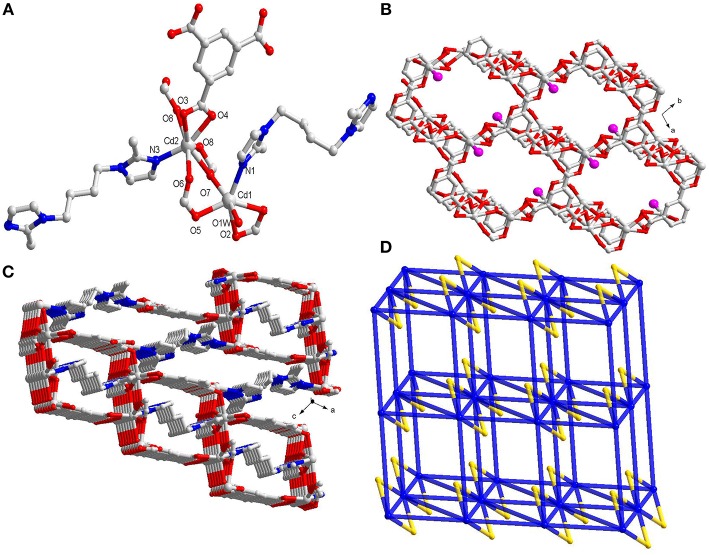
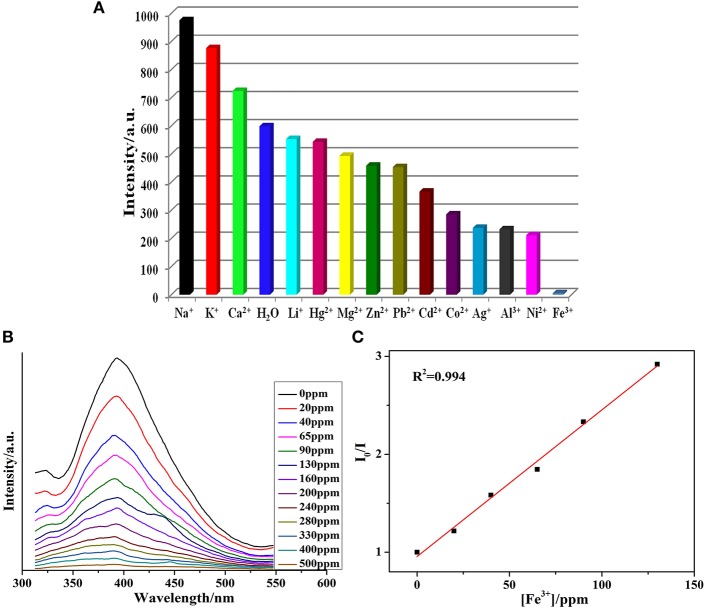
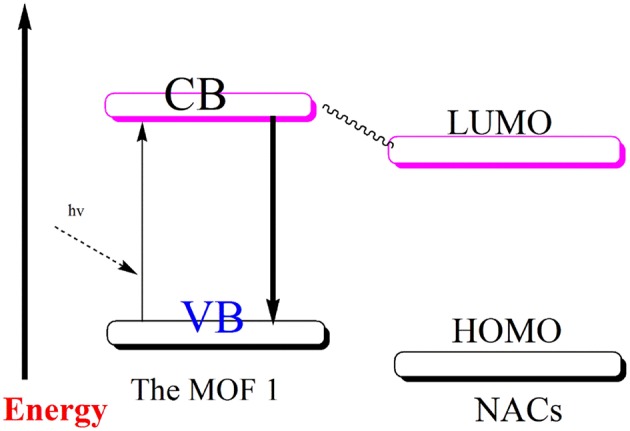
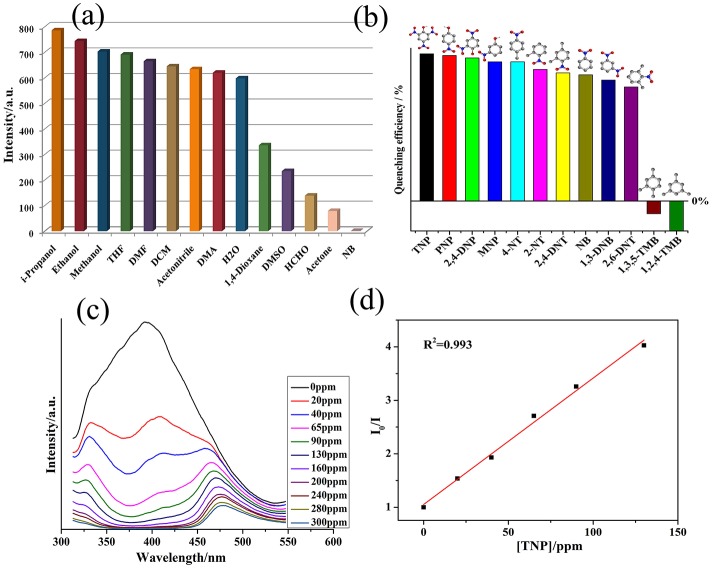
The precise unification of functional groups and photoluminescence properties can give rise to MOFs that can offer diverse applications like selective detection of nitroaromatic compounds (NACs) which are considered to be an important ingredient of explosive as well as cation and anion sensing. Hence, a new 3D metal-organic framework (MOF) [Cd(btc)(bib)(HCOO)(HO)·HO] () has been synthesized using mixed ligand strategy by solvothermal reaction of cadmium acetate with two ligands . 1,3,5-benzenetricarboxylic acid (Hbtc) and 1,4-bis(2-methyl-imidazol-1-yl)butane (bib). The MOF possesses highly 10-connected network which is based on {Cd(btc)(bib)} molecular building block. The studies showed that could be taken as the fluorescent sensor for sensitive recognition of NACs, in particular 2,4,6-trinitrophenol (TNP) with notable quenching ( = 5.42 × 10 M) and LOD of 1.77 ppm. Additionally, also displayed selective sensing for Fe ions with = 6.05 × 10 M and LOD = 1.56 ppm. Also, this dual sensor displayed excellent reusability toward the detection of TNP and Fe ion. Theoretical calculations have been performed to propose the probable mechanism for the sensing luminescence intensity. Calculations indicated that because of the charge transfer and weak interaction that is operating between NACs and MOF, the weakening in the photoluminescence intensity resulted.
官能团与光致发光特性的精确统一能够产生金属有机框架材料(MOFs),这类材料可用于多种应用,比如选择性检测被认为是爆炸物重要成分的硝基芳香族化合物(NACs)以及阳离子和阴离子传感。因此,通过乙酸镉与两种配体1,3,5-苯三甲酸(Hbtc)和1,4-双(2-甲基咪唑-1-基)丁烷(bib)的溶剂热反应,采用混合配体策略合成了一种新型三维金属有机框架材料[Cd(btc)(bib)(HCOO)(H₂O)·H₂O] ()。该金属有机框架材料具有基于{Cd(btc)(bib)}分子构建块的高度10连接网络。研究表明,该材料可作为荧光传感器用于灵敏识别NACs,特别是对2,4,6-三硝基苯酚(TNP)具有显著的猝灭效果(Ksv = 5.42 × 10⁴ M⁻¹),检测限为1.77 ppm。此外,该材料对Fe³⁺离子也表现出选择性传感,Ksv = 6.05 × 10³ M⁻¹,检测限为1.56 ppm。而且,这种双功能传感器对TNP和Fe³⁺离子的检测具有出色的可重复使用性。已进行理论计算以提出传感发光强度的可能机制。计算表明,由于NACs与金属有机框架材料之间存在电荷转移和弱相互作用,导致光致发光强度减弱。