Oakes Allison H, Chang Hsien-Yen, Segal Jodi B
Department of Health Policy and Management, Johns Hopkins University Bloomberg School of Public Health, Baltimore, MD, USA.
Center for Health Services and Outcomes Research of the Bloomberg School of Public Health, Baltimore, MD, USA.
BMC Health Serv Res. 2019 May 2;19(1):280. doi: 10.1186/s12913-019-4079-0.
Overuse is a leading contributor to the high cost of health care in the United States. Overuse harms patients and is a definitive waste of resources. The Johns Hopkins Overuse Index (JHOI) is a normalized measure of systemic health care services overuse, generated from claims data, that has been used to describe overuse in Medicare beneficiaries and to understand drivers of overuse. We aimed to adapt the JHOI for application to a commercially insured US population, to examine geographic variation in systemic overuse in this population, and to analyze trends over time to inform whether systemic overuse is an enduring problem.
We analyzed commercial insurance claims from 18 to 64 year old beneficiaries. We calculated a semiannual JHOI for each of the 375 Metropolitan Statistical Areas and 47 rural regions of the US. We generated maps to examine geographic variation and then analyzed each region's change in their JHOI quintile from January 2011 to June 2015.
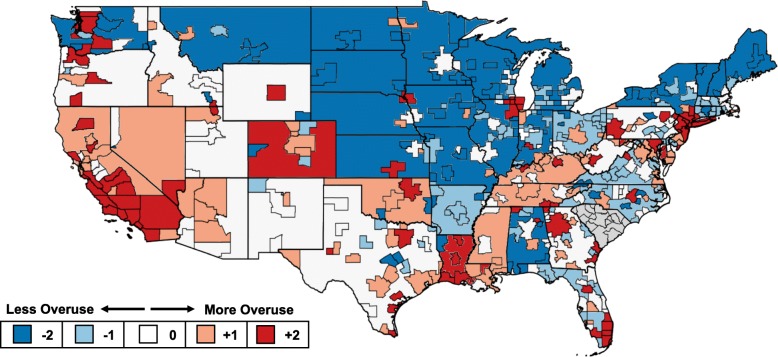
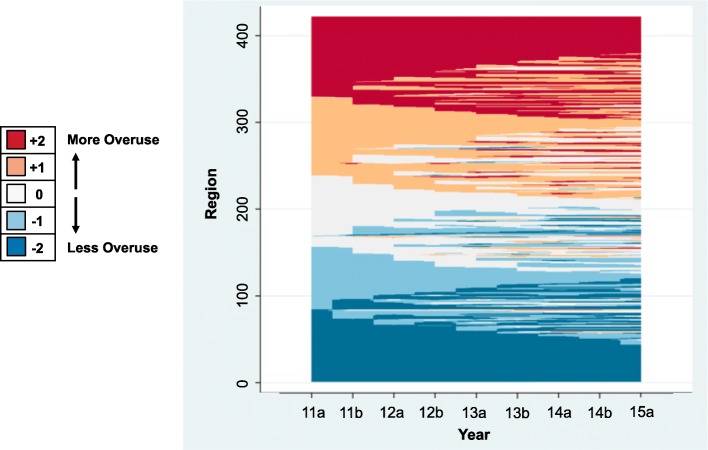
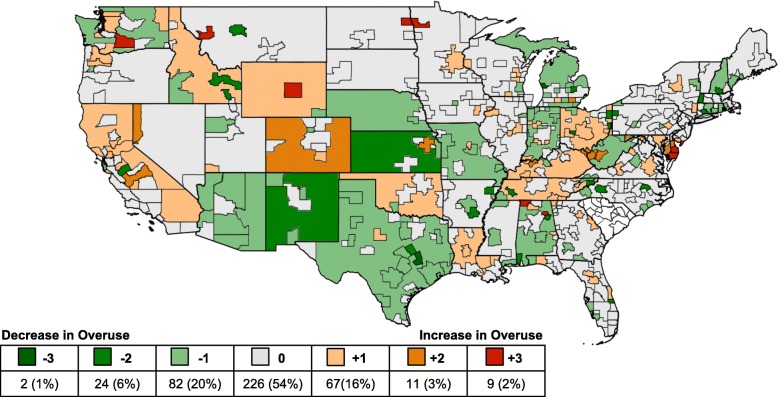
The JHOI varied markedly across the US. Across the country, rural regions tended to have less systemic overuse than their MSA counterparts (p < 0.01). Regional systemic overuse is positively correlated from one time period to the next (p < 0.001). Between 2011 and 2015, 53.7% (N = 226) of regions remained in the same quintile of the JHOI. Eighty of these regions had a persistently high or persistently low JHOI throughout study duration.
The systemic overuse of health care resources is an enduring, regional problem. Areas identified as having a persistently high rate of systemic overuse merit further investigation to understand drivers and potential points of intervention.
过度使用是导致美国医疗保健成本高昂的主要因素。过度使用对患者有害,是对资源的明确浪费。约翰霍普金斯过度使用指数(JHOI)是一种基于索赔数据生成的系统性医疗服务过度使用的标准化衡量指标,已用于描述医疗保险受益人的过度使用情况,并了解过度使用的驱动因素。我们旨在使JHOI适用于美国商业保险人群,研究该人群中系统性过度使用的地理差异,并分析随时间的趋势,以了解系统性过度使用是否是一个持久的问题。
我们分析了18至64岁受益人的商业保险索赔。我们为美国375个大都市统计区和47个农村地区分别计算了半年期的JHOI。我们生成地图以检查地理差异,然后分析了每个地区在2011年1月至2015年6月期间JHOI五分位数的变化。
JHOI在美国各地差异显著。在全国范围内,农村地区的系统性过度使用往往低于其大都市统计区的对应地区(p < 0.01)。不同时期的区域系统性过度使用呈正相关(p < 0.001)。2011年至2015年期间,53.7%(N = 226)的地区JHOI仍处于同一五分位数。其中80个地区在整个研究期间JHOI一直处于高位或低位。
医疗保健资源的系统性过度使用是一个持久的区域性问题。被确定为系统性过度使用率持续较高的地区值得进一步调查,以了解驱动因素和潜在的干预点。