Department of Psychiatry, School of Medicine, Federal University of Sao Paulo (UNIFESP), Rua Major Maragliano, 241 - Predio Academico - Vila Mariana Mariana, São Paulo - CEP: 04017-030, São Paulo, SP, Brazil.
Institute of Mental Health, Division of Psychiatry and Applied Psychology, School of Medicine, University of Nottingham, Nottingham, UK.
Health Qual Life Outcomes. 2019 May 2;17(1):75. doi: 10.1186/s12955-019-1143-8.
Modifying lifestyle risk factors for dementia is a public health priority. Motivation for change is integral to the modification of health-related risk behaviours. This study investigates the psychometric properties of the previously validated tool entitled 'Motivation to Change Lifestyle and Health Behaviours for Dementia Risk Reduction Scale' (MCLHB-DRR) for use in the UK.
A sample of 3,948 individuals aged 50 and over completed the 27-item MCLHB-DRR online. The psychometric properties of the scale were explored via Exploratory Principal Axis Factoring (PAF) with Oblimin rotation. Confirmatory Factor Analysis (CFA) was used to confirm the factor structure using chi-square (χ2), the goodness-of-fit index (GFI), the comparative fit index (CFI), the root mean square error of approximation (RMSEA) and Root Mean Square Residual (RMR) as fit indices to evaluate the model fit. Internal consistency (Cronbach α) was measured for the final scale version.
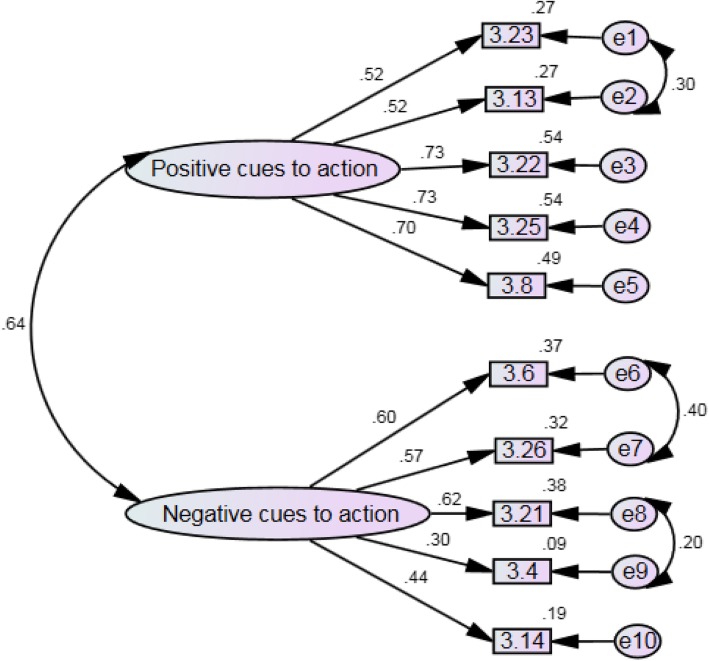
Exploratory Factor Analysis (EFA) resulted in a parsimonious 10-item, two-factor structure (5 items each, factor loadings > 0.3) that explained 52.83% of total variance. Based on the Pattern Matrix, Factor 1 was labelled "Positive Cues to Action" and Factor 2 was labelled "Negative Cues to Action". After addressing some errors in covariances, CFA showed a good fit where all fit indices were larger than 0.90 (GFI = 0.968, CFI = 0.938) and smaller than 0.08 (RMSEA = 0.072, RMR = 0.041). The standardized coefficients of Factor 1 and Factor 2 ranged from 0.30 to 0.73 and were all statistically significant (p < 0.001). The final scale showed moderate to high reliability scores (Factor 1 α = 0.809; Factor 2 α = 0.701; Overall α = 0.785).
The new MOCHAD-10 (Motivation to Change Behaviour for Dementia Risk Reduction Scale) is a short, reliable and robust two-factor, 10-item clinical tool for use in preventative health care and research to evaluate motivation to change lifestyle for dementia risk reduction.
改变痴呆症的生活方式风险因素是公共卫生的重点。改变的动机是健康相关风险行为改变的一个组成部分。本研究旨在调查先前验证的题为“改变生活方式和降低痴呆风险的健康行为动机量表”(MCLHB-DRR)的心理测量特性,以用于英国。
3948 名年龄在 50 岁及以上的参与者在线完成了 27 项 MCLHB-DRR。通过 Oblimin 旋转的探索性主成分因子分析(PAF)探讨了该量表的心理测量特性。使用卡方(χ2)、拟合优度指数(GFI)、比较拟合指数(CFI)、近似均方根误差(RMSEA)和均方根残差(RMR)作为拟合指标,采用验证性因子分析(CFA)来确认因子结构,以评估模型拟合情况。采用 Cronbach α 测量最终量表版本的内部一致性。
探索性因素分析(EFA)得出了一个简约的 10 项两因素结构(每项 5 项,因子负荷>0.3),解释了总方差的 52.83%。根据模式矩阵,因子 1 被标记为“积极行动线索”,因子 2 被标记为“消极行动线索”。在解决了一些协方差错误后,CFA 显示出良好的拟合度,所有拟合指标均大于 0.90(GFI=0.968,CFI=0.938)且小于 0.08(RMSEA=0.072,RMR=0.041)。因子 1 和因子 2 的标准化系数范围为 0.30 至 0.73,均具有统计学意义(p<0.001)。最终量表的可靠性评分中等至较高(因子 1α=0.809;因子 2α=0.701;总α=0.785)。
新的 MOCHAD-10(降低痴呆风险的行为改变动机量表)是一种简短、可靠且强大的两因素、10 项临床工具,可用于预防性保健和研究,以评估改变生活方式降低痴呆风险的动机。