Department of Epidemiology and Biostatistics, Collage of Health and Medical Sciences, Haramaya University, Haramaya, Ethiopia.
Department of Epidemiology and Biostatistics, Institute of Public Health, Collage of Medicine and Health Sciences, University of Gondar, Gondar, Ethiopia.
PLoS One. 2019 May 2;14(5):e0215967. doi: 10.1371/journal.pone.0215967. eCollection 2019.
Incidence of Acute Kidney Injury (AKI) among Type 2 diabetic patients is significantly increasing. But, earlier studies has focused on the admitted patients which may hide the true nature of the Acute Kidney Injury among Type 2 Diabetic (T2D) patients. So, this study was conducted to determine the time to Acute Kidney Injury and its predictors among Type 2 Diabetic patients in Harari Region, East Ethiopia.
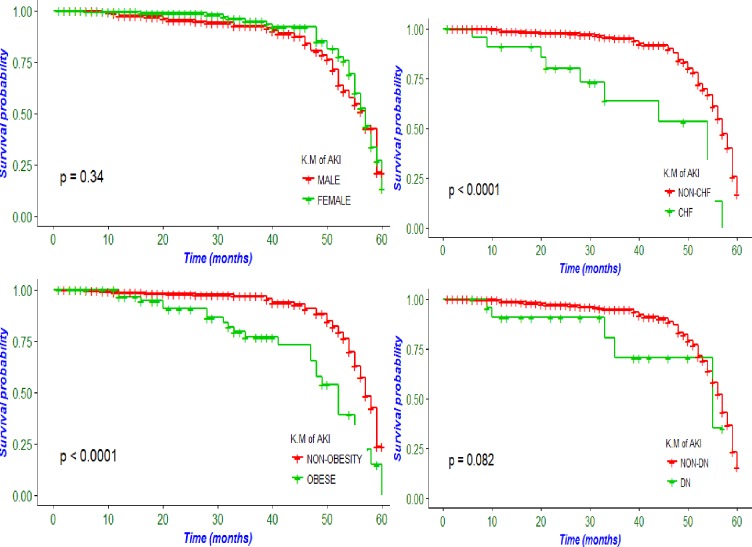
We conducted a retrospective cohort study among type 2 diabetic patients who had been receiving treatment at government hospitals of Harari region, Ethiopia from 2013 to 2017. We extracted data from patients' medical records. We estimated incidence rate and compared survival curves between different exposure groups using Kaplan-Meier and log-rank test. Weibull regression model was fitted to the data to identify the predictor variables. Variables with p-value <0.05 were considered statistically significant.
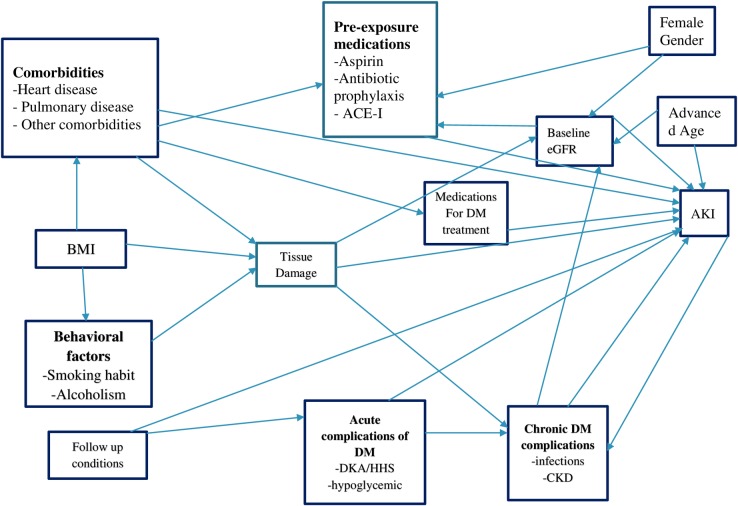
Overall, 14.5% (95%CI: 11.7-17.9) of the study population developed acute kidney injury, with median survival time of 57 months. The significant predictors were physical activity [Adjusted Time Ratio (ATR):95%CI; 0.6 (0.49-0.75)], congestive heart failure [ATR:95%CI; 0.84 (0.71-0.99)], chronic kidney disease [ATR:95%CI; 0.77(0.65-0.91)], hypertension [ATR:95%CI; 0.78(0.65-0.91)], obesity [ATR:95%CI; 0.84(0.74-0.96)], diabetic nephropathy [ATR:95%CI; 0.80(0.65-0.98)], diuretics & beta blockers [ATR:95%CI; 0.85(0.74-0.97)], and delay of follow-up [ATR:95%CI; 0.97(0.96-0.98)].
Incidence of acute kidney injury was high in our study area. Hence, identification and controlling of comorbidities along with regular monitoring of kidney function are needed to prevent or delay the risk of acute kidney injury in type 2 diabetic patients.
2 型糖尿病患者急性肾损伤(AKI)的发病率显著增加。但是,早期的研究集中在住院患者身上,这可能掩盖了 2 型糖尿病(T2D)患者急性肾损伤的真实情况。因此,本研究旨在确定哈拉拉地区 2 型糖尿病患者急性肾损伤的时间及其预测因素。
我们对 2013 年至 2017 年在埃塞俄比亚哈拉拉地区政府医院接受治疗的 2 型糖尿病患者进行了回顾性队列研究。我们从患者的病历中提取数据。我们使用 Kaplan-Meier 和对数秩检验比较了不同暴露组的发生率和生存曲线。使用威布尔回归模型对数据进行拟合,以确定预测变量。具有 p 值<0.05 的变量被认为具有统计学意义。
总体而言,研究人群中有 14.5%(95%CI:11.7-17.9)发生急性肾损伤,中位生存时间为 57 个月。显著的预测因素包括体力活动[调整时间比(ATR):95%CI;0.6(0.49-0.75)]、充血性心力衰竭[ATR:95%CI;0.84(0.71-0.99)]、慢性肾脏病[ATR:95%CI;0.77(0.65-0.91)]、高血压[ATR:95%CI;0.78(0.65-0.91)]、肥胖[ATR:95%CI;0.84(0.74-0.96)]、糖尿病肾病[ATR:95%CI;0.80(0.65-0.98)]、利尿剂和β受体阻滞剂[ATR:95%CI;0.85(0.74-0.97)]和随访延迟[ATR:95%CI;0.97(0.96-0.98)]。
在我们的研究区域,急性肾损伤的发病率很高。因此,需要识别和控制合并症,并定期监测肾功能,以预防或延迟 2 型糖尿病患者急性肾损伤的风险。