Pannebakker Merel M, Mills Katie, Johnson Margaret, Emery Jon D, Walter Fiona M
Research Associate, The Primary Care Unit, Department of Public Health and Primary Care, University of Cambridge, Cambridge, UK.
Patient Representative, c/o The Primary Care Unit, Department of Public Health and Primary Care, University of Cambridge, Cambridge, UK.
BJGP Open. 2019 Mar 20;3(1):bjgpopen18X101635. doi: 10.3399/bjgpopen18X101635. eCollection 2019 Apr.
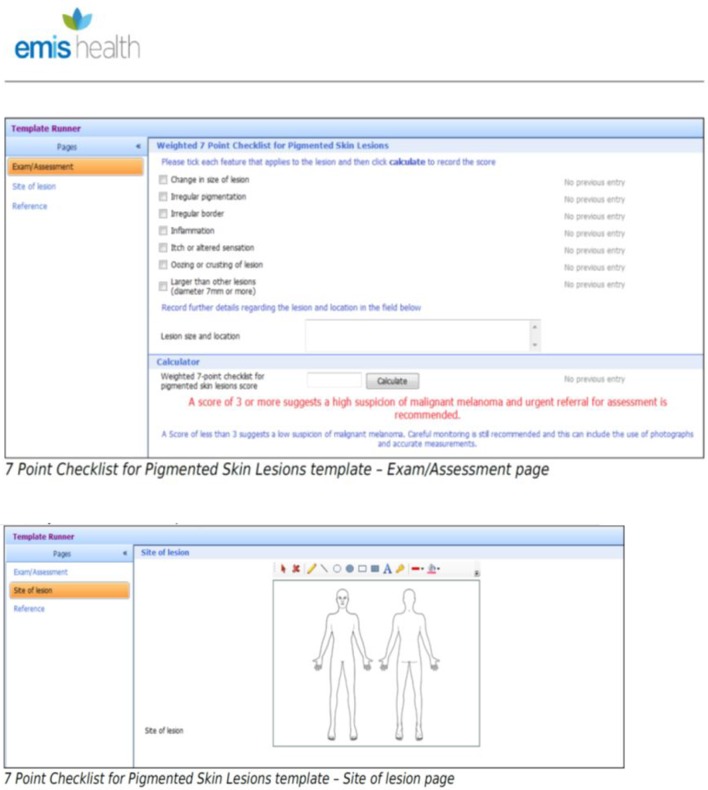
Timely diagnosis of the serious skin cancer melanoma can improve patient outcomes. Clinical guidelines suggest that GPs use checklists, such as the 7-point checklist (7PCL), to assess pigmented lesions. In 2016, the 7PCL was disseminated by EMIS as an electronic clinical decision support (eCDS) tool.
To understand GP and patient perspectives on the implementation and usefulness of the eCDS.
DESIGN & SETTING: Semi-structured interviews with GPs and patients were undertaken. The interviews took place in four general practices in the south east of England following consultations using the eCDS for suspicious pigmented lesions.
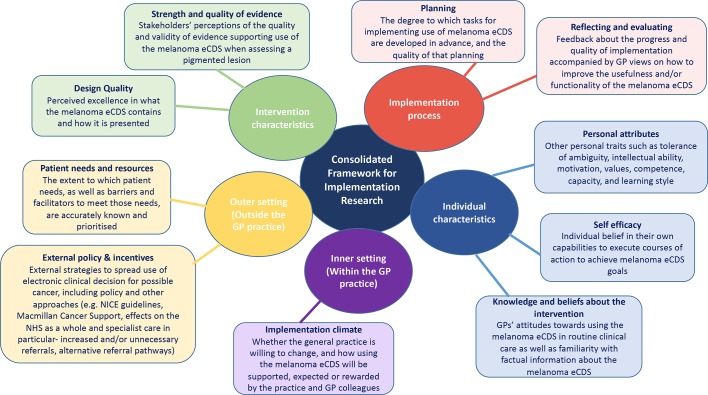
Data were collected from semi-structured face-to-face interviews with GPs and from telephone interviews with patients. They were recorded and transcribed verbatim. The Consolidated Framework for Implementation Research (CFIR) underpinned the analysis using thematic approaches.
A total of 14 interviews with GPs and 14 interviews with patients were undertaken. Most GPs reported that, as the eCDS was embedded in the medical record, it was useful, easy to use, time-efficient, and could facilitate patient-GP communication. They were less clear that it could meet policy or patient needs to improve early diagnosis, and some felt that it could lead to unnecessary referrals. Few felt that it had been sufficiently implemented at practice level. More felt confident with their own management of moles, and that the eCDS could be most useful for borderline decision-making. No patients were aware that the eCDS had been used during their consultation.
Successful implementation of a new tool, such as eCDS for melanoma, requires GPs to perceive its value and understand how it can best be integrated into clinical practice. Disseminating a tool without such explanations is unlikely to promote its adoption into routine practice.
及时诊断严重的皮肤癌黑色素瘤可改善患者预后。临床指南建议全科医生使用清单,如七点清单(7PCL)来评估色素沉着病变。2016年,7PCL由EMIS作为电子临床决策支持(eCDS)工具进行推广。
了解全科医生和患者对eCDS实施情况及有用性的看法。
对全科医生和患者进行半结构化访谈。在英格兰东南部的四家普通诊所,针对使用eCDS评估可疑色素沉着病变后的会诊情况进行访谈。
通过与全科医生的半结构化面对面访谈以及与患者的电话访谈收集数据。访谈进行录音并逐字转录。采用主题分析法,以实施研究综合框架(CFIR)为分析基础。
共对14名全科医生和14名患者进行了访谈。大多数全科医生报告称,由于eCDS嵌入了病历,它很有用、易于使用、节省时间,并且可以促进医患沟通。他们不太确定它是否能满足改善早期诊断的政策或患者需求,一些人认为它可能导致不必要的转诊。很少有人认为它在实践层面得到了充分实施。更多人对自己处理痣的能力更有信心,并且认为eCDS对临界决策最有用。没有患者意识到在他们的会诊过程中使用了eCDS。
成功实施一种新工具,如黑色素瘤的eCDS,需要全科医生认识到其价值,并了解如何最好地将其融入临床实践。在没有此类解释的情况下推广一种工具不太可能促进其在常规实践中的采用。