School of Biological Sciences, The University of Western Australia, Perth, Western Australia, Australia.
Centre for Microscopy, Characterisation and Analysis, The University of Western Australia, Perth, Western Australia, Australia.
J Exp Bot. 2019 Aug 7;70(15):3995-4009. doi: 10.1093/jxb/erz156.
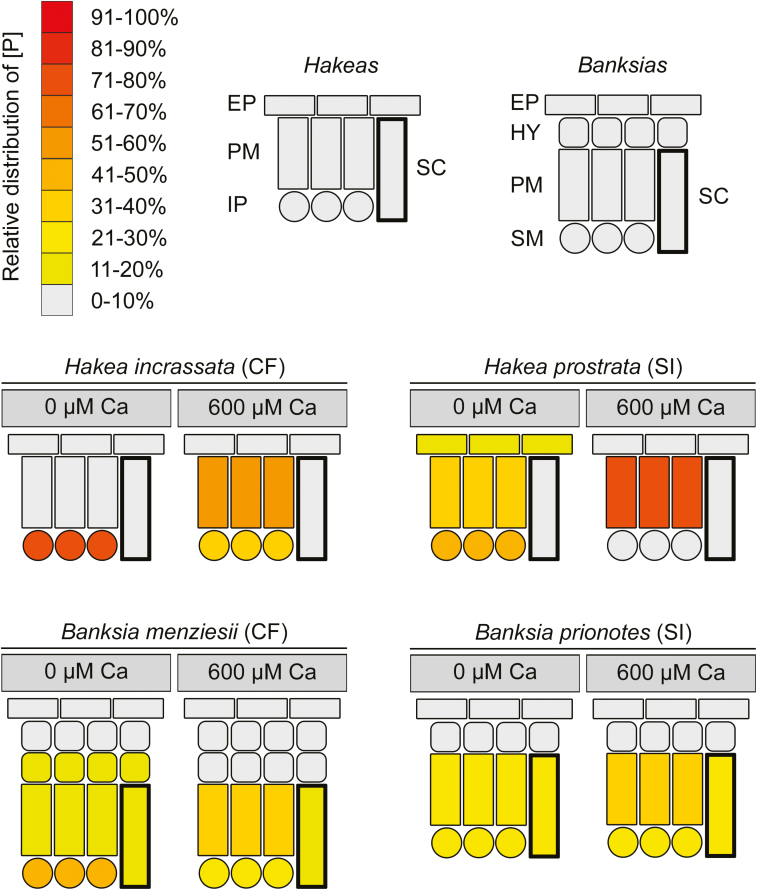
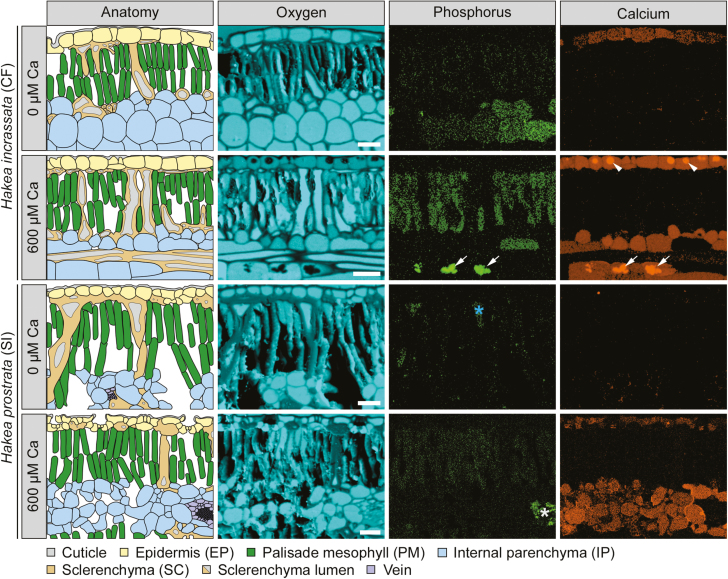
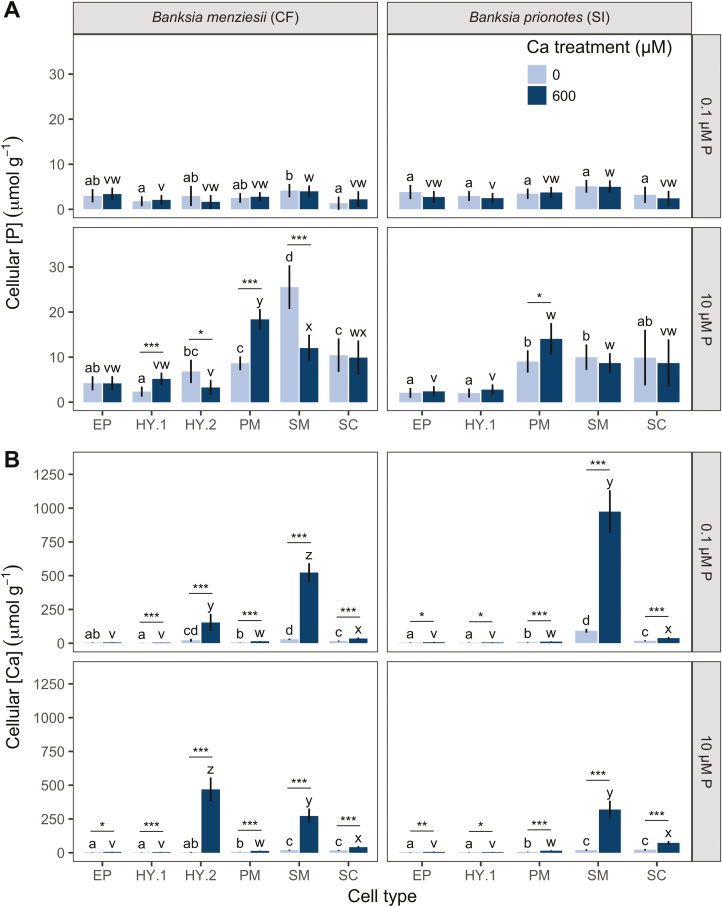
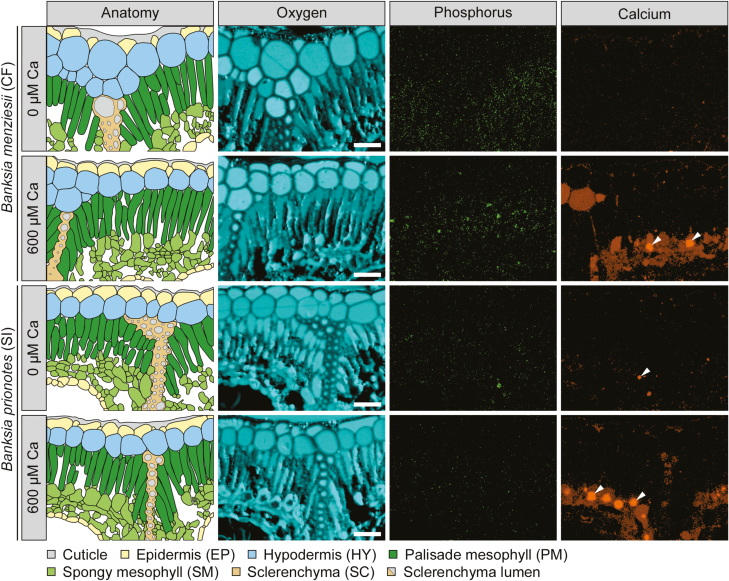
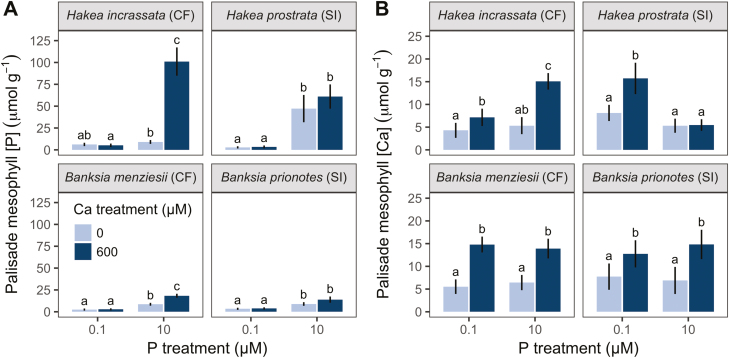
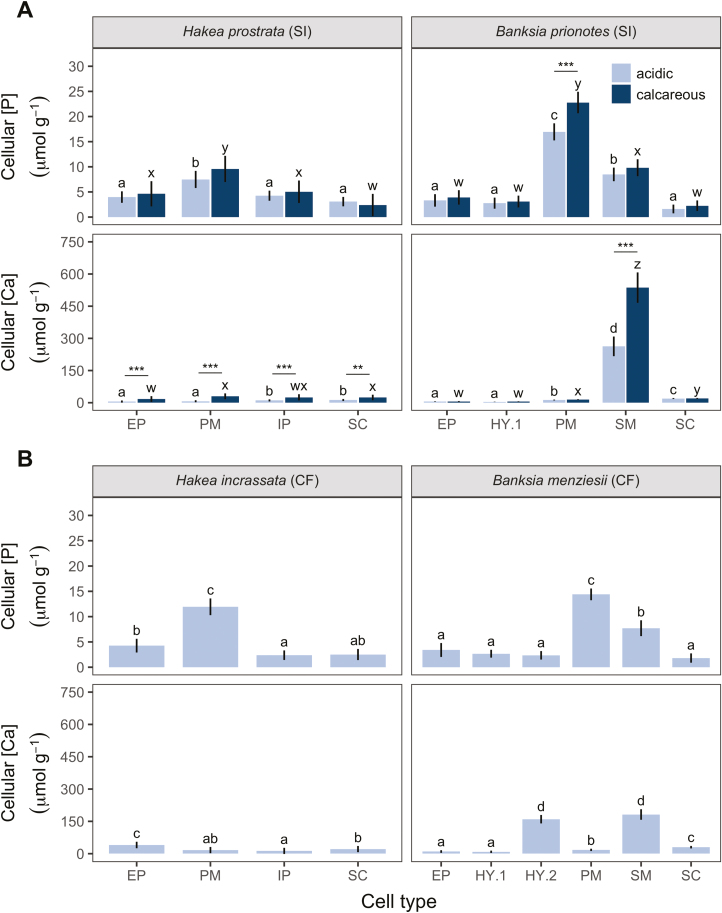
Over 650 Proteaceae occur in south-western Australia, contributing to the region's exceptionally high biodiversity. Most Proteaceae occur exclusively on severely nutrient-impoverished, acidic soils (calcifuge), whilst only few also occur on young, calcareous soils (soil-indifferent), higher in calcium (Ca) and phosphorus (P). The calcifuge habit of Proteaceae is explained by Ca-enhanced P toxicity, putatively linked to the leaf cell-specific allocation of Ca and P. Separation of these elements is essential to avoid the deleterious precipitation of Ca-phosphate. We used quantitative X-ray microanalysis to determine leaf cell-specific nutrient concentrations of two calcifuge and two soil-indifferent Proteaceae grown in hydroponics at a range of Ca and P concentrations. Calcium enhanced the preferential allocation of P to palisade mesophyll (PM) cells under high P conditions, without a significant change in whole leaf [P]. Calcifuges showed a greater PM [P] compared with soil-indifferent species, corresponding to their greater sensitivity. This study advances our mechanistic understanding of Ca-enhanced P toxicity, supporting the proposed model, and demonstrating its role in the calcifuge distribution of Proteaceae. This furthers our understanding of nutrient interactions at the cellular level and highlights its importance to plant functioning.
在澳大利亚西南部,有超过 650 种山龙眼科植物,这使得该地区拥有极高的生物多样性。大多数山龙眼科植物仅生长在极度缺乏养分、呈酸性的土壤(钙不亲和)上,而只有少数也生长在年轻的、钙质土壤(土壤不挑剔)上,这种土壤中钙(Ca)和磷(P)的含量较高。山龙眼科植物的钙不亲和习性可以用 Ca 增强的 P 毒性来解释,这可能与 Ca 和 P 在叶细胞中的特定分配有关。为了避免 Ca-磷酸盐的有害沉淀,必须将这些元素分离。我们使用定量 X 射线微分析来确定在水培条件下,两种钙不亲和和两种土壤不挑剔的山龙眼科植物在一系列 Ca 和 P 浓度下的叶细胞特定养分浓度。在高 P 条件下,Ca 增强了 P 向栅栏薄壁组织(PM)细胞的优先分配,而整个叶片中的[P]没有显著变化。与土壤不挑剔的物种相比,钙不亲和物种的 PM[P]更高,这与其更高的敏感性相对应。这项研究推进了我们对 Ca 增强的 P 毒性的机制理解,支持了所提出的模型,并证明了其在山龙眼科植物钙不亲和分布中的作用。这进一步加深了我们对细胞水平养分相互作用的理解,并强调了其对植物功能的重要性。