Department of Psychology, University of Kentucky, Lexington, Kentucky.
Division of Behavioral Medicine and Clinical Psychology, Cincinnati Children's Hospital Medical Center, Cincinnati, Ohio.
Psychophysiology. 2019 Sep;56(9):e13388. doi: 10.1111/psyp.13388. Epub 2019 May 3.
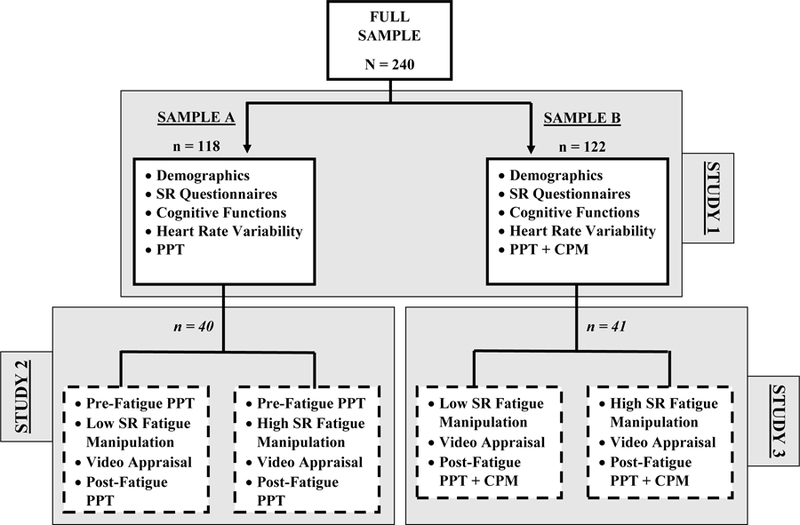
Self-regulatory (SR) ability is an important resource for managing pain, but chronic pain patients experience chronic self-regulatory fatigue even when they are not in pain. Pressure pain thresholds (PPT) and pain inhibition are two mechanisms that differentiate people with and without chronic pain. It was hypothesized that trait SR ability would be associated with higher PPT and better pain inhibition and that PPT and pain inhibition would be lower following high versus low SR fatigue. Three studies tested these hypotheses. Study 1 had 240 pain-free undergraduates complete measures of trait SR ability and PPT; 122 also provided data on pain inhibition. Study 2 had 38 of Study 1's participants return for two additional sessions in which they underwent PPT testing under conditions of high or low SR fatigue (within-person, counterbalanced). Study 3 repeated these procedures with pain inhibition as the outcome (n = 39). Results revealed that individual differences in SR ability were not associated with PPT or pain inhibition (all ps > 0.05). Within people, neither PPT (F(1, 36) = 1.57, p = 0.22) nor pain inhibition (F(1, 37) = 1.79, p = 0.19) were significantly different under conditions of low versus high SR fatigue. Results do not support the hypotheses that PPT or pain inhibition associate with individual differences in trait SR ability or transient changes in state SR fatigue in the absence of pain. Instead, the SR deficits in chronic pain patients may arise from the experience of chronic pain.
自我调节(SR)能力是管理疼痛的重要资源,但慢性疼痛患者即使在不疼痛时也会经历慢性自我调节疲劳。压力疼痛阈值(PPT)和疼痛抑制是区分有和没有慢性疼痛的两种机制。据推测,特质 SR 能力与较高的 PPT 和更好的疼痛抑制相关,而在高 SR 疲劳与低 SR 疲劳时,PPT 和疼痛抑制会降低。三项研究检验了这些假设。研究 1 有 240 名无疼痛的本科生完成了特质 SR 能力和 PPT 的测量;其中 122 人还提供了疼痛抑制的数据。研究 2 有 38 名研究 1 的参与者返回进行另外两次测试,他们在高或低 SR 疲劳条件下(个体内,平衡)接受 PPT 测试。研究 3 用疼痛抑制作为结果重复了这些程序(n=39)。结果表明,SR 能力的个体差异与 PPT 或疼痛抑制无关(所有 p 值>0.05)。在个体内部,无论是 PPT(F(1, 36)=1.57,p=0.22)还是疼痛抑制(F(1, 37)=1.79,p=0.19),在低 SR 疲劳与高 SR 疲劳条件下都没有显著差异。结果不支持 PPT 或疼痛抑制与特质 SR 能力的个体差异相关,也不支持在没有疼痛的情况下状态 SR 疲劳的短暂变化与个体差异相关的假设。相反,慢性疼痛患者的 SR 缺陷可能源于慢性疼痛的体验。