Department of Psychiatry, Yale University School of Medicine, West Haven, Connecticut.
Veterans Affairs Connecticut Healthcare Center, West Haven, Connecticut.
JAMA Netw Open. 2019 May 3;2(5):e193447. doi: 10.1001/jamanetworkopen.2019.3447.
There is a well-established negative association of educational attainment (EA) and other traits related to cognitive ability with posttraumatic stress disorder (PTSD), but the underlying mechanisms are poorly understood.
To investigate the association of PTSD with traits related to EA.
DESIGN, SETTING, AND PARTICIPANTS: Genetic correlation, polygenic risk scoring, and mendelian randomization (MR) were conducted including 23 185 individuals with PTSD and 151 309 control participants from the Psychiatric Genomics Consortium for PTSD and up to 1 131 881 individuals assessed for EA and related traits from UK Biobank, 23andMe, and the Social Science Genetic Association Consortium. Data were analyzed from July 3 through November 19, 2018.
Genetic correlation obtained from linkage disequilibrium score regression, phenotypic variance explained by polygenic risk scores, and association estimates from MR.
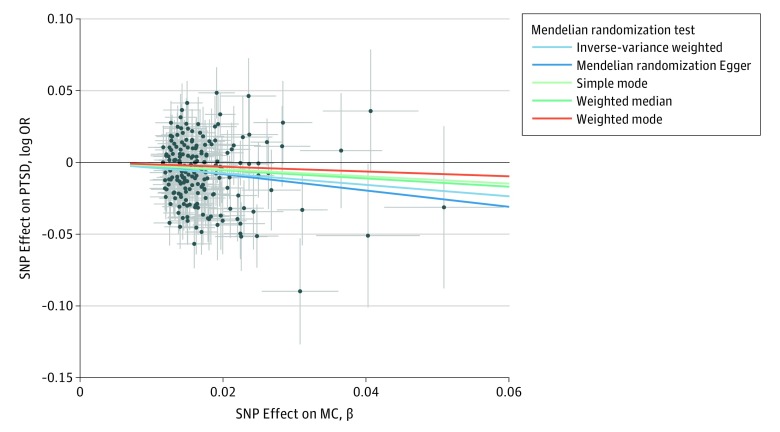
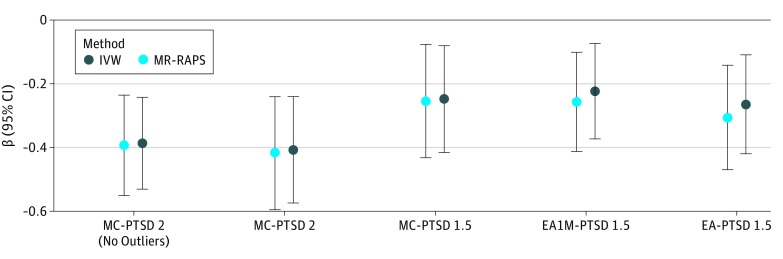
Summary association data from multiple genome-wide association studies were available for a total of 1 180 352 participants (634 391 [53.7%] women). Posttraumatic stress disorder showed negative genetic correlations with EA (rg = -0.26; SE = 0.05; P = 4.60 × 10⁻⁸). Mendelian randomization analysis, conducting considering a random-effects inverse-variance weighted method, indicated that EA has a negative association with PTSD (β = -0.23; 95% CI, -0.07 to -0.39; P = .004). Investigating potential mediators of the EA-PTSD association, propensity for trauma exposure and risk-taking behaviors were observed as risk factors for PTSD independent of EA (trauma exposure: β = 0.37; 95% CI, 0.19 to 0.52; P = 2.57 × 10⁻⁵; risk-taking: β = 0.76; 95% CI, 0.38 to 1.13; P = 1.13 × 10⁻⁴), while income may mediate the association of EA with PSTD (MR income: β = -0.18; 95% CI, -0.29 to -0.07; P = .001; MR EA: β = -0.23; 95% CI, -0.39 to -0.07; P = .004; multivariable MR income: β = -0.32; 95% CI, -0.57 to 0.07; P = .02; multivariable MR EA: β = -0.04; 95% CI, -0.29 to 0.21; SE, 0.13; P = .79).
Large-scale genomic data sets add further evidence to the negative association of EA with PTSD, also supporting the role of economic status as a mediator in the association observed.
受教育程度(EA)和与认知能力相关的其他特征与创伤后应激障碍(PTSD)之间存在明确的负相关关系,但潜在机制尚不清楚。
研究 PTSD 与与 EA 相关的特征之间的关联。
设计、设置和参与者:遗传相关性、多基因风险评分和孟德尔随机化(MR)分析包括来自 PTSD 精神疾病基因组联合会的 23525 名 PTSD 患者和 151309 名对照参与者,以及 UK Biobank、23andMe 和社会科学基因关联联合会中评估 EA 和相关特征的多达 1131881 名参与者。数据分析于 2018 年 7 月 3 日至 11 月 19 日进行。
通过连锁不平衡评分回归获得的遗传相关性、多基因风险评分解释的表型方差以及 MR 的关联估计。
共有 1180352 名参与者(634391[53.7%]名女性)提供了来自多个全基因组关联研究的汇总关联数据。创伤后应激障碍与 EA 呈负遗传相关性(rg=-0.26;SE=0.05;P=4.60×10⁻⁸)。孟德尔随机化分析,采用随机效应逆方差加权法进行,表明 EA 与 PTSD 呈负相关(β=-0.23;95%CI,-0.07 至 -0.39;P=0.004)。研究 EA-PTSD 关联的潜在中介物时,发现创伤暴露和冒险行为是独立于 EA 的 PTSD 的风险因素(创伤暴露:β=0.37;95%CI,0.19 至 0.52;P=2.57×10⁻⁵;冒险行为:β=0.76;95%CI,0.38 至 1.13;P=1.13×10⁻⁴),而收入可能是 EA 与 PTSD 关联的中介物(MR 收入:β=-0.18;95%CI,-0.29 至 -0.07;P=0.001;MR EA:β=-0.23;95%CI,-0.39 至 -0.07;P=0.004;多变量 MR 收入:β=-0.32;95%CI,-0.57 至 0.07;P=0.02;多变量 MR EA:β=-0.04;95%CI,-0.29 至 0.21;SE,0.13;P=0.79)。
大规模基因组数据集进一步证明了 EA 与 PTSD 之间的负相关关系,也支持经济状况在观察到的关联中作为中介物的作用。