Nishimura Tsutomu, Tada Harue, Fukushima Masanori
Institute for Advancement of Clinical and Translational Science (iACT), Graduate School of Medicine, Kyoto University, 54 Kawahara-cho, Shogoin, Sakyo-ku, Kyoto 606-8507, Japan.
Translational Research Center for Medical Innovation, 1-5-4 Minatojima-minamimachi, Chuo-ku, Kobe 650-0047, Japan.
Animals (Basel). 2019 Apr 30;9(5):208. doi: 10.3390/ani9050208.
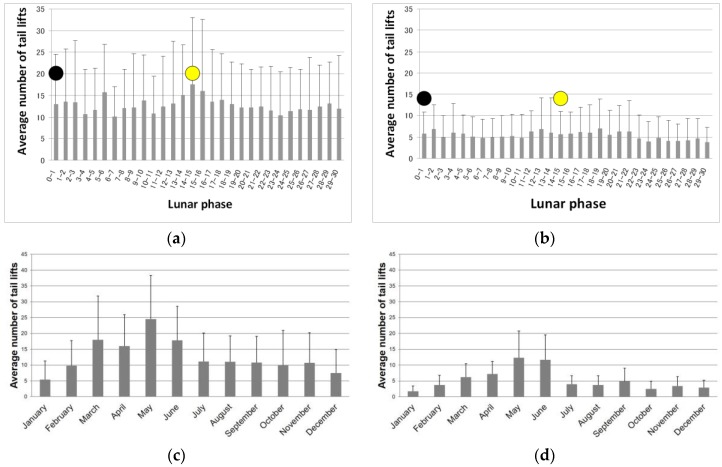
We previously showed that the agamid lizard responded to an extremely low-frequency electromagnetic field (ELF-EMF; frequency: 6 and 8 Hz; peak magnetic field: 2.6 µT; peak electric field: 10 V/m) with tail-lifting behavior. In addition, the tail-lifting response to ELF-EMF disappeared when the parietal eyes of the lizards were covered by small round aluminum caps. This result suggests that the parietal eye contributes to light-dependent magnetoreception. In the present study, we set up an ELF-EMF group to evaluate the long-term effect of the ELF-EMF on lizards' behavior and examine our hypothesis that exposure to ELF-EMFs increases the magnetic field sensitivity in lizards. We therefore include the lunar phase (full moon/new moon) and K index as environmental factors related to the geomagnetic field in the analysis. The number of tail lifts per individual per day was the response variable while calendar month, daily mean temperature, daily mean humidity, daily mean atmospheric pressure, full moon, new moon, and K index were the explanatory variables. We analyzed an ELF-EMF group and a control group separately. In a multiple linear regression analysis, the independent determinants associated with the number of tail lifts were the full moon, the temperature, February, March, April, and May in the ELF-EMF group and March, April, May, and June in the control group. The in the ELF-EMF group responded to the full moon whereas those in the control group did not. In addition, in the ELF-EMF group, the number of tail lifts was higher on days when the K index was higher ( = 0.07) in the first period whereas there was no such tendency in either period in the control group. There is the possibility that the exposure to ELF-EMFs may increase magnetic-field sensitivity in lizards.
我们之前发现,鬣蜥会对极低频电磁场(ELF - EMF;频率:6和8赫兹;峰值磁场:2.6微特斯拉;峰值电场:10伏/米)产生抬尾行为。此外,当蜥蜴的顶眼被小圆形铝帽覆盖时,对ELF - EMF的抬尾反应就会消失。这一结果表明,顶眼有助于光依赖型磁感受。在本研究中,我们设立了一个ELF - EMF组,以评估ELF - EMF对蜥蜴行为的长期影响,并检验我们的假设,即暴露于ELF - EMF会提高蜥蜴的磁场敏感性。因此,我们在分析中纳入了月相(满月/新月)和K指数作为与地磁场相关的环境因素。每天每只蜥蜴的抬尾次数为反应变量,而日历月份、日平均温度、日平均湿度、日平均气压、满月、新月和K指数为解释变量。我们分别分析了一个ELF - EMF组和一个对照组。在多元线性回归分析中,与ELF - EMF组抬尾次数相关的独立决定因素是满月、温度、2月、3月、4月和5月,而对照组是3月、4月、5月和6月。ELF - EMF组的蜥蜴对满月有反应,而对照组的蜥蜴则没有。此外,在ELF - EMF组中,第一阶段K指数较高时( = 0.07)的日子里抬尾次数更多,而对照组在两个阶段都没有这种趋势。暴露于ELF - EMF可能会提高蜥蜴磁场敏感性,存在这种可能性。