Departments of Gastroenterology At King'S College Hospital, Denmark Hill, London, SE59RS, UK.
Darent Valley Hospital, Darent Wood Road, Dartford, Kent, UK.
Inflammopharmacology. 2019 Jun;27(3):465-473. doi: 10.1007/s10787-019-00595-4. Epub 2019 May 3.
There is considerable interest in the possible importance of the gut microflora in the pathophysiology of the inflammatory bowel diseases (IBD) ulcerative colitis (UC) and Crohn's disease (CD). Probiotics offer a potential adjuvant treatment in these patients by modifying the intestinal milieu, but reports of their efficacy are conflicting.
To assess the efficacy of a multi-strain probiotic (Symprove™, Symprove Ltd, Farnham, United Kingdom) in quality of life issues and intestinal inflammation in patients with asymptomatic UC and CD.
A single-centre, randomised, double-blind, placebo-controlled trial of adult patients with asymptomatic IBD. Patients received 4 weeks of treatment with the probiotic or placebo (1 ml/kg/day). The primary efficacy measure was the difference in change in the IBD Quality of Life Questionnaire results (QOL) between probiotic vs. placebo at week 4. Secondary outcome measures included analyses of the change in laboratory findings, including faecal calprotectin (FCAL).
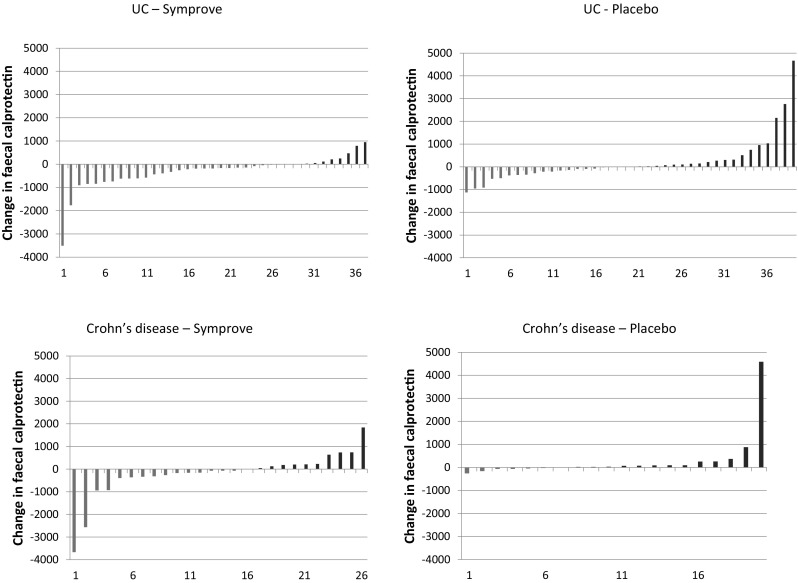
Over 500 patients were recruited to the study and 81 and 61 patients with UC and CD, respectively were randomised and completed the study. There were no significant differences in IBD-QOL scores between placebo and the probiotic groups. Similarly, there were no significant changes observed in the laboratory data. However, the differences in FCAL between patients with UC before and after probiotics versus placebo approached statistical significance with a p value of 0.076. Post-hoc analyses showed that the FCAL levels were significantly (p < 0.015) reduced in the UC patients receiving the probiotic as opposed to placebo. No significant changes were seen in CD. No serious adverse events were observed.
This multi-strain probiotic is associated with decreased intestinal inflammation in patients with UC, but not in CD and is well tolerated. Further research is required to see if the probiotic reduces the incidence of clinical relapses in asymptomatic IBD patients.
肠道微生物群在炎症性肠病(IBD)溃疡性结肠炎(UC)和克罗恩病(CD)的病理生理学中可能具有重要意义,这引起了相当大的关注。益生菌通过改变肠道环境,为这些患者提供了一种潜在的辅助治疗方法,但关于其疗效的报告存在矛盾。
评估多菌株益生菌(Symprove™,Symprove Ltd,英国法纳姆)在无症状 UC 和 CD 患者生活质量问题和肠道炎症方面的疗效。
这是一项在成人无症状 IBD 患者中进行的单中心、随机、双盲、安慰剂对照试验。患者接受 4 周的益生菌或安慰剂(1ml/kg/天)治疗。主要疗效指标是第 4 周时益生菌与安慰剂相比,IBD 生活质量问卷(QOL)结果变化的差异。次要结局指标包括分析实验室发现的变化,包括粪便钙卫蛋白(FCAL)。
该研究共招募了 500 多名患者,分别有 81 名和 61 名 UC 和 CD 患者随机分组并完成了研究。安慰剂和益生菌组的 IBD-QOL 评分无显著差异。同样,实验室数据也没有明显变化。然而,UC 患者在使用益生菌前后与安慰剂相比,FCAL 的差异接近统计学意义(p 值为 0.076)。事后分析显示,与安慰剂相比,UC 患者接受益生菌治疗后 FCAL 水平显著降低(p<0.015)。在 CD 中未观察到显著变化。未观察到严重不良事件。
这种多菌株益生菌与 UC 患者的肠道炎症减轻有关,但与 CD 无关,且耐受性良好。需要进一步研究以确定益生菌是否能降低无症状 IBD 患者的临床复发率。