Guo Weijin, Hansson Jonas, van der Wijngaart Wouter
Micro and Nanosystems, KTH Royal Institute of Technology, Osquldas väg 10, Stockholm, 100 44 Sweden.
Microsyst Nanoeng. 2018 Mar 26;4:2. doi: 10.1038/s41378-018-0002-9. eCollection 2018.
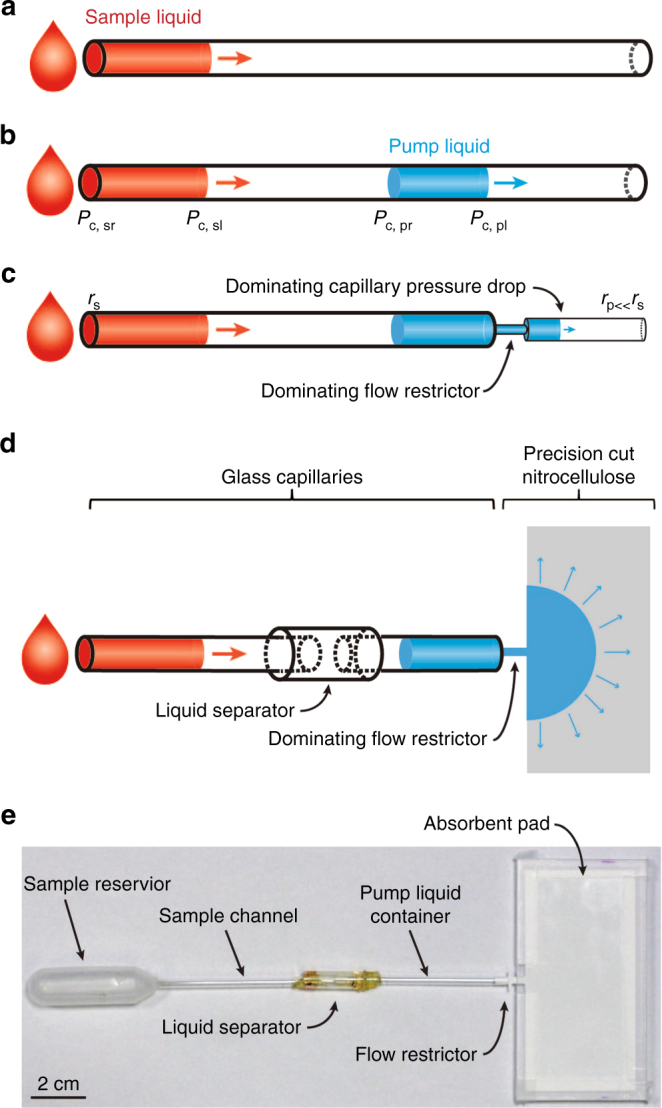
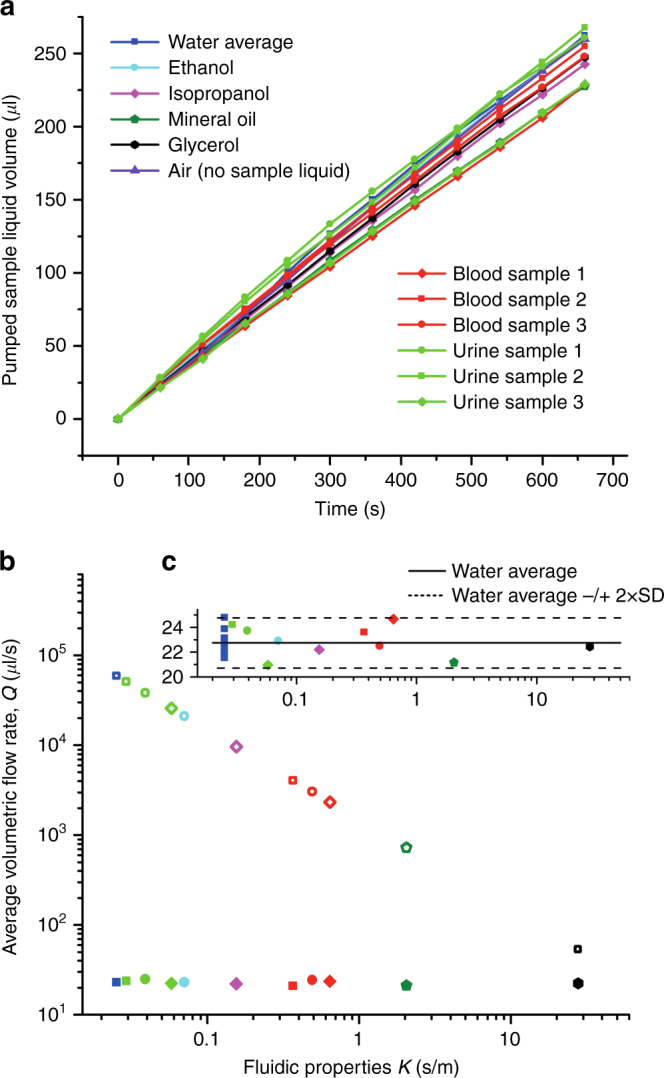
Capillary pumping is an attractive means of liquid actuation because it is a passive mechanism, i.e., it does not rely on an external energy supply during operation. The capillary flow rate generally depends on the liquid sample viscosity and surface energy. This poses a problem for capillary-driven systems that rely on a predictable flow rate and for which the sample viscosity or surface energy are not precisely known. Here, we introduce the capillary pumping of sample liquids with a flow rate that is constant in time and independent of the sample viscosity and sample surface energy. These features are enabled by a design in which a well-characterized pump liquid is capillarily imbibed into the downstream section of the pump and thereby pulls the unknown sample liquid into the upstream pump section. The downstream pump geometry is designed to exert a Laplace pressure and fluidic resistance that are substantially larger than those exerted by the upstream pump geometry on the sample liquid. Hence, the influence of the unknown sample liquid on the flow rate is negligible. We experimentally tested pumps of the new design with a variety of sample liquids, including water, different samples of whole blood, different samples of urine, isopropanol, mineral oil, and glycerol. The capillary filling speeds of these liquids vary by more than a factor 1000 when imbibed to a standard constant cross-section glass capillary. In our new pump design, 20 filling tests involving these liquid samples with vastly different properties resulted in a constant volumetric flow rate in the range of 20.96-24.76 μL/min. We expect this novel capillary design to have immediate applications in lab-on-a-chip systems and diagnostic devices.
毛细管泵送是一种颇具吸引力的液体驱动方式,因为它是一种被动机制,即在运行过程中不依赖外部能量供应。毛细管流速通常取决于液体样品的粘度和表面能。这给依赖可预测流速且样品粘度或表面能并不确切知晓的毛细管驱动系统带来了问题。在此,我们介绍一种对样品液体进行毛细管泵送的方法,其流速在时间上恒定,且与样品粘度和样品表面能无关。这些特性是通过一种设计实现的,即一种特性明确的泵液通过毛细管作用被吸入泵的下游部分,从而将未知的样品液体拉入泵的上游部分。下游泵的几何结构设计成能施加比上游泵几何结构对样品液体施加的拉普拉斯压力和流体阻力大得多的压力和阻力。因此,未知样品液体对流速的影响可忽略不计。我们用多种样品液体对新设计的泵进行了实验测试,这些液体包括水、不同的全血样品、不同的尿液样品、异丙醇、矿物油和甘油。当这些液体被吸入标准恒定横截面的玻璃毛细管时,它们的毛细管填充速度相差超过1000倍。在我们的新泵设计中,对涉及这些性质差异极大的液体样品进行的20次填充测试,得到的恒定体积流速范围为20.96 - 24.76微升/分钟。我们预计这种新颖的毛细管设计将在芯片实验室系统和诊断设备中立即得到应用。