Ribeiro Helena, Libânio Diogo, Castro Rui, Ferreira Anibal, Barreiro Pedro, Boal Carvalho Pedro, Capela Tiago, Pimentel-Nunes Pedro, Santos Cristina, Dinis-Ribeiro Mário
Gastroenterology Department, Amato Lusitano Hospital, Castelo Branco, Portugal.
Gastroenterology Department, Portuguese Oncology Institute of Porto, Porto, Portugal.
Endosc Int Open. 2019 May;7(5):E633-E640. doi: 10.1055/a-0828-7541. Epub 2019 May 2.
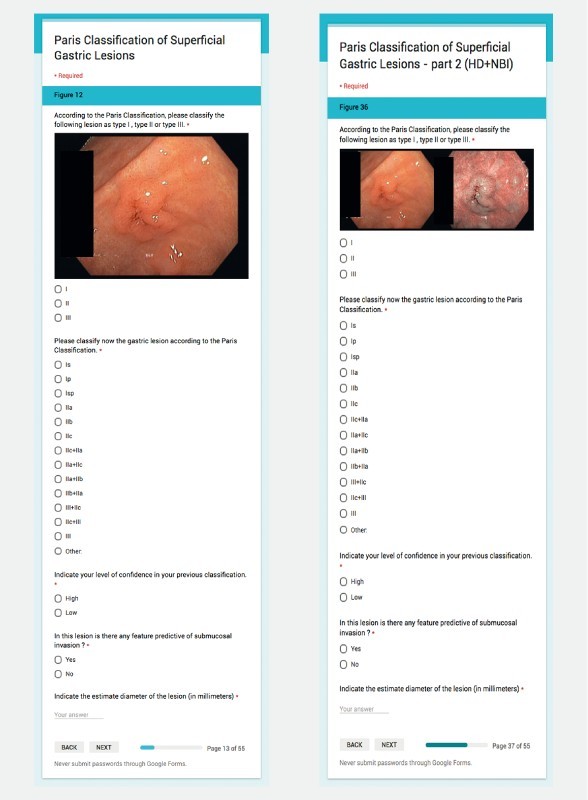
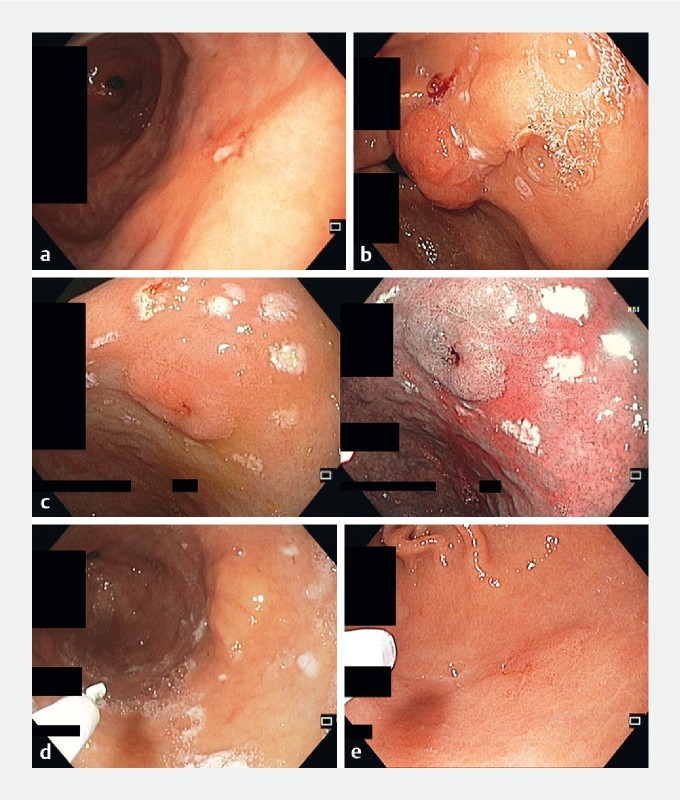
Paris Classification is used to classify gastrointestinal superficial neoplastic lesions and to predict presence of submucosal invasion. We aimed to evaluate interobserver reliability and agreement for this classification among Western endoscopists. A total of 54 superficial gastric lesions were independently classified according to Paris classification by eight endoscopists (4 experts and 4 non-experts). Observers were asked to classify two sets of images - first, obtained with high-resolution white light (HR-WL) endoscopy and secondly, with the same HR-WL images paired with images obtained with high-resolution Narrow Band Imaging (HR-NBI) - HR-WL + NBI image group. Overall interobserver reliability when asked to classify in I, II or III was good both using HR-WL images and HR-WL + NBI images (wK of 0.65 and 0.70, respectively). The proportion of agreement for type III lesions was 0.48 for HR-WL images increasing to 0.74 in the HR-WL + NBI group. Interobserver reliability for identification of a IIc component was only moderate (wK 0,47). NBI improves both sensitivity and interobserver reliability among trainees (from wK 0.19 to 0.47). Specificity was higher than sensitivity in predicting submucosal invasion. Overall, the reliability of Paris classification is moderate to good. Training on this classification or its revision and use of technology such as NBI may improve not only reliability and agreement but also accuracy.
巴黎分类法用于对胃肠道浅表性肿瘤病变进行分类,并预测黏膜下浸润的存在情况。我们旨在评估西方内镜医师对该分类法的观察者间可靠性和一致性。共有54例胃浅表病变由8位内镜医师(4位专家和4位非专家)根据巴黎分类法进行独立分类。要求观察者对两组图像进行分类——第一组是通过高分辨率白光(HR-WL)内镜获得的图像,第二组是相同的HR-WL图像与通过高分辨率窄带成像(HR-NBI)获得的图像配对——HR-WL+NBI图像组。当要求对I、II或III型进行分类时,使用HR-WL图像和HR-WL+NBI图像的观察者间总体可靠性均良好(加权Kappa值分别为0.65和0.70)。对于III型病变,HR-WL图像的一致性比例为0.48,在HR-WL+NBI组中增至0.74。识别IIc成分的观察者间可靠性仅为中等(加权Kappa值0.47)。NBI提高了受训者的敏感性和观察者间可靠性(从加权Kappa值0.19提高到0.47)。在预测黏膜下浸润方面,特异性高于敏感性。总体而言,巴黎分类法的可靠性为中等至良好。针对该分类法的培训或其修订以及使用NBI等技术不仅可能提高可靠性和一致性,还可能提高准确性。