ONE LOGIC, Munich, Germany.
Definiens, Munich, Germany.
J Immunother Cancer. 2019 May 6;7(1):121. doi: 10.1186/s40425-019-0589-x.
Immune checkpoint therapies (ICTs) targeting the programmed cell death-1 (PD1)/programmed cell death ligand-1 (PD-L1) pathway have improved outcomes for patients with non-small cell lung cancer (NSCLC), particularly those with high PD-L1 expression. However, the predictive value of manual PD-L1 scoring is imperfect and alternative measures are needed. We report an automated image analysis solution to determine the predictive and prognostic values of the product of PD-L1+ cell and CD8+ tumor infiltrating lymphocyte (TIL) densities (CD8xPD-L1 signature) in baseline tumor biopsies.
Archival or fresh tumor biopsies were analyzed for PD-L1 and CD8 expression by immunohistochemistry. Samples were collected from 163 patients in Study 1108/NCT01693562, a Phase 1/2 trial to evaluate durvalumab across multiple tumor types, including NSCLC, and a separate cohort of 199 non-ICT- patients. Digital images were automatically scored for PD-L1+ and CD8+ cell densities using customized algorithms applied with Developer XD™ 2.7 software.
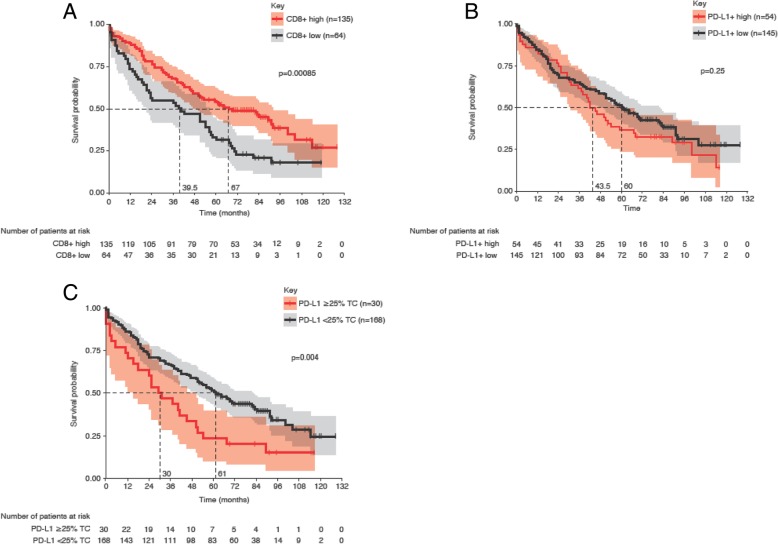
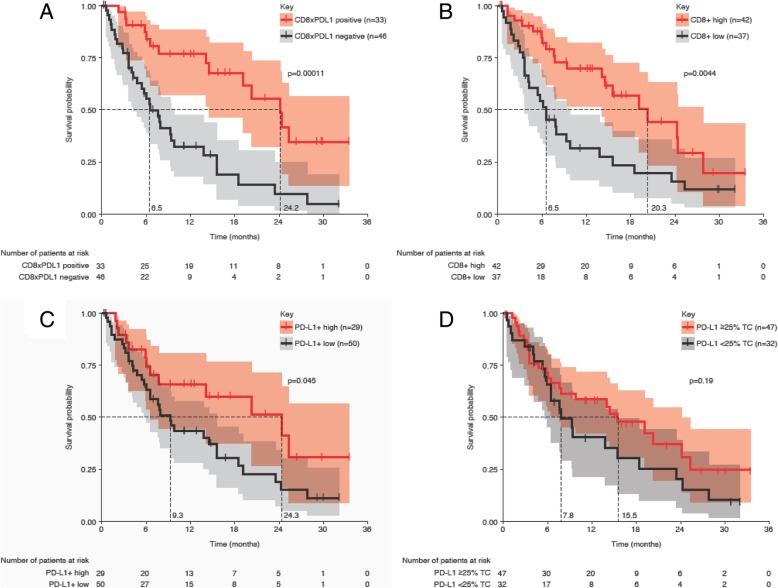
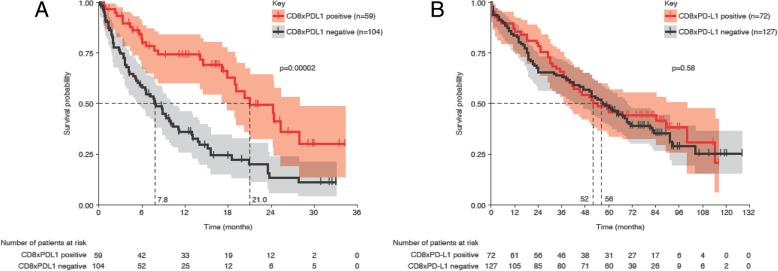
For patients who received durvalumab, median overall survival (OS) was 21.0 months for CD8xPD-L1 signature-positive patients and 7.8 months for signature-negative patients (p = 0.00002). The CD8xPD-L1 signature provided greater stratification of OS than high densities of CD8+ cells, high densities of PD-L1+ cells, or manually assessed tumor cell PD-L1 expression ≥25%. The CD8xPD-L1 signature did not stratify OS in non-ICT patients, although a high density of CD8+ cells was associated with higher median OS (high: 67 months; low: 39.5 months, p = 0.0009) in this group.
An automated CD8xPD-L1 signature may help to identify NSCLC patients with improved response to durvalumab therapy. Our data also support the prognostic value of CD8+ TILS in NSCLC patients who do not receive ICT.
ClinicalTrials.gov identifier: NCT01693562 . Study code: CD-ON-MEDI4736-1108. Interventional study (ongoing but not currently recruiting). Actual study start date: August 29, 2012. Primary completion date: June 23, 2017 (final data collection date for primary outcome measure).
针对程序性细胞死亡-1(PD1)/程序性细胞死亡配体-1(PD-L1)通路的免疫检查点疗法(ICTs)改善了非小细胞肺癌(NSCLC)患者的预后,尤其是那些高 PD-L1 表达的患者。然而,手动 PD-L1 评分的预测价值并不完美,需要替代指标。我们报告了一种自动化图像分析解决方案,用于确定基线肿瘤活检中 PD-L1+细胞和 CD8+肿瘤浸润淋巴细胞(TIL)密度(CD8xPD-L1 特征)乘积的预测和预后价值。
通过免疫组织化学分析对来自研究 1108/NCT01693562 的 163 名患者的存档或新鲜肿瘤活检进行 PD-L1 和 CD8 表达分析。这项 1 期/2 期试验评估了 durvalumab 在多种肿瘤类型中的作用,包括 NSCLC,同时纳入了另一组 199 名未接受 ICT 治疗的患者。使用专门的算法和 Developer XD 2.7 软件对 PD-L1+和 CD8+细胞密度进行自动评分。
对于接受 durvalumab 治疗的患者,CD8xPD-L1 特征阳性患者的中位总生存期(OS)为 21.0 个月,特征阴性患者的中位 OS 为 7.8 个月(p=0.00002)。CD8xPD-L1 特征比高 CD8+细胞密度、高 PD-L1+细胞密度或手动评估的肿瘤细胞 PD-L1 表达≥25%更能分层 OS。该特征在非 ICT 患者中未分层 OS,但在该组中,高 CD8+细胞密度与较高的中位 OS 相关(高:67 个月;低:39.5 个月,p=0.0009)。
一种自动化的 CD8xPD-L1 特征可能有助于识别对 durvalumab 治疗反应更好的 NSCLC 患者。我们的数据还支持 CD8+TILS 在未接受 ICT 治疗的 NSCLC 患者中的预后价值。
ClinicalTrials.gov 标识符:NCT01693562。研究代码:CD-ON-MEDI4736-1108。干预性研究(正在进行但尚未招募)。实际研究开始日期:2012 年 8 月 29 日。主要完成日期:2017 年 6 月 23 日(主要结局指标的最终数据收集日期)。