Institute of Health Informatics, University College London, London, UK.
Department of Population Science and Experimental Medicine, Institute of Cardiovascular Science, University College London, London, UK.
Int J Epidemiol. 2019 Jun 1;48(3):849-860. doi: 10.1093/ije/dyz071.
Short and long sleep duration have been linked with poorer cognitive outcomes, but it remains unclear whether these associations are causal.
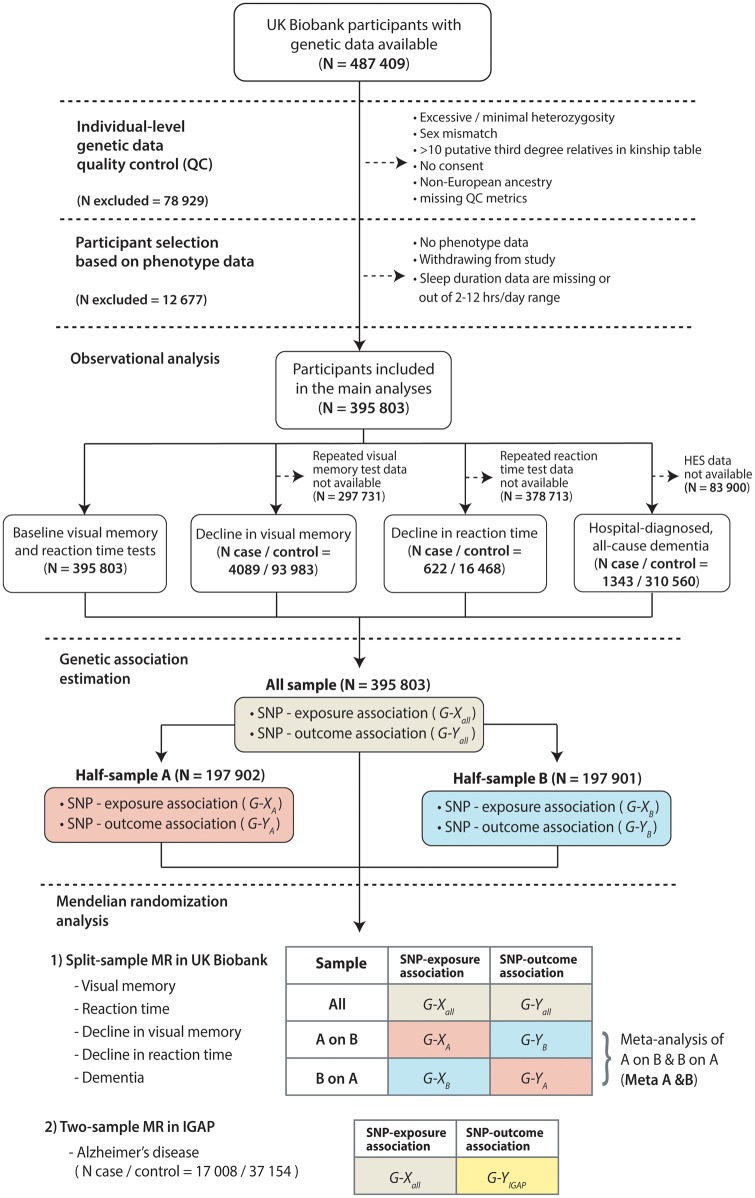
We conducted the first Mendelian randomization (MR) study with 77 single-nucleotide polymorphisms (SNPs) for sleep duration using individual-participant data from the UK Biobank cohort (N = 395 803) and summary statistics from the International Genomics of Alzheimer's Project (N cases/controls = 17 008/37 154) to investigate the potential impact of sleep duration on cognitive outcomes.
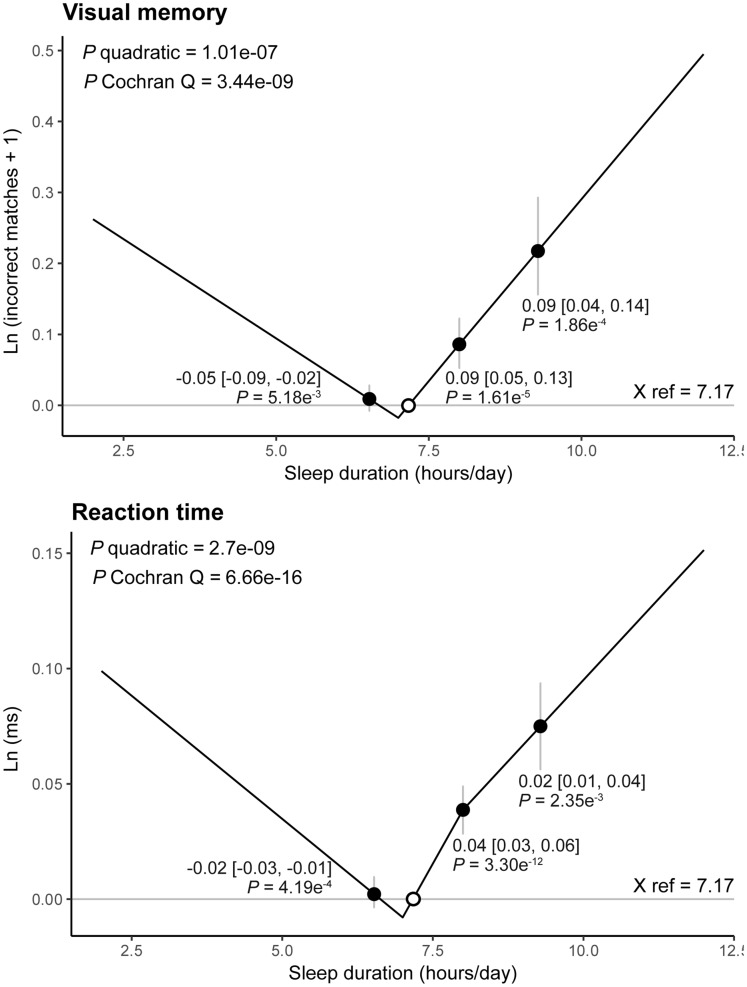
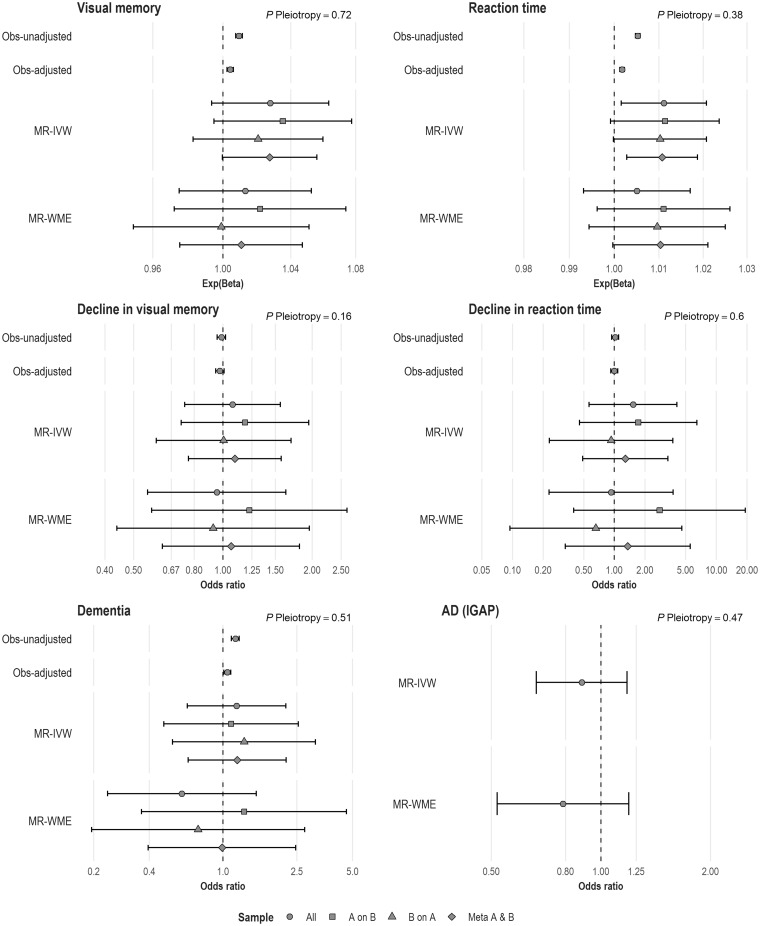
Linear MR suggested that each additional hour/day of sleep was associated with 1% [95% confidence interval (CI) = 0-2%; P = 0.008] slower reaction time and 3% more errors in visual-memory test (95% CI = 0-6%; P = 0.05). There was little evidence to support associations of increased sleep duration with decline in visual memory [odds ratio (OR) per additional hour/day of sleep = 1.10 (95% CI = 0.76-1.57); P = 0.62], decline in reaction time [OR = 1.28 (95% CI = 0.49-3.35); P = 0.61], all-cause dementia [OR = 1.19 (95% CI = 0.65-2.19); P = 0.57] or Alzheimer's disease risk [OR = 0.89 (95% CI = 0.67-1.18); P = 0.41]. Non-linear MR suggested that both short and long sleep duration were associated with poorer visual memory (P for non-linearity = 3.44e-9) and reaction time (P for non-linearity = 6.66e-16).
Linear increase in sleep duration has a small negative effect on reaction time and visual memory, but the true association might be non-linear, with evidence of associations for both short and long sleep duration. These findings suggest that sleep duration may represent a potential causal pathway for cognition.
短时间和长时间的睡眠与较差的认知结果有关,但目前尚不清楚这些关联是否具有因果关系。
我们使用英国生物库队列(N=395803)的个体参与者数据和国际阿尔茨海默病基因组学项目(N 病例/对照=17008/37154)的汇总统计数据进行了第一项睡眠持续时间的孟德尔随机化(MR)研究,共涉及 77 个单核苷酸多态性(SNP),以调查睡眠持续时间对认知结果的潜在影响。
线性 MR 表明,每天多睡 1 小时与反应时间慢 1%[95%置信区间(CI)=0-2%;P=0.008]和视觉记忆测试错误增加 3%[95%CI=0-6%;P=0.05]相关。几乎没有证据表明,增加睡眠时间与视觉记忆衰退[每增加 1 小时/天的睡眠的优势比(OR)=1.10(95%CI=0.76-1.57);P=0.62]、反应时间衰退[OR=1.28(95%CI=0.49-3.35);P=0.61]、全因痴呆[OR=1.19(95%CI=0.65-2.19);P=0.57]或阿尔茨海默病风险[OR=0.89(95%CI=0.67-1.18);P=0.41]相关。非线性 MR 表明,短时间和长时间的睡眠均与较差的视觉记忆(非线性 P 值=3.44e-9)和反应时间(非线性 P 值=6.66e-16)相关。
睡眠时间的线性增加对反应时间和视觉记忆有轻微的负面影响,但真实的关联可能是非线性的,短时间和长时间的睡眠均与认知结果相关。这些发现表明,睡眠时间可能是认知的一个潜在因果途径。