Center for Child Health Research, Faculty of Medicine and Health Technology, Tampere University, Tampere, Finland.
Center for Quantitative Medicine, Duke-NUS Medical School, Singapore.
PLoS One. 2019 May 7;14(5):e0216536. doi: 10.1371/journal.pone.0216536. eCollection 2019.
Intermittent preventive treatment in pregnancy (IPTp) with azithromycin and monthly sulfadoxine-pyrimethamine increased the mean child weight, mid-upper arm and head circumference at four weeks of age in a rural low-income setting. Now we assess for how long these gains were sustained during 0-5 years of age.
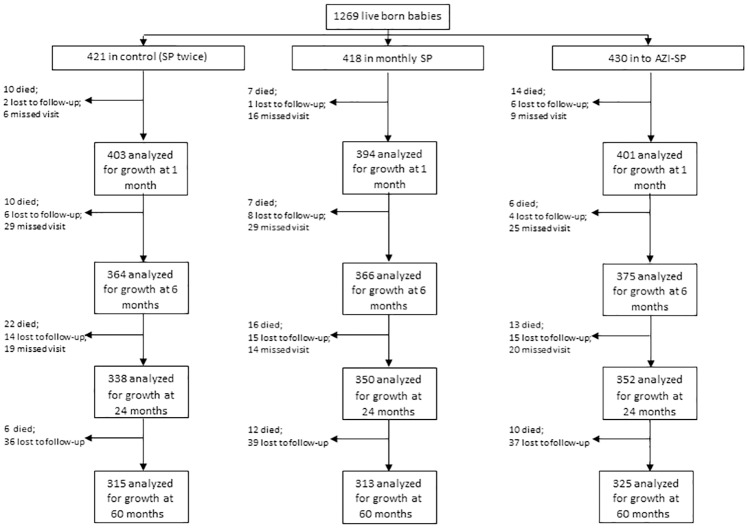
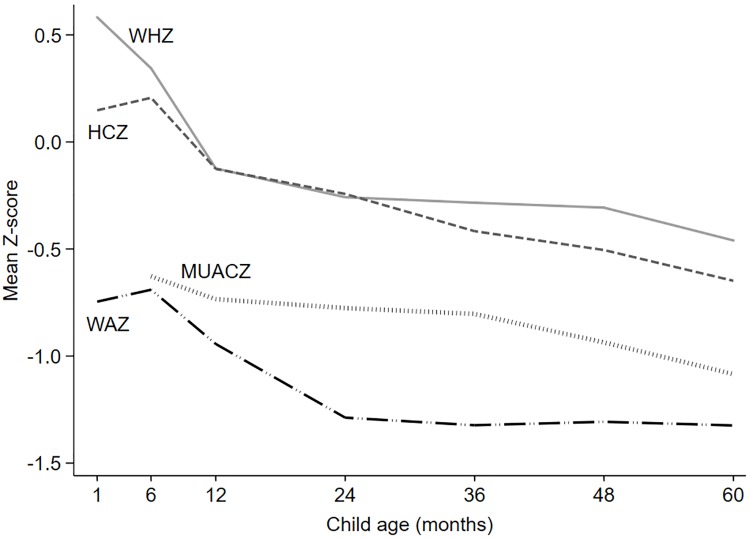
We enrolled 1320 pregnant Malawian women in a randomized trial and treated them with two doses of sulfadoxine-pyrimethamine (control) or monthly sulfadoxine-pyrimethamine as IPTp against malaria, or monthly sulfadoxine-pyrimethamine and two doses of azithromycin (AZI-SP) as IPTp against malaria and reproductive tract infections. Child weight, mid-upper arm circumference, head circumference and weight-for-height Z-score were recorded at one, six, 12, 24, 36, 48, and 60 months.
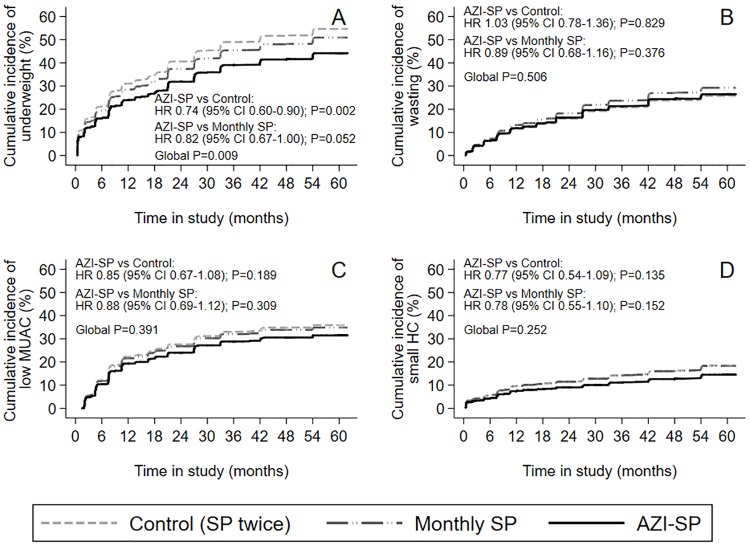
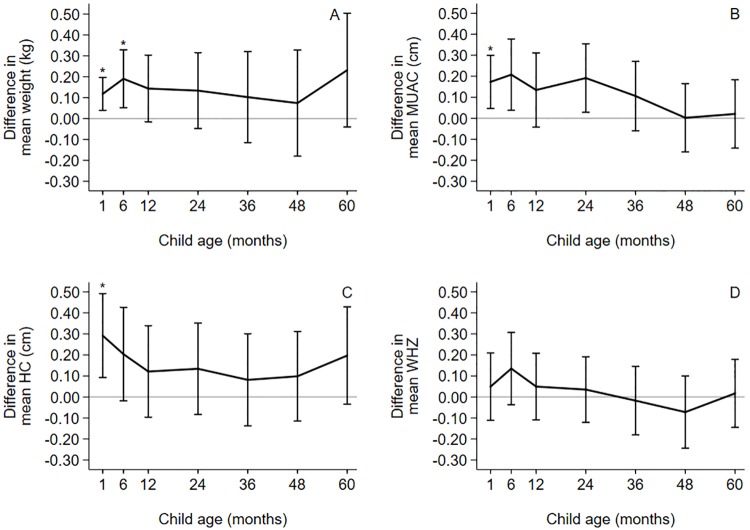
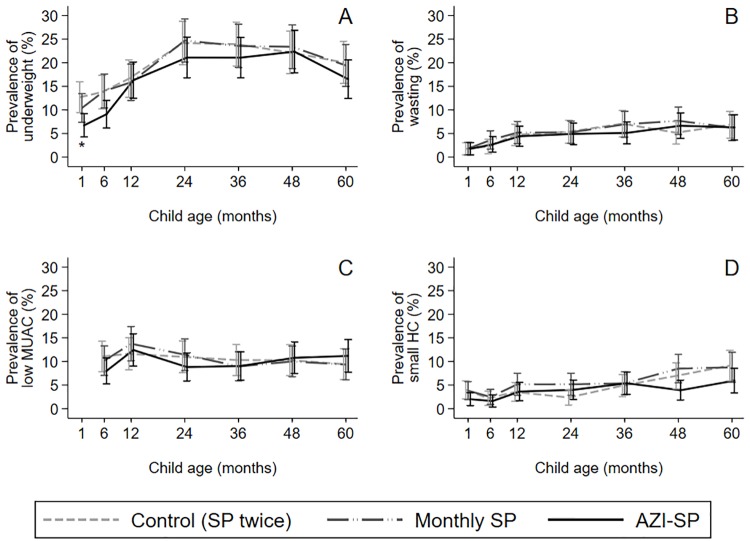
Throughout follow-up, the mean child weight was approximately 100 g higher (difference in means 0.12 kg, 95% CI 0.04-0.20, P = 0.003 at one month; 0.19 kg, 95% CI 0.05-0.33, P = 0.007, at six months), mean head circumference 2 mm larger (0.3 cm, 95% CI 0.1 to 0.5, P = 0.004 at one month) and the cumulative incidence of underweight by five years of age was lower (hazard ratio 0.74, 95% CI 0.60 to 0.90, P = 0.002) in the AZI-SP group than in the control group. The 2 mm difference in the mean mid-upper arm circumference at one month (0.2 cm, 95% CI 0.0 to 0.3, P = 0.007) disappeared after three years of age. There was no difference in mean weight-for-height Z-score at any time point.
In Malawi, IPTp with azithromycin and monthly sulfadoxine-pyrimethamine has a modest, 3-5-year positive impact on child weight, mid-upper arm circumference and head circumference, but not on weight-for-height Z-score.
在农村低收入环境中,用阿奇霉素进行间歇性预防治疗(IPT)和每月用磺胺多辛-乙胺嘧啶增加了儿童体重、中上臂围和头围在四周龄时的平均值。现在,我们评估这些收益在 0-5 岁期间持续了多长时间。
我们在一项随机试验中招募了 1320 名马拉维孕妇,并对她们进行了两剂磺胺多辛-乙胺嘧啶(对照)或每月磺胺多辛-乙胺嘧啶作为疟疾的 IPT,或每月磺胺多辛-乙胺嘧啶和两剂阿奇霉素(AZI-SP)作为疟疾和生殖 tract 感染的 IPT。在一个月、六个月、十二个月、二十四个月、三十六个月、四十八个月和六十个月时记录儿童体重、中上臂围、头围和体重身高 Z 分数。
在整个随访期间,儿童体重平均增加约 100 克(差异平均值 0.12 公斤,95%CI0.04-0.20,P=0.003 于一个月;0.19 公斤,95%CI0.05-0.33,P=0.007,在六个月),平均头围大 2 毫米(0.3 厘米,95%CI0.1 至 0.5,P=0.004 于一个月),五岁以下儿童体重不足的累积发病率较低(风险比 0.74,95%CI0.60 至 0.90,P=0.002)在 AZI-SP 组比在对照组。一个月时平均中上臂围的 2 毫米差异(0.2 厘米,95%CI0.0 至 0.3,P=0.007)在三岁后消失。在任何时间点,平均体重身高 Z 分数都没有差异。
在马拉维,用阿奇霉素进行 IPT 和每月用磺胺多辛-乙胺嘧啶对儿童体重、中上臂围和头围有适度的、3-5 年的积极影响,但对体重身高 Z 分数没有影响。