Limia Celia Maria, Sauzay Chloé, Urra Hery, Hetz Claudio, Chevet Eric, Avril Tony
Proteostasis & Cancer Team, Institut National de la Santé Et la Recherche Médicale U1242 Chemistry, Oncogenesis, Stress and Signaling, Université de Rennes, 35042 Rennes, France.
Centre Eugène Marquis, 35042 Rennes, France.
Cancers (Basel). 2019 May 6;11(5):631. doi: 10.3390/cancers11050631.
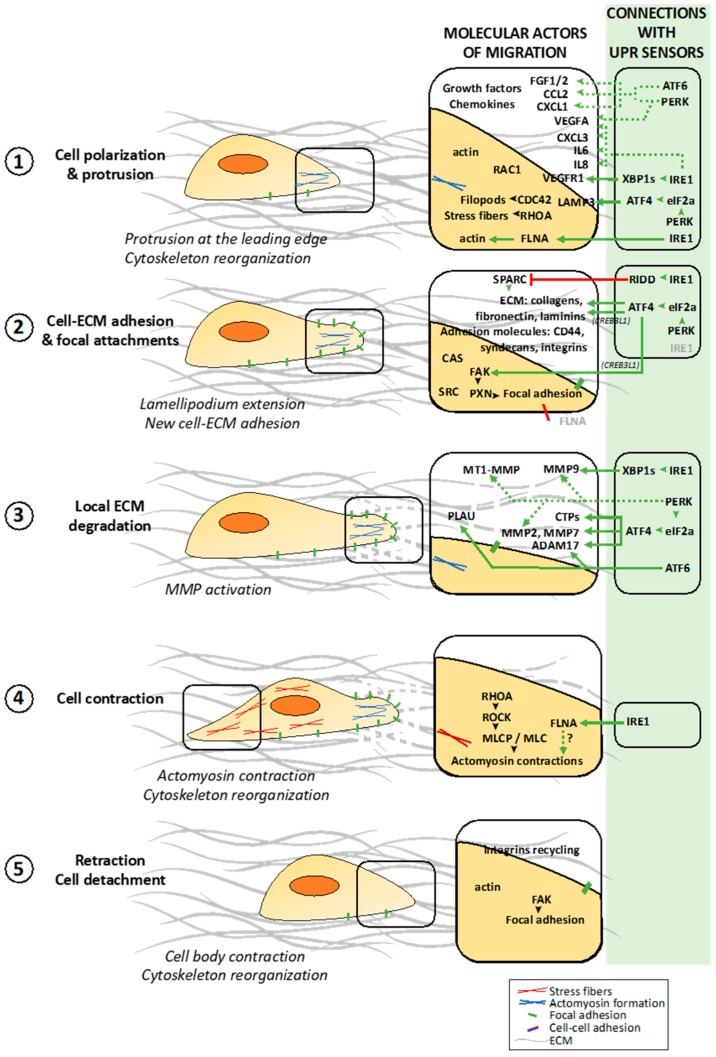
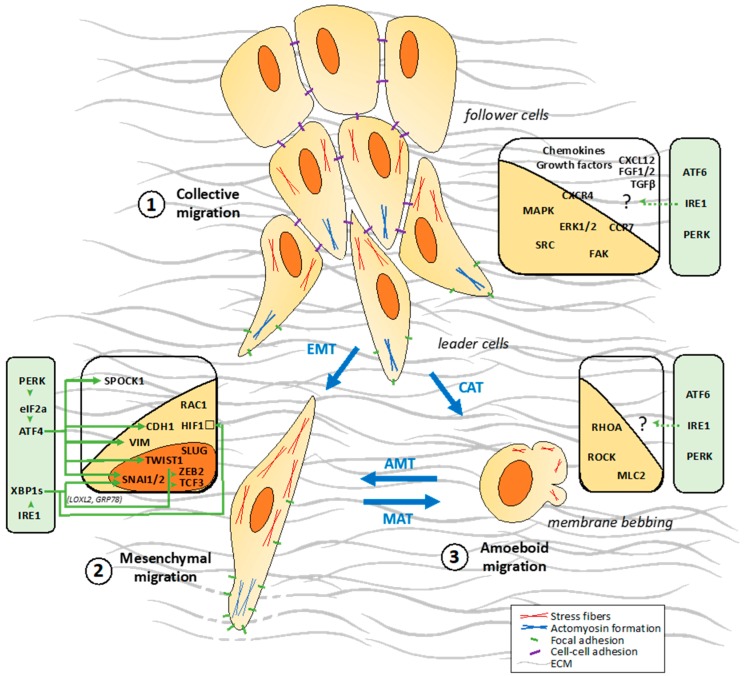
Endoplasmic reticulum (ER) proteostasis is often altered in tumor cells due to intrinsic (oncogene expression, aneuploidy) and extrinsic (environmental) challenges. ER stress triggers the activation of an adaptive response named the Unfolded Protein Response (UPR), leading to protein translation repression, and to the improvement of ER protein folding and clearance capacity. The UPR is emerging as a key player in malignant transformation and tumor growth, impacting on most hallmarks of cancer. As such, the UPR can influence cancer cells' migration and invasion properties. In this review, we overview the involvement of the UPR in cancer progression. We discuss its cross-talks with the cell migration and invasion machinery. Specific aspects will be covered including extracellular matrix (ECM) remodeling, modification of cell adhesion, chemo-attraction, epithelial-mesenchymal transition (EMT), modulation of signaling pathways associated with cell mobility, and cytoskeleton remodeling. The therapeutic potential of targeting the UPR to treat cancer will also be considered with specific emphasis in the impact on metastasis and tissue invasion.
由于内在(癌基因表达、非整倍体)和外在(环境)挑战,内质网(ER)蛋白质稳态在肿瘤细胞中常常发生改变。内质网应激触发一种名为未折叠蛋白反应(UPR)的适应性反应的激活,导致蛋白质翻译抑制,并提高内质网蛋白质折叠和清除能力。UPR正在成为恶性转化和肿瘤生长的关键参与者,影响癌症的大多数特征。因此,UPR可影响癌细胞的迁移和侵袭特性。在本综述中,我们概述了UPR在癌症进展中的作用。我们讨论了它与细胞迁移和侵袭机制的相互作用。将涵盖的具体方面包括细胞外基质(ECM)重塑、细胞黏附的改变、化学吸引、上皮-间质转化(EMT)、与细胞迁移相关的信号通路调节以及细胞骨架重塑。还将考虑靶向UPR治疗癌症的治疗潜力,特别强调其对转移和组织侵袭的影响。