Department of Biomedical Signals and Systems, University of Twente, Enschede, The Netherlands.
Department of Neurology, Amsterdam Neuroscience, Amsterdam UMC, University of Amsterdam, Amsterdam, The Netherlands.
J Neuroeng Rehabil. 2019 May 7;16(1):54. doi: 10.1186/s12984-019-0528-6.
The basal ganglia and cerebellum are brain structures involved in movement initiation, execution and termination. They are thought to be involved in the tremor generation and movement deficits in Parkinson's disease (PD) and essential tremor (ET). Especially in PD, maintaining cyclic movement, such as walking or tapping can be significantly disturbed. Providing external cues improves timing of these movements in PD but its effect on ET has not yet been studied in depth. The aim of this study is to evaluate the usefulness of a bimanual tapping task as a tool during clinical decision making.
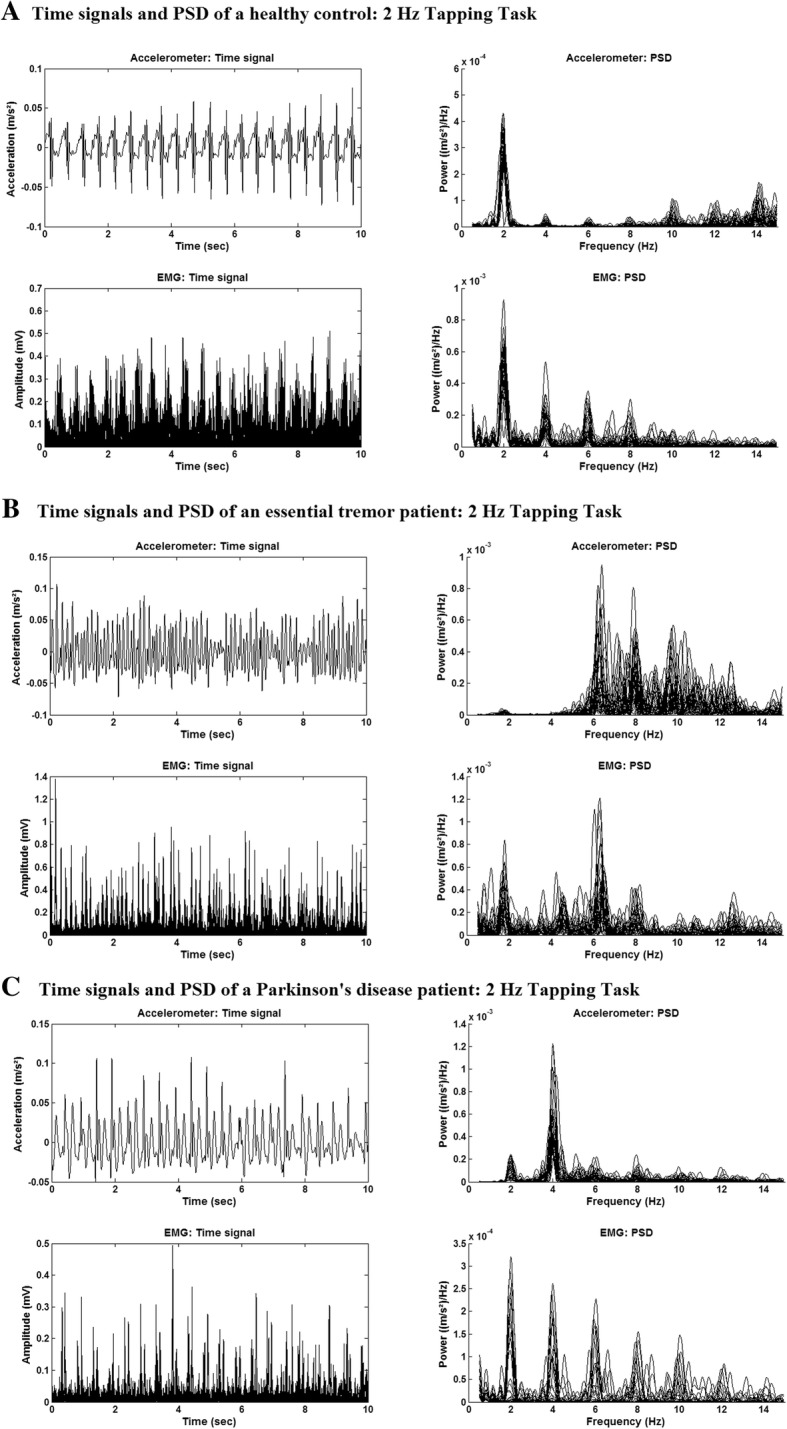
Hand movements and tremor was recorded using accelerometers and EMG (m. extensor carpi ulnaris) from PD and ET patients and healthy controls during a bimanual tapping task as a way to distinguish PD from ET. All subjects performed the tapping task at two different frequencies, 2 Hz and 4 Hz, with and without the presence of auditory cues.
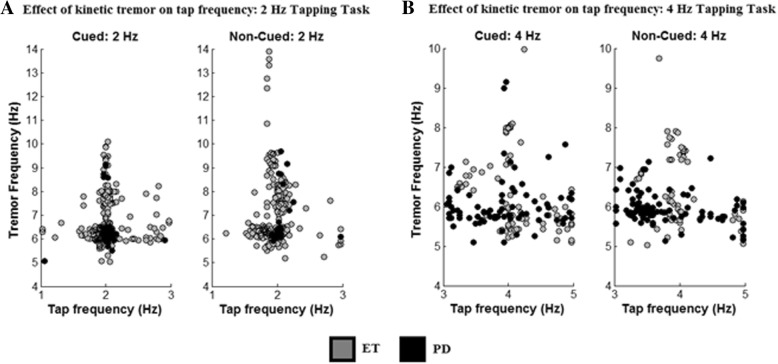
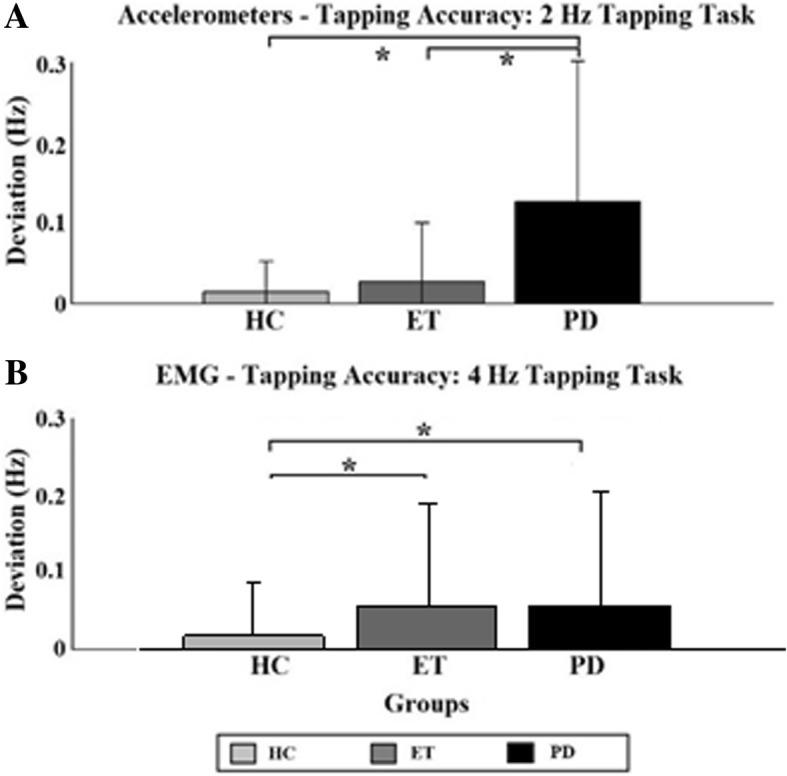
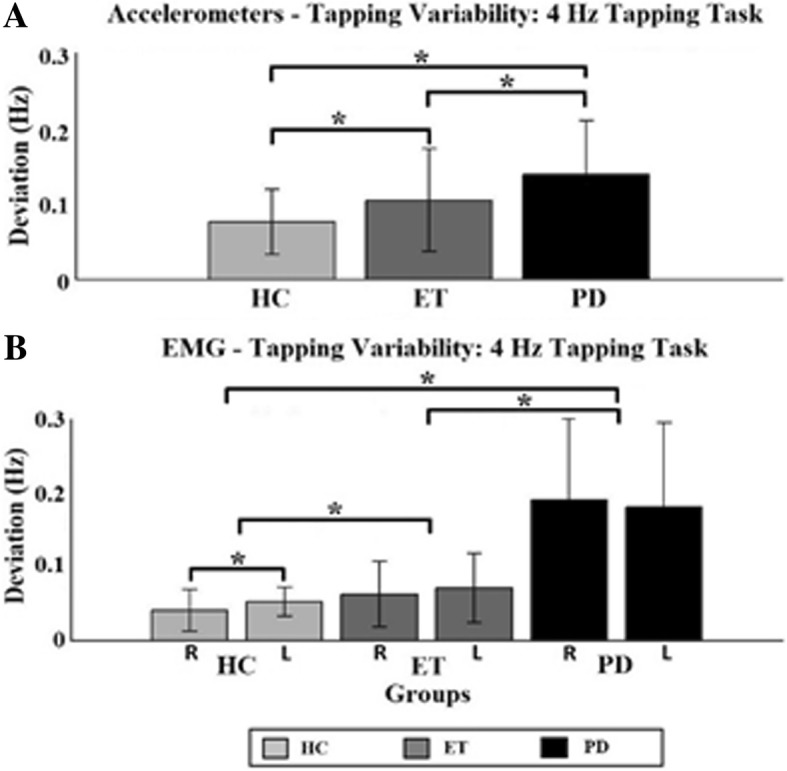
No significant intra-group differences were found in the patient groups. Acceleration data revealed significantly less accurate tapping and more variable tapping in PD than in ET and healthy controls. ET subjects tapped less accurate and with a greater variability than healthy controls during the 4 Hz tapping task. Most interestingly the tapping accuracy improved in PD patients when kinetic tremor was recorded with EMG during the task.
Providing ET and PD patients with an external cue results in different tapping performances between patient groups and healthy controls. Furthermore, the findings suggest that kinetic tremor in PD enables patients to perform the task with a greater accuracy. So far this has not been shown in other studies.
基底神经节和小脑是与运动起始、执行和终止相关的脑结构。它们被认为与帕金森病(PD)和特发性震颤(ET)的震颤产生和运动缺陷有关。尤其是在 PD 中,维持诸如行走或敲击等周期性运动可能会受到严重干扰。提供外部提示可以改善这些运动的定时,但它对 ET 的影响尚未深入研究。本研究旨在评估双手敲击任务作为临床决策工具的有用性。
使用加速度计和 EMG(尺侧腕伸肌)记录 PD 和 ET 患者以及健康对照者在双手敲击任务期间的手部运动和震颤,以区分 PD 和 ET。所有受试者在两种不同的频率(2 Hz 和 4 Hz)下,在有和没有听觉提示的情况下进行敲击任务。
在患者组内未发现显著的组内差异。加速度数据显示,与 ET 和健康对照组相比,PD 患者的敲击准确性较低,变异性较大。与健康对照组相比,ET 患者在 4 Hz 敲击任务中的敲击准确性较低,变异性较大。最有趣的是,当在任务期间使用 EMG 记录运动性震颤时,PD 患者的敲击准确性得到了改善。
为 ET 和 PD 患者提供外部提示会导致患者组和健康对照组之间的敲击表现不同。此外,这些发现表明 PD 中的运动性震颤使患者能够更准确地执行任务。到目前为止,这在其他研究中尚未显示。