Department of Microbiology and Immunology, University of Maryland School of Medicine, Baltimore, Maryland, USA.
Sigmovir Biosystems, Inc., Rockville, Maryland, USA.
mBio. 2019 May 7;10(3):e00810-19. doi: 10.1128/mBio.00810-19.
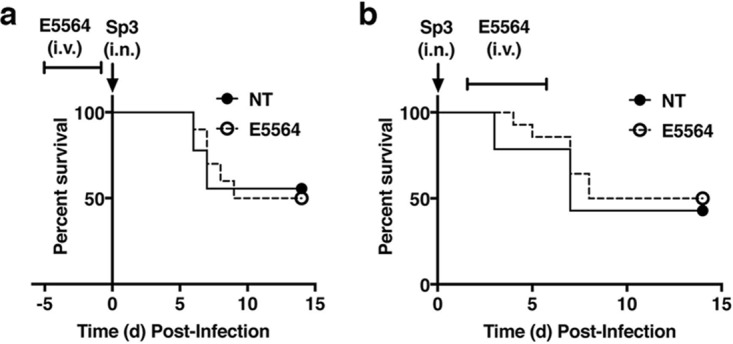
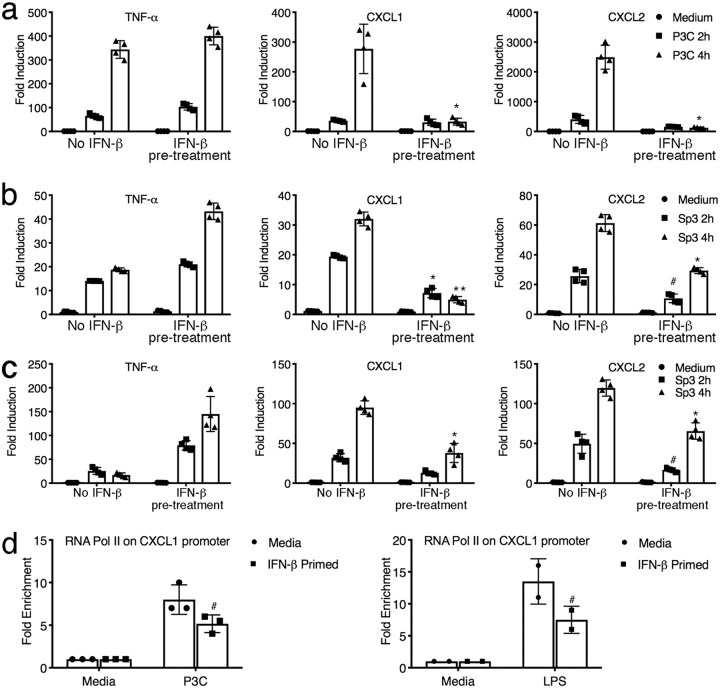
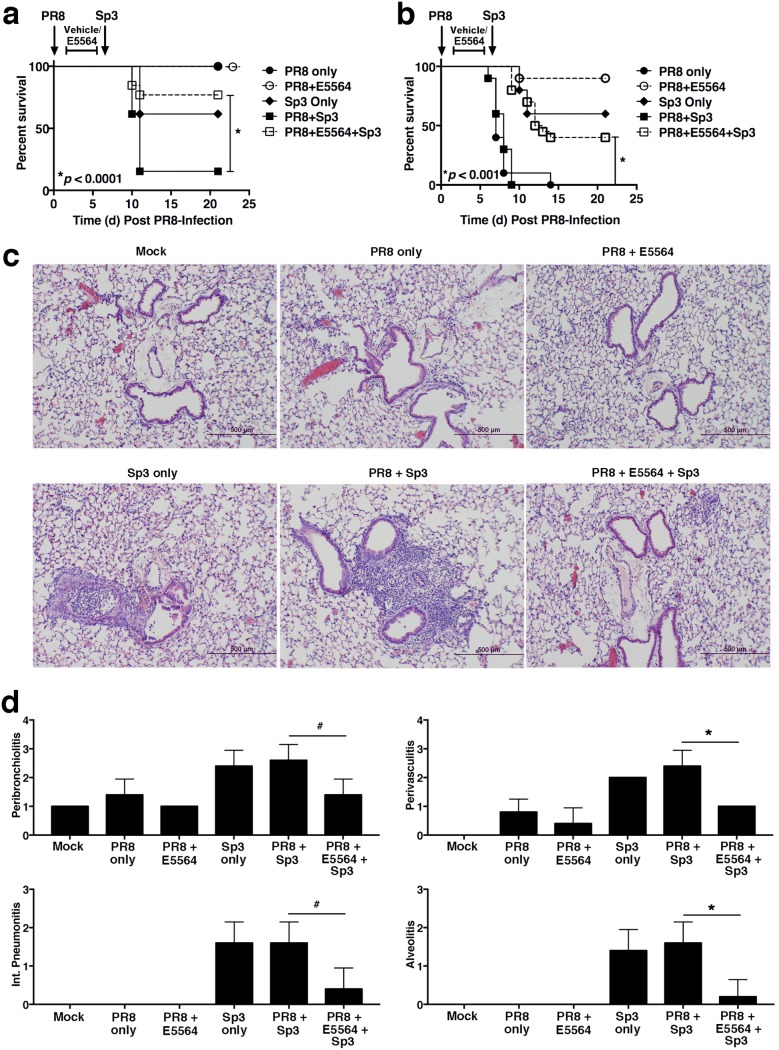
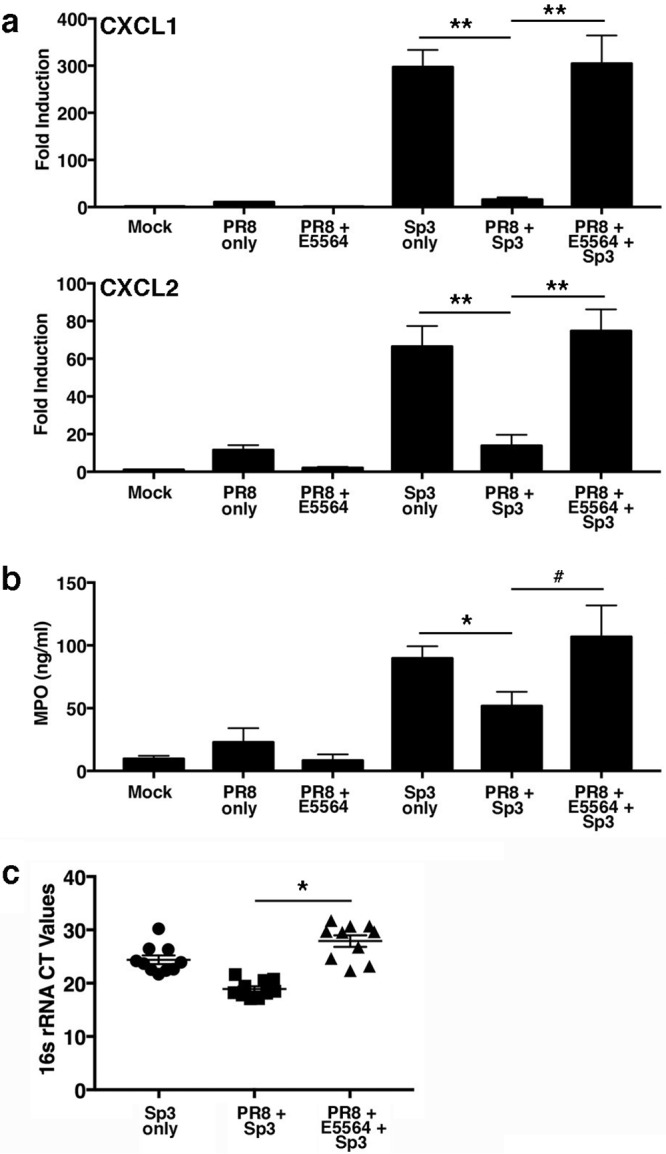
We previously reported that the Toll-like receptor 4 (TLR4) antagonist Eritoran blocks acute lung injury (ALI) therapeutically in mouse and cotton rat models of influenza. However, secondary (2°) bacterial infection following influenza virus infection is associated with excess morbidity and mortality. Wild-type (WT) mice infected with mouse-adapted influenza A/Puerto Rico/8/34 virus (PR8) and, 7 days later, with serotype 3 () exhibited significantly enhanced lung pathology and lethality that was reversed by Eritoran therapy after PR8 infection but before infection. Cotton rats infected with nonadapted pH1N1 influenza virus and then superinfected with methicillin-resistant also exhibited increased lung pathology and serum high-mobility-group box 1 (HMGB1) levels, both of which were blunted by Eritoran therapy. In mice, PR8 infection suppressed -induced CXCL1 and CXCL2 mRNA, reducing neutrophil infiltration and increasing the bacterial burden, all of which were reversed by Eritoran treatment. While beta interferon (IFN-β)-deficient (IFN-β) mice are highly susceptible to PR8, they exhibited delayed death upon superinfection, indicating that while IFN-β was protective against influenza, it negatively impacted the host response to IFN-β-treated WT macrophages selectively suppressed -induced CXCL1/CXCL2 transcriptionally, as evidenced by reduced recruitment of RNA polymerase II to the CXCL1 promoter. Thus, influenza establishes a "trained" state of immunosuppression toward 2° bacterial infection, in part through the potent induction of IFN-β and its downstream transcriptional regulation of chemokines, an effect reversed by Eritoran. Enhanced susceptibility to 2° bacterial infections following infection with influenza virus is a global health concern that accounts for many hospitalizations and deaths, particularly during pandemics. The complexity of the impaired host immune response during 2° bacterial infection has been widely studied. Both type I IFN and neutrophil dysfunction through decreased chemokine production have been implicated as mechanisms underlying enhanced susceptibility to 2° bacterial infections. Our findings support the conclusion that selective suppression of CXCL1/CXCL2 represents an IFN-β-mediated "training" of the macrophage transcriptional response to TLR2 agonists and that blocking of TLR4 therapeutically with Eritoran after influenza virus infection reverses this suppression by blunting influenza-induced IFN-β.
我们之前报道过 Toll 样受体 4(TLR4)拮抗剂 Eritoran 可在流感的小鼠和棉鼠模型中治疗性阻断急性肺损伤(ALI)。然而,流感病毒感染后继发的(2°)细菌感染与发病率和死亡率的增加有关。感染了经小鼠适应的流感 A/Puerto Rico/8/34 病毒(PR8)的野生型(WT)小鼠,在 7 天后再感染血清型 3 的(),其肺部病理学和死亡率显著增加,而 Eritoran 治疗在 PR8 感染后但在感染前可逆转这种情况。感染了非适应 pH1N1 流感病毒然后再感染耐甲氧西林的的棉鼠,也表现出了增加的肺部病理学和血清高迁移率族蛋白 1(HMGB1)水平,而这两种情况都可以通过 Eritoran 治疗得到缓解。在小鼠中,PR8 感染抑制了诱导的 CXCL1 和 CXCL2 mRNA,减少了中性粒细胞浸润并增加了细菌负荷,所有这些都可以通过 Eritoran 治疗来逆转。虽然β干扰素(IFN-β)缺陷(IFN-β)小鼠对 PR8 高度易感,但它们在继发感染时死亡时间延迟,表明虽然 IFN-β对流感有保护作用,但它对宿主对 2°细菌感染的反应产生负面影响。IFN-β 处理的 WT 巨噬细胞选择性地抑制了诱导的 CXCL1/CXCL2 的转录,这一点可以从 RNA 聚合酶 II 向 CXCL1 启动子募集减少得到证明。因此,流感通过强烈诱导 IFN-β及其对趋化因子的下游转录调控,对 2°细菌感染建立了一种“训练”状态的免疫抑制,这种作用可以通过 Eritoran 逆转。流感病毒感染后对 2°细菌感染的易感性增加是一个全球性的健康问题,这导致了许多住院和死亡,尤其是在大流行期间。2°细菌感染期间宿主免疫反应受损的复杂性已得到广泛研究。通过减少趋化因子产生导致的 I 型 IFN 和中性粒细胞功能障碍都被认为是对 2°细菌感染易感性增加的机制。我们的研究结果支持以下结论:选择性抑制 CXCL1/CXCL2 代表了巨噬细胞对 TLR2 激动剂转录反应的 IFN-β 介导的“训练”,并且在流感病毒感染后用 Eritoran 进行 TLR4 治疗性阻断可通过抑制流感诱导的 IFN-β来逆转这种抑制。