Institute for Computer Research, University of Alicante, P.O. Box 99, 03080 Alicante, Spain.
RoboticsLab-URJC, Universidad Rey Juan Carlos, Madrid, Spain.
Comput Intell Neurosci. 2019 Apr 2;2019:9412384. doi: 10.1155/2019/9412384. eCollection 2019.
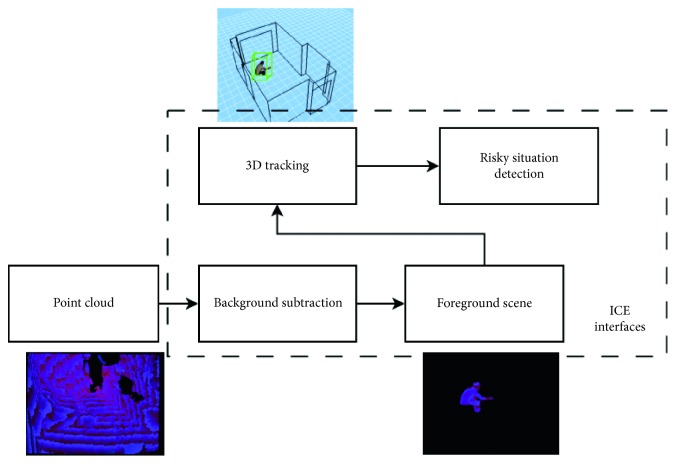
Ambient assisted living (AAL) environments are currently a key focus of interest as an option to assist and monitor disabled and elderly people. These systems can improve their quality of life and personal autonomy by detecting events such as entering potentially dangerous areas, potential fall events, or extended stays in the same place. Nonetheless, there are areas that remain outside the scope of AAL systems due to the placement of cameras. There also exist sources of danger in the scope of the camera that the AAL system cannot detect. These sources of danger are relatively small in size, occluded, or nonstatic. To solve this problem, we propose the inclusion of a robot which maps such uncovered areas looking for new potentially dangerous areas that go unnoticed by the AAL. The robot then sends this information to the AAL system in order to improve its performance. Experimentation in real-life scenarios successfully validates our approach.
环境辅助生活(AAL)环境目前是一个关注的焦点,作为一种辅助和监测残疾人和老年人的选择。这些系统可以通过检测进入潜在危险区域、潜在跌倒事件或在同一地点长时间停留等事件来提高他们的生活质量和个人自主权。尽管如此,由于摄像头的位置,仍有一些领域超出了 AAL 系统的范围。在 AAL 系统无法检测到的摄像头范围内,也存在危险源。这些危险源的尺寸相对较小、被遮挡或非静态。为了解决这个问题,我们提出了引入机器人的方案,机器人可以对这些未被覆盖的区域进行测绘,寻找 AAL 系统可能未检测到的新的潜在危险区域。然后,机器人将此信息发送到 AAL 系统,以提高其性能。在真实场景中的实验成功验证了我们的方法。