• 文献检索
  • 文档翻译
  • 深度研究
  • 学术资讯
  • Suppr Zotero 插件Zotero 插件
  • 邀请有礼
  • 套餐&价格
  • 历史记录
应用&插件
Suppr Zotero 插件Zotero 插件浏览器插件Mac 客户端Windows 客户端微信小程序
定价
高级版会员购买积分包购买API积分包
服务
文献检索文档翻译深度研究API 文档MCP 服务
关于我们
关于 Suppr公司介绍联系我们用户协议隐私条款
关注我们

Suppr 超能文献

核心技术专利:CN118964589B侵权必究
粤ICP备2023148730 号-1Suppr @ 2026

文献检索

告别复杂PubMed语法,用中文像聊天一样搜索,搜遍4000万医学文献。AI智能推荐,让科研检索更轻松。

立即免费搜索

文件翻译

保留排版,准确专业,支持PDF/Word/PPT等文件格式,支持 12+语言互译。

免费翻译文档

深度研究

AI帮你快速写综述,25分钟生成高质量综述,智能提取关键信息,辅助科研写作。

立即免费体验

面向老年人的陪伴机器人:罗杰斯的进化概念分析方法。

Companion robots for older adults: Rodgers' evolutionary concept analysis approach.

作者信息

Kim Jeongeun, Kim Sukwha, Kim Seongheui, Lee Euehun, Heo Yoonjeong, Hwang Cheol-Yong, Choi Yun-Young, Kong Hyoun-Joong, Ryu Hyeongju, Lee Hyeongsuk

机构信息

Research Institute of Nursing Science, Seoul National University, Seoul, Republic of Korea.

Department of Reconstructive Plastic Surgery, Medical Big Data Research Center, Seoul National University College of Medicine, Seoul, Republic of Korea.

出版信息

Intell Serv Robot. 2021;14(5):729-739. doi: 10.1007/s11370-021-00394-3. Epub 2021 Nov 16.

DOI:10.1007/s11370-021-00394-3
PMID:34804242
原文链接:https://pmc.ncbi.nlm.nih.gov/articles/PMC8593639/
Abstract

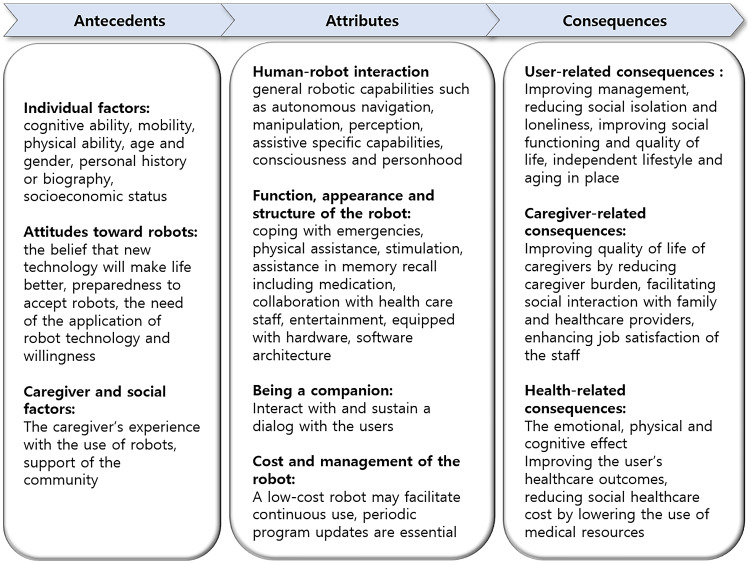
This study aims to analyze the concept of companion robots for older adults from the perspective of nursing. This study employed a concept analysis. The literature from July 2011 to June 2021 was sought from databases using specific keywords. Any quantitative or qualitative study published in English or Korean focusing on companion robots for older adults was included in the study. Rodgers' evolutionary concept analysis was used to clarify the antecedents, attributes, and consequences. Seventy-five eligible articles were studied. The findings were categorized into antecedents, attributes, and consequences. Companion robot antecedents were classified into individual factors, attitude toward robots, and caregiver and social factors. The defining attributes included human-robot interaction, function, features, structure, cost, and management of the robot being a companion. Consequences were categorized into user, caregiver, and health related. Companion robots are designed to enhance well-being, quality of life, and independence by providing service and companionship and assisting daily life. This mainly includes cognitive and social support, mobility support, relaxation, health monitoring, and self-care support through human-robot interaction. The attributes, antecedents, and consequences of companion robots identified in this study can inform future decision making and interventions by caregivers for aging in place.

摘要

本研究旨在从护理角度分析针对老年人的陪伴机器人的概念。本研究采用了概念分析法。通过使用特定关键词从数据库中检索2011年7月至2021年6月的文献。纳入研究的是任何以英文或韩文发表的、聚焦于老年人陪伴机器人的定量或定性研究。采用罗杰斯的进化概念分析法来阐明前因、属性和后果。对75篇符合条件的文章进行了研究。研究结果被分为前因、属性和后果。陪伴机器人的前因分为个体因素、对机器人的态度以及照顾者和社会因素。定义属性包括人机交互、功能、特征、结构、成本以及作为陪伴者的机器人的管理。后果分为与用户、照顾者和健康相关的方面。陪伴机器人旨在通过提供服务和陪伴以及协助日常生活来提高幸福感、生活质量和独立性。这主要包括通过人机交互提供认知和社会支持、行动支持、放松、健康监测和自我护理支持。本研究中确定的陪伴机器人的属性、前因和后果可为照顾者未来关于原地养老的决策和干预提供参考。
https://cdn.ncbi.nlm.nih.gov/pmc/blobs/a1e3/8593639/64fc72cbd04d/11370_2021_394_Fig3_HTML.jpg
https://cdn.ncbi.nlm.nih.gov/pmc/blobs/a1e3/8593639/796fdec87ab0/11370_2021_394_Fig1_HTML.jpg
https://cdn.ncbi.nlm.nih.gov/pmc/blobs/a1e3/8593639/98d44a4787f9/11370_2021_394_Fig2_HTML.jpg
https://cdn.ncbi.nlm.nih.gov/pmc/blobs/a1e3/8593639/64fc72cbd04d/11370_2021_394_Fig3_HTML.jpg
https://cdn.ncbi.nlm.nih.gov/pmc/blobs/a1e3/8593639/796fdec87ab0/11370_2021_394_Fig1_HTML.jpg
https://cdn.ncbi.nlm.nih.gov/pmc/blobs/a1e3/8593639/98d44a4787f9/11370_2021_394_Fig2_HTML.jpg
https://cdn.ncbi.nlm.nih.gov/pmc/blobs/a1e3/8593639/64fc72cbd04d/11370_2021_394_Fig3_HTML.jpg

相似文献

1
Companion robots for older adults: Rodgers' evolutionary concept analysis approach.面向老年人的陪伴机器人:罗杰斯的进化概念分析方法。
Intell Serv Robot. 2021;14(5):729-739. doi: 10.1007/s11370-021-00394-3. Epub 2021 Nov 16.
2
Transitional care: Concept analysis using Rodgers' evolutionary approach.过渡护理:基于罗德斯进化法的概念分析
Int J Nurs Stud. 2019 Nov;99:103387. doi: 10.1016/j.ijnurstu.2019.103387. Epub 2019 Aug 1.
3
Improving the Social Well-Being of Single Older Adults Using the LOVOT Social Robot: Qualitative Phenomenological Study.利用 LOVOT 社交机器人提高单身老年人的社会幸福感:定性现象学研究。
JMIR Hum Factors. 2024 Aug 23;11:e56669. doi: 10.2196/56669.
4
Identifying Features that Enhance Older Adults' Acceptance of Robots: A Mixed Methods Study.识别特征,提高老年人对机器人的接受度:混合方法研究。
Gerontology. 2019;65(4):441-450. doi: 10.1159/000494881. Epub 2019 Mar 7.
5
Needs and Preferences of Middle-Aged and Older Adults in Taiwan for Companion Robots and Pets: Survey Study.台湾中老年群体对陪伴机器人和宠物的需求和偏好:调查研究。
J Med Internet Res. 2021 Jun 11;23(6):e23471. doi: 10.2196/23471.
6
Eating experiences in people living with dementia: A concept analysis using Rodgers's methodology.痴呆症患者的饮食体验:基于罗杰斯方法论的概念分析。
J Adv Nurs. 2024 Nov;80(11):4461-4475. doi: 10.1111/jan.16191. Epub 2024 Apr 5.
7
Recommendations for designing conversational companion robots with older adults through foundation models.通过基础模型与老年人设计对话式陪伴机器人的建议。
Front Robot AI. 2024 May 27;11:1363713. doi: 10.3389/frobt.2024.1363713. eCollection 2024.
8
Intelligent Physical Robots in Health Care: Systematic Literature Review.智能物理机器人在医疗保健中的应用:系统文献综述。
J Med Internet Res. 2023 Jan 18;25:e39786. doi: 10.2196/39786.
9
User-Centered Design of Companion Robot Pets Involving Care Home Resident-Robot Interactions and Focus Groups With Residents, Staff, and Family: Qualitative Study.以用户为中心的陪伴机器人宠物设计,涉及养老院居民与机器人的互动以及与居民、工作人员和家属的焦点小组讨论:定性研究
JMIR Rehabil Assist Technol. 2021 Nov 1;8(4):e30337. doi: 10.2196/30337.
10
A concept analysis of transitional care for people with cancer.癌症患者过渡期护理的概念分析。
Nurs Open. 2024 Jan;11(1):e2083. doi: 10.1002/nop2.2083.

引用本文的文献

1
Investigating Elderly Individuals' Acceptance of Artificial Intelligence (AI)-Powered Companion Robots: The Influence of Individual Characteristics.调查老年人对人工智能驱动的陪伴机器人的接受度:个体特征的影响。
Behav Sci (Basel). 2025 May 18;15(5):697. doi: 10.3390/bs15050697.
2
Human-Robot Intimacy: Acceptance of Robots as Intimate Companions.人机亲密关系:将机器人接受为亲密伴侣
Biomimetics (Basel). 2024 Sep 19;9(9):566. doi: 10.3390/biomimetics9090566.
3
Telepresence Robot Intervention to Reduce Loneliness and Social Isolation in Older Adults Living at Home (Project DOMIROB): Protocol for a Clinical Nonrandomized Study.

本文引用的文献

1
Needs and Preferences of Middle-Aged and Older Adults in Taiwan for Companion Robots and Pets: Survey Study.台湾中老年群体对陪伴机器人和宠物的需求和偏好:调查研究。
J Med Internet Res. 2021 Jun 11;23(6):e23471. doi: 10.2196/23471.
2
Barriers and facilitators to the implementation of social robots for older adults and people with dementia: a scoping review.社会机器人在老年人和痴呆症患者中的应用障碍和促进因素:范围综述。
BMC Geriatr. 2021 Jun 9;21(1):351. doi: 10.1186/s12877-021-02277-9.
3
Attitudes of the elderly living independently towards the use of robots to assist with activities of daily living.
远程临场机器人干预以减少居家老年人的孤独感和社会隔离(DOMIROB项目):一项临床非随机研究方案
JMIR Res Protoc. 2022 Oct 31;11(10):e40528. doi: 10.2196/40528.
独居老人对使用机器人辅助日常生活活动的态度。
Work. 2021;69(1):55-65. doi: 10.3233/WOR-205166.
4
Social Telepresence Robots: A Narrative Review of Experiments Involving Older Adults before and during the COVID-19 Pandemic.社交型远程临场机器人:一项关于新冠疫情前后涉及老年人的实验的叙述性综述。
Int J Environ Res Public Health. 2021 Mar 30;18(7):3597. doi: 10.3390/ijerph18073597.
5
Older adults' experiences and perceptions of living with Bomy, an assistive dailycare robot: a qualitative study.老年人使用 Bomy 这款日常辅助机器人的体验和看法:一项定性研究。
Assist Technol. 2022 Jul 4;34(4):487-497. doi: 10.1080/10400435.2021.1877210. Epub 2021 May 3.
6
The Perceptions of People with Dementia and Key Stakeholders Regarding the Use and Impact of the Social Robot MARIO.《关于社交机器人 MARIO 的使用和影响,痴呆症患者及主要利益相关者的看法》
Int J Environ Res Public Health. 2020 Nov 20;17(22):8621. doi: 10.3390/ijerph17228621.
7
Robotic Pet Use Among Community-Dwelling Older Adults.社区居住的老年人使用机器人宠物。
J Gerontol B Psychol Sci Soc Sci. 2020 Oct 16;75(9):2018-2028. doi: 10.1093/geronb/gbaa119.
8
Role of Assistive Robots in the Care of Older People: Survey Study Among Medical and Nursing Students.辅助机器人在老年人护理中的作用:对医学和护理专业学生的调查研究。
J Med Internet Res. 2020 Aug 12;22(8):e18003. doi: 10.2196/18003.
9
Home-Based Cognitively Assistive Robots: Maximizing Cognitive Functioning and Maintaining Independence in Older Adults Without Dementia.居家认知辅助机器人:提高认知功能,使无痴呆的老年成年人保持独立。
Clin Interv Aging. 2020 Jul 13;15:1129-1139. doi: 10.2147/CIA.S253236. eCollection 2020.
10
Ethical perceptions towards real-world use of companion robots with older people and people with dementia: survey opinions among younger adults.年轻人对陪伴机器人在老年人和痴呆症患者实际应用的伦理看法:一项针对年轻人的调查意见。
BMC Geriatr. 2020 Jul 14;20(1):244. doi: 10.1186/s12877-020-01641-5.