Department of Orthopaedic Surgery, Wakamatsu Hospital of the University of Occupational and Environmental Health, 1-17-1, Hamamachi, Wakamatsu, Kitakyushu, Fukuoka, 808-0024, Japan.
DISC sports and Spine, Marina Del Rey, USA.
Knee Surg Sports Traumatol Arthrosc. 2020 May;28(5):1648-1655. doi: 10.1007/s00167-019-05520-4. Epub 2019 May 7.
The purposes of this study were to (1) evaluate the effect of age on clinical outcomes of arthroscopic femoroacetabular impingement (FAI) with labral preservation surgery and (2) identify predictors of poor postoperative clinical outcomes.
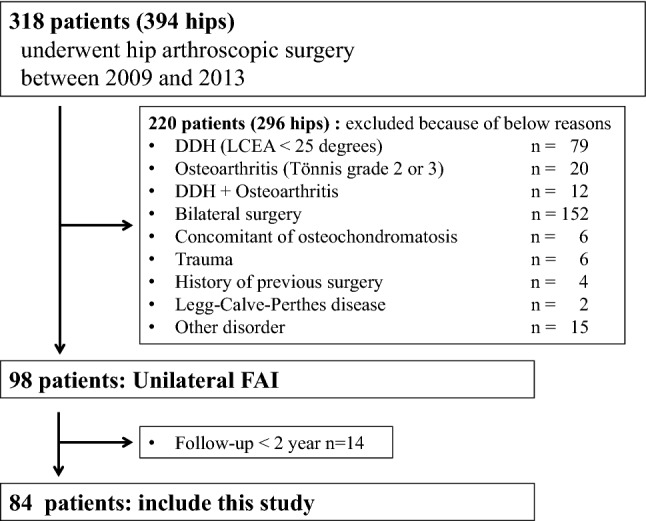
Eighty-four patients who underwent hip arthroscopic treatment for FAI between 2009 and 2013 were retrospectively reviewed. Patients were divided into three groups based on age. The Advanced age group consisted of patients over 70 years old, the Middle age group consisted of patients in their 50s and 60s, and the Younger age group consisted of patients less than 50 years of age. Total hip arthroplasty (THA) conversion, radiographic progression of osteoarthritis and patient-reported outcomes including modified Harris Hip Score (MHHS) and Non-arthritic Hip Score (NAHS) were investigated.
The mean follow-up period was 32.2 (range 24-60) months. THA was required in 3 patients in their 50s and 60s, which was a significantly higher rate compared to that in patients Younger than 50 years old (17% vs 0%, p = 0.036). Progression to osteoarthritis was also significantly more frequent in patients in their 50s and 60s than in patients in their 70s (50s and 60s: 33%; 70s: 0%, p = 0.030). In all age groups, the preoperative MHHS and NAHS improved at last follow-up (p < 0.001). The 50s and 60s age group [hazard ratio (HR) 6.62], preoperative mild osteoarthritic change (Tönnis grade 1, HR: 3.29) and severe cartilage damage on the acetabulum (HR: 2.63) were risk factors for progressive osteoarthritis and THA conversion.
Arthroscopic FAI correction and labral preservation surgery provide favourable clinical outcomes for patients over 70 years old in the absence of significant osteoarthritis and severe acetabular chondral damage. Patients in their 50s and 60s have a higher risk of both THA conversion and progressive osteoarthritis, while patients aged over 70 years show no evidence of progressive osteoarthritis. Chronologic age in isolation is not an absolute contra-indication to hip arthroscopy.
III.
本研究旨在:(1) 评估年龄对保留盂唇的髋关节镜下股骨髋臼撞击症(FAI)治疗的临床结果的影响;(2) 确定术后临床结果不佳的预测因素。
回顾性分析了 2009 年至 2013 年间接受髋关节镜治疗 FAI 的 84 例患者。根据年龄将患者分为三组。高龄组为 70 岁以上的患者,中龄组为 50 岁至 60 岁的患者,低龄组为 50 岁以下的患者。研究内容包括全髋关节置换术(THA)转换、影像学进展性骨关节炎以及患者报告的结果,包括改良 Harris 髋关节评分(MHHS)和非关节炎髋关节评分(NAHS)。
平均随访时间为 32.2(24-60)个月。在 50 岁和 60 岁的患者中,有 3 例需要进行 THA,这一比例明显高于 50 岁以下的患者(17% vs 0%,p=0.036)。50 岁和 60 岁的患者中进展为骨关节炎的比例也明显高于 70 岁的患者(50 岁和 60 岁:50%;70 岁:0%,p=0.030)。在所有年龄组中,术前 MHHS 和 NAHS 在末次随访时均有所改善(p<0.001)。50 岁和 60 岁年龄组(HR 6.62)、术前轻度骨关节炎改变(Tönnis 分级 1,HR:3.29)和髋臼严重软骨损伤(HR:2.63)是进展性骨关节炎和 THA 转换的危险因素。
对于无明显骨关节炎和严重髋臼软骨损伤的 70 岁以上患者,髋关节镜下 FAI 矫正和盂唇保留手术可获得良好的临床效果。50 岁和 60 岁的患者 THA 转换和进展性骨关节炎的风险较高,而 70 岁以上的患者则没有进展性骨关节炎的证据。单纯的年龄并不是髋关节镜手术的绝对禁忌症。
III 级。