Leurs C E, Twaalfhoven Ham, Lissenberg-Witte B I, van Pesch V, Dujmovic I, Drulovic J, Castellazzi M, Bellini T, Pugliatti M, Kuhle J, Villar L M, Alvarez-Cermeño J C, Alvarez-Lafuente R, Hegen H, Deisenhammer F, Walchhofer L M, Thouvenot E, Comabella M, Montalban X, Vécsei L, Rajda C, Galimberti D, Scarpini E, Altintas A, Rejdak K, Frederiksen J L, Pihl-Jensen G, Jensen Peh, Khalil M, Voortman M M, Fazekas F, Saiz A, La Puma D, Vercammen M, Vanopdenbosch L, Uitdehaag Bmj, Killestein J, Bridel C, Teunissen C
Department of Neurology, MS Center Amsterdam, VU University Medical Center, De Boelelaan 1118, Amsterdam 1081 HZ, The Netherlands.
Neurochemistry Laboratory and Biobank, Department of Clinical Chemistry, MS Center Amsterdam, Amsterdam Neuroscience, Amsterdam UMC, location VUmc, Amsterdam, The Netherlands.
Mult Scler. 2020 Jul;26(8):912-923. doi: 10.1177/1352458519845844. Epub 2019 May 8.
To validate kappa free light chain (KFLC) and lambda free light chain (LFLC) indices as a diagnostic biomarker in multiple sclerosis (MS).
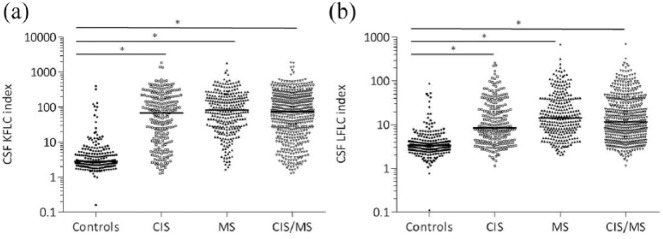
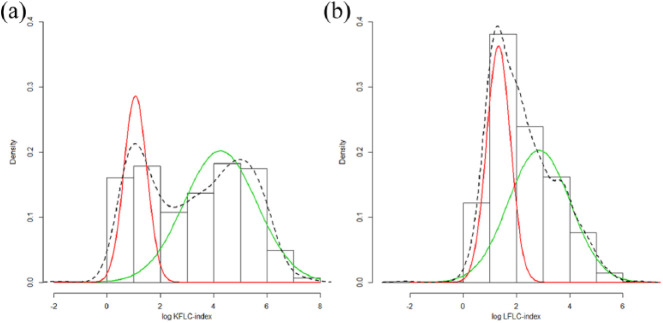
We performed a multicenter study including 745 patients from 18 centers (219 controls and 526 clinically isolated syndrome (CIS)/MS patients) with a known oligoclonal IgG band (OCB) status. KFLC and LFLC were measured in paired cerebrospinal fluid (CSF) and serum samples. Gaussian mixture modeling was used to define a cut-off for KFLC and LFLC indexes.
The cut-off for the KFLC index was 6.6 (95% confidence interval (CI) = 5.2-138.1). The cut-off for the LFLC index was 6.9 (95% CI = 4.5-22.2). For CIS/MS patients, sensitivity of the KFLC index (0.88; 95% CI = 0.85-0.90) was higher than OCB (0.82; 95%CI = 0.79-0.85; < 0.001), but specificity (0.83; 95% CI = 0.78-0.88) was lower (OCB = 0.92; 95% CI = 0.89-0.96; < 0.001). Both sensitivity and specificity for the LFLC index were lower than OCB.
Compared with OCB, the KFLC index is more sensitive but less specific for diagnosing CIS/MS. Lacking an elevated KFLC index is more powerful for excluding MS compared with OCB but the latter is more important for ruling in a diagnosis of CIS/MS.
验证κ游离轻链(KFLC)和λ游离轻链(LFLC)指标作为多发性硬化症(MS)诊断生物标志物的有效性。
我们开展了一项多中心研究,纳入了来自18个中心的745例患者(219例对照和526例临床孤立综合征(CIS)/MS患者),这些患者的寡克隆IgG带(OCB)状态已知。在配对的脑脊液(CSF)和血清样本中测量KFLC和LFLC。采用高斯混合模型确定KFLC和LFLC指标的临界值。
KFLC指标的临界值为6.6(95%置信区间(CI)=5.2 - 138.1)。LFLC指标的临界值为6.9(95%CI = 4.5 - 22.2)。对于CIS/MS患者,KFLC指标的敏感性(0.88;95%CI = 0.85 - 0.90)高于OCB(0.82;95%CI = 0.79 - 0.85;P < 0.001),但特异性(0.83;95%CI = 0.78 - 0.88)较低(OCB = 0.92;95%CI = 0.89 - 0.96;P < 0.001)。LFLC指标的敏感性和特异性均低于OCB。
与OCB相比,KFLC指标对CIS/MS的诊断更敏感但特异性较低。与OCB相比缺乏升高的KFLC指标对排除MS更具说服力,但后者对确诊CIS/MS更重要。