Fernández-Domínguez Manuel, Ortega-Asensio Victor, Fuentes-Numancia Elena, Aragoneses Juan Manuel, Barbu Horia Mihail, Ramírez-Fernández María Piedad, Delgado-Ruiz Rafael Arcesio, Calvo-Guirado José Luis, Samet Nahum, Gehrke Sergio Alexandre
Maxillofacial Department HM Hospitals, Doctoral Program of Translational Medicine, CEU San Pablo University, 28223 Madrid, Spain.
Department of Implant Dentistry, CEU San Pablo University, 28223 Madrid, Spain.
J Clin Med. 2019 May 7;8(5):618. doi: 10.3390/jcm8050618.
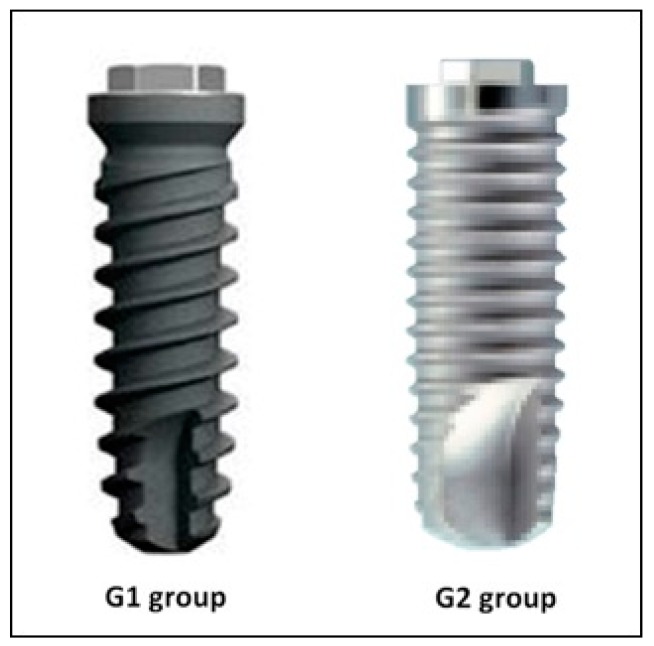
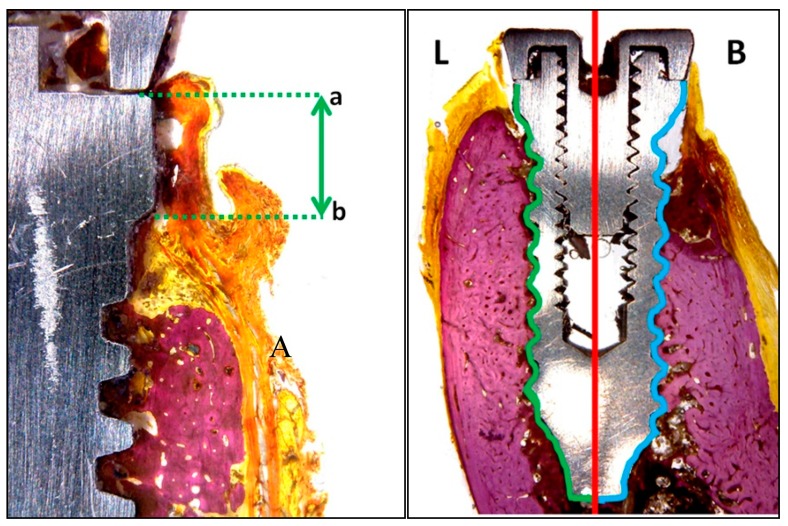
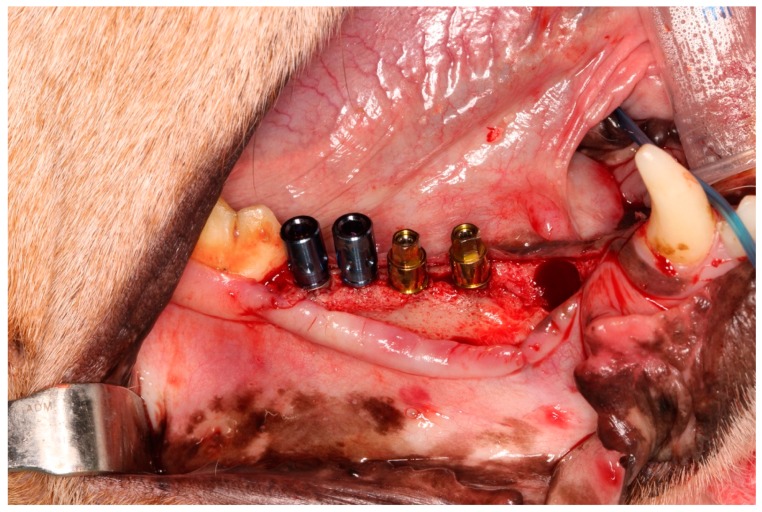
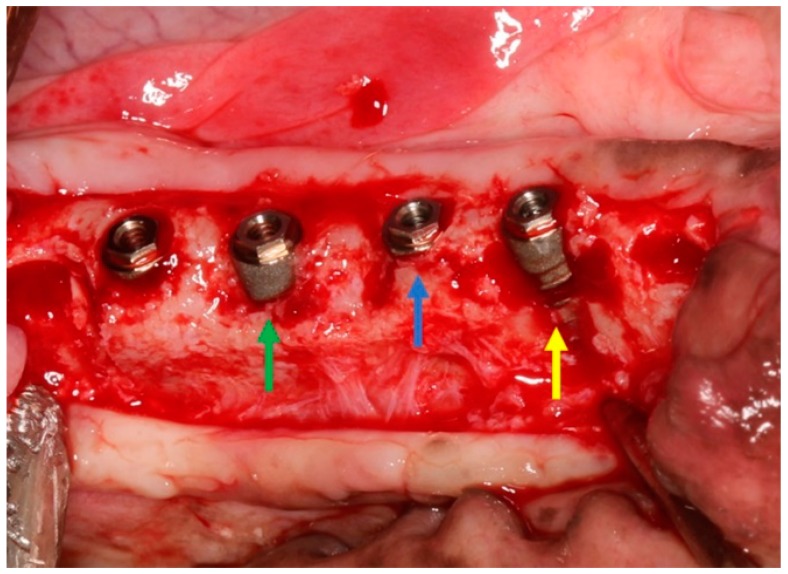
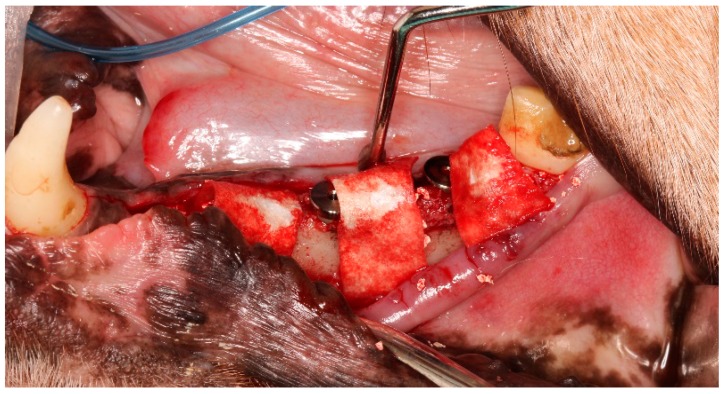
The aim of this experimental animal study was to assess guided bone regeneration (GBR) and implant stability (ISQ) around two dental implants with different macrogeometries. Forty eight dental implants were placed within six Beagle dogs. The implants were divided into two groups ( = 24 per group): G1 group implants presented semi-conical macrogeometry, a low apical self-tapping portion, and an external hexagonal connection (whereby the cervical portion was bigger than the implant body). G2 group implants presented parallel walls macrogeometry, a strong apical self-tapping portion, and an external hexagonal connection (with the cervical portion parallel to the implant body). Buccal (mouth-related) defects of 2 mm (c2 condition) and 5 mm (c3 condition) were created. For the control condition with no defect (c1), implants were installed at crestal bone level. Eight implants in each group were installed under each condition. The implant stability quotient (ISQ) was measured immediately after implant placement, and on the day of sacrifice (3 months after the implant placement). Histological and histomorphometric procedures and analysis were performed to assess all samples, measuring crestal bone loss (CBL) and bone-to-implant contact (BIC). The data obtained were compared with statistical significance set at < 0.05. The ISQ results showed a similar evolution between the groups at the two evaluation times, although higher values were found in the G1 group under all conditions. Within the limitations of this animal study, it may be concluded that implant macrogeometry is an important factor influencing guided bone regeneration in buccal defects. Group G1 showed better buccal bone regeneration (CBL) and BIC % at 3 months follow up, also parallel collar design can stimulate bone regeneration more than divergent collar design implants. The apical portion of the implant, with a stronger self-tapping feature, may provide better initial stability, even in the presence of a bone defect in the buccal area.
本实验动物研究的目的是评估两种具有不同宏观几何形状的牙种植体周围的引导骨再生(GBR)和种植体稳定性(ISQ)。在6只比格犬体内植入了48颗牙种植体。这些种植体被分为两组(每组n = 24):G1组种植体呈现半锥形宏观几何形状,根尖自攻部分较低,外部为六边形连接(颈部比种植体主体大)。G2组种植体呈现平行壁宏观几何形状,根尖自攻部分较强,外部为六边形连接(颈部与种植体主体平行)。制造了2毫米(c2条件)和5毫米(c3条件)的颊侧(与口腔相关)骨缺损。对于无骨缺损的对照条件(c1),种植体安装在牙槽嵴顶骨水平。每组在每种条件下植入8颗种植体。在种植体植入后立即以及处死当天(种植体植入后3个月)测量种植体稳定性商数(ISQ)。对所有样本进行组织学和组织形态计量学程序及分析,测量牙槽嵴顶骨吸收(CBL)和骨与种植体接触(BIC)。将获得的数据进行比较,设定统计学显著性P < 0.05。ISQ结果显示,在两个评估时间点,两组之间的变化趋势相似,尽管在所有条件下G1组的值更高。在本动物研究的局限性内,可以得出结论,种植体宏观几何形状是影响颊侧骨缺损引导骨再生的重要因素。G1组在3个月随访时显示出更好的颊侧骨再生(CBL)和BIC百分比,而且平行颈部设计比发散颈部设计的种植体更能刺激骨再生。种植体的根尖部分具有更强的自攻特性,即使在颊侧区域存在骨缺损的情况下,也可能提供更好的初始稳定性。