Hao Binfei, Ma Mingguo, Li Shiwei, Li Qiuping, Hao Dalei, Huang Jing, Ge Zhongxi, Yang Hong, Han Xujun
Research Base of Karst Eco-Environments at Nanchuan in Chongqing, Ministry of Nature Resources, Chongqing Key Laboratory of Karst Environment, School of Geographical Sciences, Southwest University, Chongqing 400715, China.
Chongqing Engineering Research Center for Remote Sensing Big Data Application, School of Geographical Sciences, Southwest University, Chongqing 400715, China.
Sensors (Basel). 2019 May 7;19(9):2118. doi: 10.3390/s19092118.
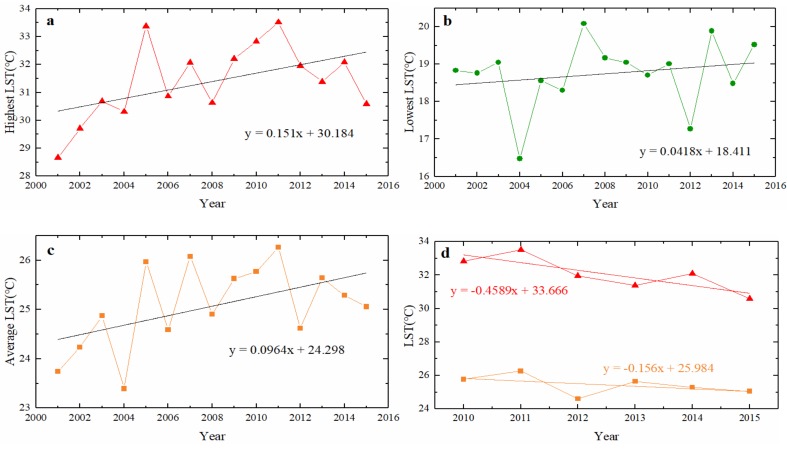
Possible environmental change and ecosystem degradation have received increasing attention since the construction of Three Gorges Reservoir Catchment (TGRC) in China. The advanced Google Earth Engine (GEE) cloud-based platform and the large number of Geosciences and Remote Sensing datasets archived in GEE were used to analyze the land use and land cover change (LULCC) and climate variation in TGRC. GlobeLand30 data were used to evaluate the spatial land dynamics from 2000 to 2010 and Landsat 8 Operational Land Imager (OLI) images were applied for land use in 2015. The interannual variations in the Land Surface Temperature (LST) and seasonally integrated normalized difference vegetation index (SINDVI) were estimated using Moderate Resolution Imaging Spectroradiometer (MODIS) products. The climate factors including air temperature, precipitation and evapotranspiration were investigated based on the data from the Global Land Data Assimilation System (GLDAS). The results indicated that from 2000 to 2015, the cultivated land and grassland decreased by 2.05% and 6.02%, while the forest, wetland, artificial surface, shrub land and waterbody increased by 3.64%, 0.94%, 0.87%, 1.17% and 1.45%, respectively. The SINDVI increased by 3.209 in the period of 2000-2015, while the LST decreased by 0.253 °C from 2001 to 2015. The LST showed an increasing trend primarily in urbanized area, with a decreasing trend mainly in forest area. In particular, Chongqing City had the highest LST during the research period. A marked decrease in SINDVI occurred primarily in urbanized areas. Good vegetation areas were primarily located in the eastern part of the TGRC, such as Wuxi County, Wushan County, and Xingshan County. During the 2000-2015 period, the air temperature, precipitation and evapotranspiration rose by 0.0678 °C/a, 1.0844 mm/a, and 0.4105 mm/a, respectively. The climate change in the TGRC was influenced by LULCC, but the effect was limited. What is more, the climate change was affected by regional climate change in Southwest China. Marked changes in land use have occurred in the TGRC, and they have resulted in changes in the LST and SINDVI. There was a significantly negative relationship between LST and SINDVI in most parts of the TGRC, especially in expanding urban areas and growing forest areas. Our study highlighted the importance of environmental protection, particularly proper management of land use, for sustainable development in the catchment.
自中国三峡水库集水区(TGRC)建设以来,可能的环境变化和生态系统退化受到了越来越多的关注。先进的基于谷歌地球引擎(GEE)的云平台以及GEE中存档的大量地球科学和遥感数据集被用于分析TGRC的土地利用和土地覆盖变化(LULCC)以及气候变化。GlobeLand30数据用于评估2000年至2010年的空间土地动态,Landsat 8 业务陆地成像仪(OLI)图像用于2015年的土地利用情况。利用中分辨率成像光谱仪(MODIS)产品估算地表温度(LST)和季节性综合归一化植被指数(SINDVI)的年际变化。基于全球陆地数据同化系统(GLDAS)的数据,对气温、降水和蒸散等气候因子进行了研究。结果表明,2000年至2015年,耕地和草地分别减少了2.05%和6.02%,而森林、湿地、人工表面、灌木林和水体分别增加了3.64%、0.94%、0.87%、1.17%和1.45%。2000 - 2015年期间,SINDVI增加了3.209,而2001年至2015年LST下降了0.253℃。LST主要在城市化地区呈上升趋势,主要在森林地区呈下降趋势。特别是在研究期间,重庆市的LST最高。SINDVI的显著下降主要发生在城市化地区。植被良好的地区主要位于TGRC的东部,如巫溪县、巫山县和兴山县。在2000 - 2015年期间,气温、降水和蒸散分别以每年0.0678℃、1.0844毫米和0.4105毫米的速度上升。TGRC的气候变化受LULCC影响,但影响有限。此外,气候变化还受到中国西南地区区域气候变化的影响。TGRC发生了显著的土地利用变化,并导致了LST和SINDVI的变化。在TGRC的大部分地区,尤其是在扩张的城市地区和增长的森林地区,LST和SINDVI之间存在显著的负相关关系。我们的研究强调了环境保护的重要性,特别是土地利用的合理管理,对于集水区可持续发展的重要性。