• 文献检索
  • 文档翻译
  • 深度研究
  • 学术资讯
  • Suppr Zotero 插件Zotero 插件
  • 邀请有礼
  • 套餐&价格
  • 历史记录
应用&插件
Suppr Zotero 插件Zotero 插件浏览器插件Mac 客户端Windows 客户端微信小程序
定价
高级版会员购买积分包购买API积分包
服务
文献检索文档翻译深度研究API 文档MCP 服务
关于我们
关于 Suppr公司介绍联系我们用户协议隐私条款
关注我们

Suppr 超能文献

核心技术专利:CN118964589B侵权必究
粤ICP备2023148730 号-1Suppr @ 2026

文献检索

告别复杂PubMed语法,用中文像聊天一样搜索,搜遍4000万医学文献。AI智能推荐,让科研检索更轻松。

立即免费搜索

文件翻译

保留排版,准确专业,支持PDF/Word/PPT等文件格式,支持 12+语言互译。

免费翻译文档

深度研究

AI帮你快速写综述,25分钟生成高质量综述,智能提取关键信息,辅助科研写作。

立即免费体验

大健康人群与高血压人群中心踝血管指数(CAVI)与 CAVI 的比较。

Comparison of Cardio-Ankle Vascular Index (CAVI) and CAVI in Large Healthy and Hypertensive Populations.

机构信息

Mihama Hospital.

Japan Health Promotion Foundation.

出版信息

J Atheroscler Thromb. 2019 Jul 1;26(7):603-615. doi: 10.5551/jat.48314. Epub 2019 May 9.

DOI:10.5551/jat.48314
PMID:31068504
原文链接:https://pmc.ncbi.nlm.nih.gov/articles/PMC6629744/
Abstract

AIM

The cardio-ankle vascular index (CAVI) represents the blood pressure-independent arterial stiffness from the origin of the aorta to the ankle. CAVI has been proposed as a variant index. We aimed to clarify the difference between CAVI and CAVI among large populations, and to explore reasons of the difference.

METHODS

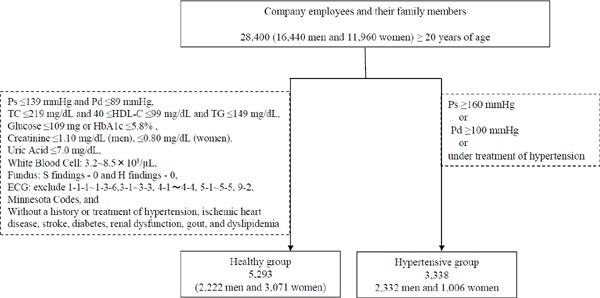
The subjects were 5,293 Japanese healthy and 3,338 hypertensive people. Simple and multiple regression analyses were performed using age, sex, body mass index, systolic, and diastolic blood pressure (Pd) as variables. Sub-group analysis was performed by sex and age. The CAVI values with and without adjustment by reference pressure were also compared.

RESULTS

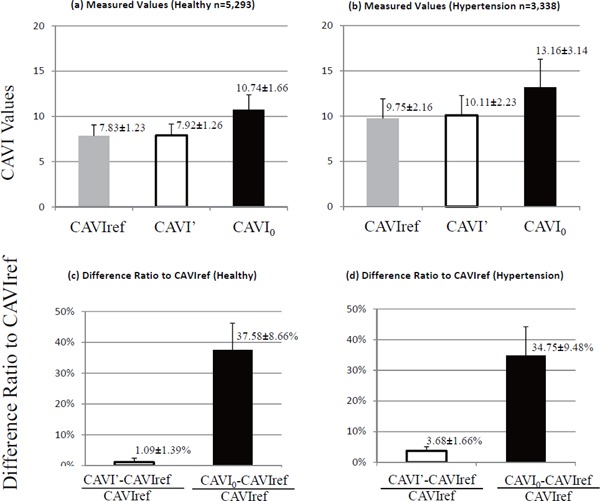
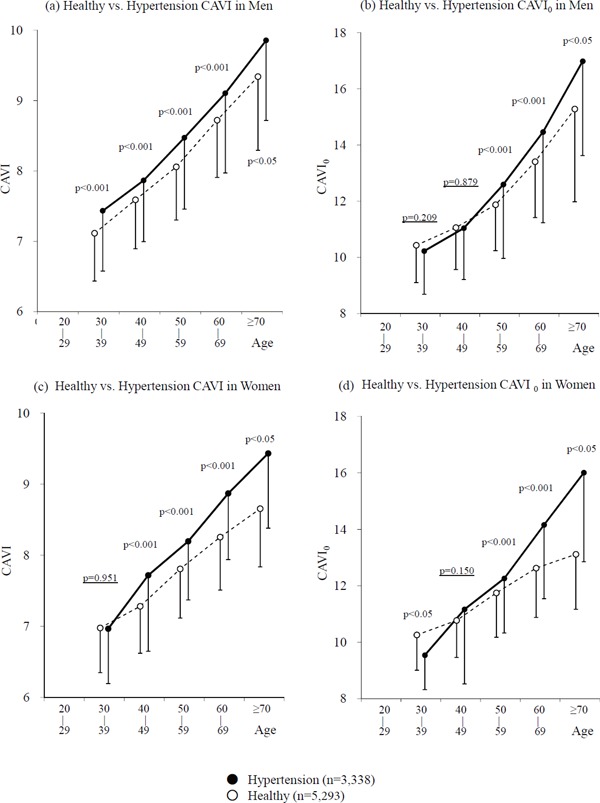
CAVI had a positive correlation with Pd, while CAVI had a negative correlation with Pd in the healthy population. The CAVI values of the hypertensive group were higher than those of healthy group in both men and women, but the CAVI values in women of the hypertensive group in the 30-39 age group was significantly lower than that of the corresponding healthy group. Differences of CAVI values with or without modification using the reference pressure were 1.09%±1.38% for the healthy group and 3.68%±1.66% for the hypertensive group.

CONCLUSION

CAVI showed the expected values, but CAVI showed inexplicable results in the healthy and hypertensive populations. The differences were due to the strong dependency of CAVI on Pd. Differences of CAVI values with or without reference pressure were negligible. These results indicate that CAVI obtained by the VaSera system is appropriate, but CAVI is not.

摘要

目的

心踝血管指数(CAVI)代表了从主动脉起源到脚踝的血压独立的动脉僵硬度。CAVI 已被提议作为一种变异指数。我们旨在阐明在大人群中 CAVI 与 CAVI 之间的差异,并探讨差异的原因。

方法

研究对象为 5293 名日本健康人和 3338 名高血压患者。使用年龄、性别、体重指数、收缩压和舒张压(Pd)作为变量进行简单和多元回归分析。按性别和年龄进行亚组分析。比较参考压校正前后的 CAVI 值。

结果

CAVI 与 Pd 呈正相关,而健康人群中 CAVI 与 Pd 呈负相关。高血压组男性和女性的 CAVI 值均高于健康组,但高血压组 30-39 岁女性的 CAVI 值明显低于相应的健康组。无论是否使用参考压力进行修正,CAVI 值的差异在健康组为 1.09%±1.38%,在高血压组为 3.68%±1.66%。

结论

CAVI 显示出预期的结果,但 CAVI 在健康人群和高血压人群中显示出无法解释的结果。差异是由于 CAVI 对 Pd 的强烈依赖性所致。参考压力下或不参考压力下的 CAVI 值差异可以忽略不计。这些结果表明,VaSera 系统获得的 CAVI 是合适的,但 CAVI 不是。
https://cdn.ncbi.nlm.nih.gov/pmc/blobs/11ba/6629744/49db621d4bd8/jat-26-603-g005.jpg
https://cdn.ncbi.nlm.nih.gov/pmc/blobs/11ba/6629744/54436098c632/jat-26-603-g001.jpg
https://cdn.ncbi.nlm.nih.gov/pmc/blobs/11ba/6629744/d2713c7aa530/jat-26-603-g002.jpg
https://cdn.ncbi.nlm.nih.gov/pmc/blobs/11ba/6629744/98534f74a025/jat-26-603-g003.jpg
https://cdn.ncbi.nlm.nih.gov/pmc/blobs/11ba/6629744/023bf8805f47/jat-26-603-g004.jpg
https://cdn.ncbi.nlm.nih.gov/pmc/blobs/11ba/6629744/49db621d4bd8/jat-26-603-g005.jpg
https://cdn.ncbi.nlm.nih.gov/pmc/blobs/11ba/6629744/54436098c632/jat-26-603-g001.jpg
https://cdn.ncbi.nlm.nih.gov/pmc/blobs/11ba/6629744/d2713c7aa530/jat-26-603-g002.jpg
https://cdn.ncbi.nlm.nih.gov/pmc/blobs/11ba/6629744/98534f74a025/jat-26-603-g003.jpg
https://cdn.ncbi.nlm.nih.gov/pmc/blobs/11ba/6629744/023bf8805f47/jat-26-603-g004.jpg
https://cdn.ncbi.nlm.nih.gov/pmc/blobs/11ba/6629744/49db621d4bd8/jat-26-603-g005.jpg

相似文献

1
Comparison of Cardio-Ankle Vascular Index (CAVI) and CAVI in Large Healthy and Hypertensive Populations.大健康人群与高血压人群中心踝血管指数(CAVI)与 CAVI 的比较。
J Atheroscler Thromb. 2019 Jul 1;26(7):603-615. doi: 10.5551/jat.48314. Epub 2019 May 9.
2
Predictive Ability of Pressure-Corrected Arterial Stiffness Indices: Comparison of Pulse Wave Velocity, Cardio-Ankle Vascular Index (CAVI), and CAVI0.压力校正的动脉僵硬度指数的预测能力:脉搏波速度、心踝血管指数(CAVI)和 CAVI0 的比较。
Am J Hypertens. 2022 Mar 8;35(3):272-280. doi: 10.1093/ajh/hpab168.
3
The Background of Calculating CAVI: Lesson from the Discrepancy Between CAVI and CAVI.计算心脏-踝血管指数(CAVI)的背景:从CAVI与其他指标差异中获得的启示 。 你提供的原文似乎有误,后面两个CAVI重复了,我按照合理推测翻译,你可根据实际情况调整。
Vasc Health Risk Manag. 2020 May 21;16:193-201. doi: 10.2147/VHRM.S223330. eCollection 2020.
4
Improved assessment of arterial stiffness using corrected cardio-ankle vascular index (CAVI) in overweight adolescents with white-coat and essential hypertension.使用校正的心脏-脚踝血管指数(CAVI)对患有白大衣高血压和原发性高血压的超重青少年的动脉僵硬度进行更好的评估。
Scand J Clin Lab Invest. 2017 Dec;77(8):665-672. doi: 10.1080/00365513.2017.1397286. Epub 2017 Nov 6.
5
Direct means of obtaining CAVI-a corrected cardio-ankle vascular stiffness index (CAVI)-from conventional CAVI measurements or their underlying variables.直接从常规 CAVI 测量值或其基础变量中获取 CAVI-a 校正的心踝血管僵硬度指数(CAVI)的方法。
Physiol Meas. 2017 Sep 21;38(10):N128-N137. doi: 10.1088/1361-6579/aa8981.
6
Model-Based Assessment of the Reference Values of CAVI in Healthy Russian Population and Benchmarking With CAVI0.基于模型的健康俄罗斯人群 CAVI 参考值评估及与 CAVI0 的基准比较。
Am J Hypertens. 2024 Jan 1;37(1):77-84. doi: 10.1093/ajh/hpad082.
7
Pediatric reference values for arterial stiffness parameters cardio-ankle vascular index and CAVI.动脉僵硬度参数心踝血管指数(CAVI)的儿科参考值。
J Am Soc Hypertens. 2018 Nov;12(11):e35-e43. doi: 10.1016/j.jash.2018.10.003. Epub 2018 Oct 22.
8
Five years of cardio-ankle vascular index (CAVI) and CAVI0: how close are we to a pressure-independent index of arterial stiffness?五年的心血管踝臂指数(CAVI)和 CAVI0:我们离动脉僵硬度的压力独立指数还有多远?
J Hypertens. 2021 Nov 1;39(11):2128-2138. doi: 10.1097/HJH.0000000000002928.
9
Association of Blood Pressure Indices with Right and Left Cardio-Ankle Vascular Index (CAVI) and Its Mathematically Corrected Form (CAVI) for the Evaluation of Atherosclerosis.血压指数与左右心踝血管指数(CAVI)及其数学校正形式(CAVI)在动脉粥样硬化评估中的相关性
J Pers Med. 2022 Aug 26;12(9):1386. doi: 10.3390/jpm12091386.
10
Parkinson's disease and the cardio-ankle vascular stiffness index.帕金森病与心-踝血管僵硬度指数
Intern Med. 2014;53(5):421-6. doi: 10.2169/internalmedicine.53.1043.

引用本文的文献

1
New Indicator of Arterial Stiffness START-Is There a Prognostic Value of Its Dynamics in Patients with Coronary Artery Disease?动脉僵硬度新指标START——其动态变化在冠心病患者中是否具有预后价值?
Biomedicines. 2024 Jul 23;12(8):1638. doi: 10.3390/biomedicines12081638.
2
Predictive significance of cardio ankle vascular index for the assessment of cardiovascular risk in hypertensive patients: A systematic review.心踝血管指数对高血压患者心血管风险评估的预测意义:系统评价。
J Clin Hypertens (Greenwich). 2024 Sep;26(9):1005-1014. doi: 10.1111/jch.14878. Epub 2024 Aug 22.
3
Relationships of the Surface Charge of Low-Density Lipoprotein (LDL) with the Serum LDL-Cholesterol and Atherosclerosis Levels in a Japanese Population: The DOSANCO Health Study.

本文引用的文献

1
Coefficients in the CAVI Equation and the Comparison Between CAVI With and Without the Coefficients Using Clinical Data.CAVI 方程中的系数以及使用临床数据比较有和无系数的 CAVI。
J Atheroscler Thromb. 2019 May 1;26(5):465-475. doi: 10.5551/jat.44834. Epub 2018 Dec 4.
2
Clinical Usefulness of the Cardio-Ankle Vascular Index as a Predictor of Primary Cardiovascular Events in Patients With Chronic Kidney Disease.心脏-踝部血管指数作为慢性肾脏病患者原发性心血管事件预测指标的临床实用性
J Clin Med Res. 2018 Dec;10(12):883-890. doi: 10.14740/jocmr3631. Epub 2018 Oct 30.
3
Pediatric reference values for arterial stiffness parameters cardio-ankle vascular index and CAVI.
日本人群中低密度脂蛋白(LDL)表面电荷与血清LDL胆固醇及动脉粥样硬化水平的关系:DOSANCO健康研究
J Atheroscler Thromb. 2025 Jan 1;32(1):34-47. doi: 10.5551/jat.64961. Epub 2024 Jul 3.
4
Cardio-Ankle Vascular Index and Aging: Differences between CAVI and CAVI0.心踝血管指数与衰老:CAVI与CAVI0之间的差异
J Clin Med. 2023 Oct 24;12(21):6726. doi: 10.3390/jcm12216726.
5
Noninvasive hemodynamic indices of vascular aging: an in silico assessment.血管老化的无创血流动力学指标:计算机模拟评估。
Am J Physiol Heart Circ Physiol. 2023 Dec 1;325(6):H1290-H1303. doi: 10.1152/ajpheart.00454.2023. Epub 2023 Sep 22.
6
Association between cardio-ankle vascular index and cardiometabolic risk factors in HIV patients in Ghana.加纳 HIV 患者的心血管-踝血管指数与心血管代谢危险因素的相关性。
Libyan J Med. 2023 Dec;18(1):2215636. doi: 10.1080/19932820.2023.2215636.
7
Vascular ageing: moving from bench towards bedside.血管衰老:从基础研究到临床应用。
Eur J Prev Cardiol. 2023 Aug 21;30(11):1101-1117. doi: 10.1093/eurjpc/zwad028.
8
Cardiovascular deconditioning and impact of artificial gravity during 60-day head-down bed rest-Insights from 4D flow cardiac MRI.60天头低位卧床休息期间心血管功能失调及人工重力的影响——来自4D流心脏磁共振成像的见解
Front Physiol. 2022 Oct 7;13:944587. doi: 10.3389/fphys.2022.944587. eCollection 2022.
9
The Correlation of Arterial Stiffness Parameters with Aging and Comorbidity Burden.动脉僵硬度参数与衰老及共病负担的相关性
J Clin Med. 2022 Sep 28;11(19):5761. doi: 10.3390/jcm11195761.
10
Comparison of Predictive Ability of Arterial Stiffness Parameters Including Cardio-Ankle Vascular Index, Pulse Wave Velocity and Cardio-Ankle Vascular Index.包括踝臂指数、脉搏波速度和踝臂指数在内的动脉僵硬度参数的预测能力比较。
Vasc Health Risk Manag. 2022 Sep 12;18:735-745. doi: 10.2147/VHRM.S378292. eCollection 2022.
动脉僵硬度参数心踝血管指数(CAVI)的儿科参考值。
J Am Soc Hypertens. 2018 Nov;12(11):e35-e43. doi: 10.1016/j.jash.2018.10.003. Epub 2018 Oct 22.
4
Reply: Medical science is based on facts and evidence.回复:医学是基于事实和证据的。
J Hypertens. 2018 Apr;36(4):960-962. doi: 10.1097/HJH.0000000000001660.
5
Medical science is based on evidence (answer to Spronck et al.'s refutation: physics cannot be disputed).医学是基于证据的(对斯普龙克等人反驳的回应:物理学无可争议)。
J Hypertens. 2018 Apr;36(4):958-960. doi: 10.1097/HJH.0000000000001661.
6
Evidence for Pressure-Independent Sympathetic Modulation of Central Pulse Wave Velocity.压力非依赖性的中央脉搏波速度的交感神经调制的证据。
J Am Heart Assoc. 2018 Jan 29;7(3):e007971. doi: 10.1161/JAHA.117.007971.
7
Effects of metabolic syndrome on arterial function in different age groups: the Advanced Approach to Arterial Stiffness study.代谢综合征对不同年龄组动脉功能的影响:动脉僵硬度先进研究。
J Hypertens. 2018 Apr;36(4):824-833. doi: 10.1097/HJH.0000000000001631.
8
Improved assessment of arterial stiffness using corrected cardio-ankle vascular index (CAVI) in overweight adolescents with white-coat and essential hypertension.使用校正的心脏-脚踝血管指数(CAVI)对患有白大衣高血压和原发性高血压的超重青少年的动脉僵硬度进行更好的评估。
Scand J Clin Lab Invest. 2017 Dec;77(8):665-672. doi: 10.1080/00365513.2017.1397286. Epub 2017 Nov 6.
9
Reply: physics cannot be disputed.回复:物理学无可争议。
J Hypertens. 2017 Jul;35(7):1523-1525. doi: 10.1097/HJH.0000000000001350.
10
Independency of the cardio-ankle vascular index from blood pressure at the time of measurement.测量时心脏-脚踝血管指数与血压的独立性。
J Hypertens. 2017 Jul;35(7):1521-1523. doi: 10.1097/HJH.0000000000001349.